Growth Flow Engineering

Growth Flow Engineering

por Moses Sam Paul
Temporada 1

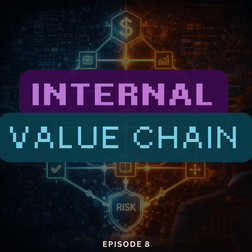
8. The Internal Value Chain - The Language of Enterprise AI Transformation.

The Internal Value Chain (IVC) is presented as a computational architecture that transforms abstract business activities into a structured, 9-node directed graph of meaning. Inspired by Linnaeus’s universal naming system, this framework assigns a specific coordinate to every unit of work, ensuring that every action is traceable to the organization’s ultimate financial valuation. By connecting two distinct paths—one for cash-flow generation and another for risk mitigation—the system eliminates "Ghost Value" and ensures that strategic goals are backed by verifiable data. Ultimately, the IVC serves as a navigation system for enterprise value, moving beyond traditional hierarchy to create a rigorous, interconnected network where higher-level outcomes depend entirely on the integrity of lower-level data. Book: The Language of Enterprise AI Transformation. Author: Moses Sam Paul Partner at Growth Flow Engineering Contact: Content@GrowthFlowEngineering.xyz
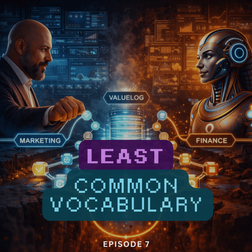
7. The Least Common Vocabulary (LCV) - The Language of Enterprise AI Transformation.

The Least Common Vocabulary (LCV) is a strategic framework designed to eliminate "Ghost Value"—the economic loss occurring when different departments fail to align during critical transitions. Rather than pursuing the impossible goal of a universal corporate language, the LCV focuses exclusively on locking the handoffs by establishing the minimum viable semantic agreement at system boundaries. By creating surgical interventions at these junctions, organizations ensure that value moves between teams, such as Marketing and Finance, without any "semantic remainder" or confusion. Valid LCV nodes must be boundary-relevant, machine-executable, bidirectionally acknowledged, and ValueLog-enforced to ensure they are functional rather than merely theoretical. Ultimately, this approach treats organizational communication like a technical standard, prioritizing economic leakage reduction over unnecessary, broad-scale linguistic alignment. Size: 1:1 Book: The Language of Enterprise AI Transformation. Author: Moses Sam Paul Partner at Growth Flow Engineering Contact: Content@GrowthFlowEngineering.xyz
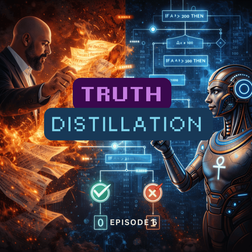
6. Truth Distillation - The Language of Enterprise AI Transformation.

This text introduces Truth Distillation, a methodology for converting vague organizational strategies into binary, machine-readable syntax that eliminates human misinterpretation. By comparing modern business goals to Hammurabi’s Code and Toyota’s Production System, the author argues that true coordination requires encoding intent into explicit decision trees and rigid specifications rather than relying on "conversational fluff." This process is described as a "violent" act because it destroys plausible deniability and forces leaders to replace aspirational language with observable formulas and execution-ready specs. Ultimately, the chapter serves as a mandate for organizations to increase their Truth Distillation Ratio, ensuring that strategy is no longer a narrative placeholder but a system-executable governing document that AI and humans can follow without ambiguity. Book: The Language of Enterprise AI Transformation. Author: Moses Sam Paul Partner at Growth Flow Engineering Contact: Content@GrowthFlowEngineering.xyz
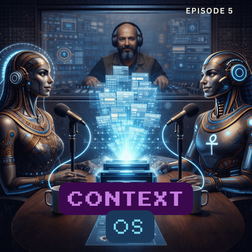
5. Context OS - The Language of Enterprise AI Transformation

IA
This text introduces the Context OS, a structural framework designed to synchronize meaning and authority across an entire organization. Moving beyond static document repositories, the author proposes a runtime semantic environment that acts like a "printing press" for modern enterprise, ensuring that every human and AI agent operates from a single, canonical source of truth. By defining precise roles, vocabulary, and economic constraints, the system prevents the "hallucinated competence" and interpretive drift that typically occur when communication relies on slow, manual alignment meetings. Ultimately, the source argues that agent effectiveness is not a result of raw processing power, but rather a function of context completeness and vocabulary precision. Book: The Language of Enterprise AI Transformation. Author: Moses Sam Paul Partner at Growth Flow Engineering Contact: Content@GrowthFlowEngineering.xyz
4. Leadership Clock - The Language of Enterprise AI Transformation

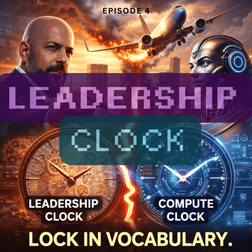
Modern organizations are currently struggling with a dangerous mismatch between the Leadership Clock, which moves at the slow pace of human consensus, and the Compute Clock, which executes tasks at the rapid speed of AI. While human management relies on lengthy cycles of meetings and deliberation to define business terms, AI agents act on those definitions instantly, meaning any semantic inconsistency can lead to immediate and widespread operational failure. The author uses the 737 MAX crashes to illustrate that when a machine's execution velocity outpaces a team's ability to correct its underlying logic, the results are catastrophic. To solve this, the text argues that companies must move beyond "governance theater" and implement a Semantic Lock, an architectural mechanism that synchronizes vocabulary across all systems simultaneously. Ultimately, the source serves as a call to action for leaders to transition from manual, document-based oversight to architectural governance that matches the real-time speed of digital execution. Book: The Language of Enterprise AI Transformation. Author: Moses Sam Paul Partner at Growth Flow Engineering Contact: Content@GrowthFlowEngineering.xyz
3. Babel QBR - The Language of Enterprise AI Transformation

IA
This text explores the concept of vocabulary decay, a systemic failure where mismatched definitions between departments lead to the creation of ghost value—metrics that appear successful on dashboards but fail to translate into actual revenue. Using the Tower of Babel as a metaphor, the author illustrates how modern organizations collapse not from a lack of effort, but from a breakdown in shared meaning that prevents effective coordination. The problem is reaching a crisis point because AI acceleration removes the human "speed limit," allowing faulty definitions to generate thousands of useless artifacts at machine velocity before they can be manually corrected. To combat this, the author proposes an Internal Value Chain and strict semantic discipline, arguing that true leadership requires enforcing canonical definitions across all technical and financial systems to ensure every unit of work produces verifiable value. Author: Moses Sam P{aul Partner - Growth Flow Engineering Book - The Language of Enterprise AI Transformation

2. Vocabulary Advantage - The Language of Enterprise AI transformation

IA
The central argument of this text is that an organization's success in the age of artificial intelligence depends less on advanced tools and more on semantic coherence, or the establishment of unified, machine-readable definitions for core business terms. While many leaders focus on the "tool layer," the author contends that without vocabulary integrity, AI models merely accelerate internal inconsistencies and create "locally correct" but "globally invalid" data. Using the downfall of WeWork as a cautionary tale, the source illustrates how failing to maintain governed infrastructure for performance language leads to a catastrophic loss of institutional trust and market value. Ultimately, the text provides a strategic framework for executives to shift their focus toward semantic architecture, ensuring that every department operates from a single, locked definition to transform raw model power into actual enterprise value. Author: Moses Sam Paul Partner - Growth Flow Engineering

1. Why the Universe Wants AI Agents - The Language of Enterprise AI Transformation - Prologue

IA
For 13.8 billion years, the universe has been on a relentless mission to organize complexity and reduce uncertainty. From the low-entropy spark of the Big Bang to the high-bandwidth neural networks of the human brain, we are part of a single, coherent narrative: the Information Continuum. In this episode, we explore the radical idea that AI agents are not just a silicon-based accident, but the inevitable next architectural layer of the universe. We trace the journey from "dissipation-driven adaptation"—the physics that practically forced life into existence—to the emergence of DNA as the world's first "active" code.We’ll dive into how human milestones like the invention of cuneiform accounting, Double-Entry Bookkeeping, and Shannon’s Information Theory were all precursors to the "Reasoning Revolution" of 2024. AI agents are the ultimate realization of this drive, shifting us from systems that merely "speak" to systems that "delegate and act" on a universal scale. Join us as we bridge the gap between thermodynamics and the future of agentic AI. Curated by MosesSamPaul GFE- L4 - @ GrowthFlowEngineering.xyz
3 de 3