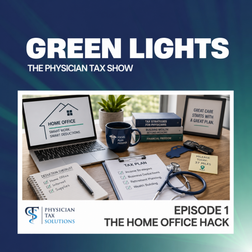
Green Lights: The Physician's Tax Show

Green Lights: The Physician's Tax Show

por Physician Tax Solutions
Temporada 1
Standard Mileage vs. Actual Vehicle Expenses: The Vehicle Write-Off
Show Title: Green Lights: The Physician's Tax Show Episode Title: Standard Mileage vs. Actual Vehicle Expenses: The Vehicle Write-Off Blueprint Presented by: Physician Tax Solutions Overview Building directly on our established strategies for home office mileage optimization (Episode 1), shift travel per diems (Episode 2), meal ledger segregation (Episode 3), family payroll (Episode 4), capital asset acceleration (Episode 5), and Section 199A QBI segmentation (Episode 6), Episode 7 tackles one of the most common—and heavily miscalculated—tax write-offs in healthcare tax planning: Standard Mileage vs. Actual Vehicle Expenses. Key Takeaways & Legal Framework Categorization of Mileage (IRC § 162) Choice 1: Standard Mileage Rate Choice 2: Actual Expense Method: The 6,000 lb GVWR Rule (IRC § 280F & § 168(k)):Passenger automobiles weighing under 6,000 lbs Gross Vehicle Weight Rating are capped by strict luxury automobile depreciation limits under Section 280{F}. Business vehicles exceeding 6,000 lbs GVWR (heavy SUVs, trucks, crossovers) are completely exempt from luxury automobile caps. By The Numbers: Standard Mileage vs. Actual Acceleration Math Let's evaluate a high-earning physician in the 37% federal marginal tax bracket who purchases a qualifying heavy business SUV (6,000lbs GVWR) for $90,000. Vehicle Purchase Price: $90,000 Business-Use Percentage (BUP): 80% (10,000 business miles logged) Total Annual Operating Expenses: $12,000 (gas, insurance, maintenance, loan interest) Standard Mileage Rate Your accountant multiplies your 10,000 business miles by the 2026 standard rate: Standard Mileage Deduction = 10,000 miles X $0.725 = $7,250 At your top marginal federal tax rate of 37%, your actual tax savings are: Standard Tax Savings = $7,250 X 37% = $2,682.50 Actual Expense Acceleration (Physician Tax Solutions) Working with specialized healthcare tax strategists, you elect actual expenses and 100% Bonus Depreciation: Calculate Business Portion of Operating Costs (80% of $12,000): Operating Deduction = $12,000 X 80% = $9,600 Calculate Year 1 Accelerated Depreciation (80% of $90,000): Year 1 Bonus Depreciation = $90,000 X80% = $72,000 Total Year 1 Actual Deduction: Total Optimized Deduction = $9,600 + $72,000 = $81,600 Calculate Cash Savings at a 37% Top Marginal Bracket: Immediate Cash Savings= $81,600 X 37% = $30,192.00 cash Physician Tax Solutions schedule an intro call. Read our companion blog
The QBI Deduction Trap: Section 199A & Entity Segmentation for Doctors
Show Title: Green Lights: The Physician's Tax Show Episode Title: The QBI Deduction Trap: Section 199A & Entity Segmentation for Doctors Presented by: Physician Tax Solutions Overview Building directly on our strategies, Episode 6 tackles one of the most frustrating tax traps in the Internal Revenue Code for high-earning medical professionals: The Section 199A Qualified Business Income (QBI) Deduction. Key Takeaways & Legal Framework The 20% Pass-Through Write-Off (IRC § 199A): Created under the Tax Cuts and Jobs Act, Section 199A allows pass-through business owners (S-Corporations, LLCs, Partnerships, and Sole Proprietorships) to deduct up to 20% of their Qualified Business Income tax-free. The SSTB Restriction (Treas. Reg. § 1.199A-5): Medical practitioners, surgeons, dentists, and clinical specialists are explicitly labeled as a Specified Service Trade or Business (SSTB)—defined as any trade or business involving the performance of services in the field of health. 2026 Statutory Phase-Out Thresholds:Full Deduction Zone: If your total taxable income is below $197,300 (single filers) or $394,600 (married filing jointly), you qualify for the full 20% QBI deduction regardless of your medical license! Phase-Out Zone: As taxable income moves through the phase-out corridor, the deduction erodes rapidly. Complete Disallowance (SSTB Cap): Once taxable income exceeds $247,300 (single) or $494,600 (joint), clinical SSTB QBI drops to 0%. The Entity Segmentation Solution: The SSTB designation applies specifically to active clinical patient care. By The Numbers: QBI Entity Segmentation Math Under Section 199A, the mathematical formula for cash-in-pocket tax savings is: QBI Tax Savings = Qualified Business Income 20% X Marginal Tax Rate Suppose you are a high-earning physician generating $600,000 in total net business revenue, placing your joint taxable income well above the $494,600 upper SSTB phase-out ceiling: 1. The Unoptimized Scenario (Reactive CPA) Your reactive accountant lumps 100% of your business revenue under a single clinical medical practice entity. The IRS labels the entire entity as an SSTB: Clinical QBI Deduction = Tax Savings = $0 You lose the 20% write-off completely across all $600,000. 2. The Optimized Scenario (Physician Tax Solutions) Working with specialized healthcare CPAs, you segment your operations. Let's calculate the deduction on your $\$150,000$ non-SSTB entity: Calculate the 20% QBI Deduction: Optimized QBI Deduction = $150,000 X 20% = $30,000 tax-free write-off Calculate Cash-in-Pocket Savings at a 37% Top Marginal Tax Bracket: Immediate Cash Savings = $30,000 X 37% = $11,100 cash kept in your bank account Net-Cash Saved Comparison Immediate Annual Cash Difference = $11,100 - $0 = $11,100 Cash Kept in Your Practice Links & Resources Physician Tax Solutions schedule an intro call read the companion blog
Section 179 & Bonus Depreciation: Instant Capital Acceleration for Doctors
Show Title: Green Lights: The Physician's Tax Show Episode Title: Section 179 & Bonus Depreciation: Instant Capital Acceleration for Doctors Presented by: Physician Tax Solutions Overview Episode 5 shifts focus directly into major practice investments and capital asset acceleration. Key Takeaways & Legal Framework The $2,500 De Minimis Safe Harbor : If your practice maintains a simple, written accounting policy established prior to the tax year, any individual asset or invoice costing $2,500 or less (e.g., laptops, monitors, office chairs, small clinical tools) can be immediately expensed rather than capitalized. Section 179 Expensing Caps: For larger capital assets, Section 179 allows businesses to deduct up to $2,500,000 of qualifying tangible personal property placed in service during the tax year. 100% Bonus Depreciation Restoration: Recent legislative updates ("The Big Beautiful Bill") restored 100% Bonus Depreciation for qualifying property placed in service. Home Office Infrastructure Acceleration: Everything acquired to equip your administrative headquarters—desks, IT servers, diagnostic monitors, and office setup items not previously written off—qualifies for immediate acceleration during the first year your home office is placed in service. The Critical 50% Vehicle Rule: To unlock Section 179 and Bonus Depreciation on business vehicles (including heavy SUVs with a Gross Vehicle Weight Rating exceeding 6,000 lbs, business use must exceed 50%. By The Numbers: Capital Acceleration Math When evaluating a $100,000 capital expenditure (e.g., clinical IT upgrade, diagnostic device, or qualifying heavy vehicle), the difference between reactive accounting and proactive capital acceleration is staggering: Under standard 5-year MACRS depreciation, a reactive accountant claims only 20% in Year 1: Year 1 Deduction = $100,000 X 20% = $20,000 At a physician's top marginal federal tax rate of 37%, this yields: Tax Savings = $20,000 X 37% = $7,400 The Optimized Acceleration Scenario (Physician Tax Solutions) Optimized Year 1 Deduction = $100,000 At that same 37$ marginal tax bracket. Immediate Cash Savings = $100,000 X 37% = $37,000 Net-Cash Saved Comparison Immediate Cash Difference = $37,000 - $7,400 = $29,600 Cash Kept in Your Bank Audit-Proof Compliance Checklist To ensure your capital deductions withstand IRS review without triggering audit penalties: Written Safe Harbor Policy: Draft and adopt a formal corporate De Minimis policy for invoices under $2,500 prior to January 1st of the tax year. Placed-in-Service Rule: Ensure assets are fully operational, delivered, and ready for clinical/administrative use before December 31st of the tax year. Pristine Vehicle & Mileage Logs: Maintain detailed usage logs establishing that business use strictly exceeds 50% to insulate the deduction from IRS recapture. Active Income Basis Verification: Align Section 179 elections with your practice entity's net active taxable income, rolling over any excess allowances as needed. Links & Resources Read the Companion Blog Book Your Blueprint Consultation
Shifting Wealth to Family (Hiring Kids & Parents)
Show Title: Green Lights: The Physician's Tax Show Episode Title: Shifting Wealth to Family (Hiring Kids & Parents) Presented by: Physician Tax Solutions Episode Summary Building on our strategies for maximizing travel per diems and optimizing meal ledgers in Episodes 2 and 3, Episode 4 addresses one of the most powerful wealth-building strategies available to independent physicians: Family Payroll. By shifting earned income from a high-earning physician’s top marginal tax bracket 37% to minor children or dependent parents who sit in 0% or low tax brackets, medical practice owners can convert non-deductible household and support expenses into tax-deductible business operating costs. Key Takeaways & Legal Framework The Zero-Tax Income Shift: Under current tax law, children can earn up to the single standard deduction threshold ($15,750) completely tax-free at the federal level, provided they have no other taxable income. The FICA & Medicare Tax Exemption (IRC § 3121(b)(3)(A)): Minor children under age 18 employed directly by a parent’s unincorporated business (Schedule C or Schedule E) are exempt from Social Security (FICA) and Medicare taxes, saving an additional 15.3%. The S-Corporation Workaround: S-Corporations do not automatically receive the minor child FICA tax exemption. To capture this deduction legally, the S-Corp issues a 1099 consulting fee to the doctor’s sole proprietorship (Schedule C) or real estate entity (Schedule E), which then employs the child on payroll. Hiring Parents & Grandparents: If you already provide financial support to elderly parents or grandparents, placing them on payroll converts out-of-pocket support into a business deduction. While subject to FICA/Medicare, the rate arbitrage between a 37% physician bracket and a parent’s 0% - 10% bracket yields substantial net cash flow gains. When high-income physicians pay child expenses (activities, tuition, savings) using post-tax dollars versus pre-tax family payroll, the savings add up quickly: Two Children Example ($30,000$ Total Payroll Shifted) Total Pre-Tax Payroll Shifted= $30,000 Federal Income Tax Saved = $30,000 X 0.37 = $11,100 Combined Net Savings = $11,100 in tax-free family wealth generated annually Audit-Proof Compliance Checklist To ensure your family payroll withstands IRS review, maintain these four core operational pillars: Bona Fide Work & Age-Appropriate Tasks: Assign clear, documented duties (e.g., shredding medical records, sanitizing equipment, digital media management, office cleaning, or rental property maintenance). Reasonable Compensation: Pay market rates for the specific task performed rather than arbitrary round lump sums. Contemporaneous Time Tracking: Maintain logbooks or digital time-tracking app records specifying date, hours worked, and specific tasks completed. Official Payroll & W-2 Issuance: Issue formal paychecks into the child’s individual bank account and generate annual Form W-2s. Links & Resources Read the Companion Blog Book Your Blueprint Consultation
The 100% Meal Myth vs. Entertainment
Show Title: Green Lights: The Physician's Tax Show Episode Title: The 100% Meal Myth: How Doctors Legally Claim 100% Tax Deductions Presented by: Physician Tax Solutions Episode Summary Building on the foundations of Episode 1 (The Home Office Hack) and Episode 2 (The 12-Hour Per Diem Secret), which tackled travel-based tax shields, this episode shifts focus directly to your day-to-day medical practice operations. Specifically, we explore the business meals and entertainment expenses that most generalist accountants completely misclassify. We dismantle the common myth that all clinical food spending is capped at a flat 50% write-off. Learn why direct entertainment expenses—like sports tickets or golf outings—are completely non-deductible (0%) even if they occur during business negotiations, and how to safely classify company social and recreational events to capture a full 100% operating deduction under Section 274(e). To safely protect your clinical wealth, you need a specialized CPA for physicians. Our team at Physician Tax Solutions understands healthcare compliance, helping you structure proactive, bulletproof corporate ledger accounts that align strictly with Section 274 guidelines. The Mathematical Breakdown: Proper Ledger Segregation Your ultimate cash-in-pocket benefit is determined by the standard travel and business deduction equation from our slides: Tax Savings = Deductible Portion X Marginal Tax Rate Let's assume you run a private medical clinic and spend a total of $10,000 per year on food, staff lunches, and business dining: 1. Standard CPA Approach: A reactive accountant dumps the entire $10,000 into a generic "Meals" category, which the IRS automatically caps at a 50% deduction: $10,000 X 50% = $5,000 deductible For a high-earning practice owner in the federal 37% marginal tax bracket, this yields: $5,000 X 37% = $1,850 in actual tax savings 2. Physician Tax Solutions Approach: By analyzing your records, we isolate that $8,000 was actually spent on structured employee appreciation, holiday parties, or public promotional events (all 100% deductible), while only $2,000 was spent on traditional client or professional dining (50% deductible). Optimized Deduction =$8,000 X 100%) + ($2,000 X 50%) = $8,000 + $1,000 = $9,000 deductible At that same 37% marginal tax rate, your actual cash-in-pocket tax savings are: $9,000 X 37% = $3,330 in optimized tax savings Net-Cash Saved: $3,330 - $1,850 = $1,480 in pure, legal cash annually Simply labeling your corporate transactions correctly keeps nearly $1,500 in cash inside your business, completely paperless. Compliance and Safe Guidelines To safely claim these deductions and insulate your practice from IRS audits: The "Five Ws": Document Who was present, What business relationship existed, When did it happen, Where did it occur, and Why was the discussion necessary. Exclude Entertainment: Never try to deduct sporting events, concerts, or country club fees these are strictly 0% deductible under IRC § 274(a)(1). Mind the Gift Cap: Business gifts are capped at a strict statutory limit of $\$25$ per recipient, per year under § 274(b). Links & Resources Read the Companion Blog Book Your Blueprint Consultation
The 12-Hour Shift Travel Deduction: Unlocking Flat-Rate Travel Deductions for Long Shifts
Show Title: Green Lights: The Physician's Tax Show Episode Title: The 12-Hour Shift Travel Deduction: Unlocking Flat-Rate Travel Deductions for Long Shifts Presented by: Physician Tax Solutions Building directly on the foundation of Episode 1 (The Home Office Hack), this episode explores how 1099 independent contractor physicians, ER doctors, and hospitalists can legally transform grueling, marathon shifts into powerful, paperless tax shields. If a traditional, reactive accountant has told you that your hospital commute or shift meals are non-deductible personal expenses, it is time to switch to proactive tax strategy. When you layer travel regulations on top of your home office, an incredible window opens for extended shifts. Under IRS guidance, from the exact moment you leave your home office to the moment you return, if that total door-to-door time period is more than $12\text{ hours}$, you are legally considered to be traveling overnight. This threshold allows you to claim standard federal per diem allowances for meals and incidentals in lieu of tracking messy, individual paper receipts. A specialized CPA for physicians understands the operational realities of healthcare shift work. The tax code does not define "overnight travel" by whether you slept in a commercial hotel room. By establishing your primary tax home and documenting your shift times, we help you safely turn regular hospital shifts into audit-proof tax deductions. The Mathematical Breakdown: Mileage & Per Diem Combined Your ultimate cash-in-pocket benefit is determined by the standard travel equation: Tax Savings = Eligible Travel Costs X Marginal Tax Rate By setting up your home office correctly and keeping a door-to-door log, you legally keep over $6,500 in cash in your bank account, completely paperless. Compliance and Safe Guidelines To safely defend these travel deductions against IRS audits: Substantiate Your Logs: Keep pristine documentation showing your exact departure times, return times, mileage logs, and active clinical shifts. Exclude Personal Travel: Personal or vacation days must be strictly excluded from your calculation. Understand Spousal Rules: Travel expenses for spouses, dependents, or others are only deductible if they have a bona fide business purpose. Links & Resources: Learn more with the companion blog Book Your Blueprint Consultation: Schedule a call now
The Home Office Hack: Unlocking Commutes with the Common Space Subtraction Method
Show Title: Green Lights: The Physician's Tax Show Episode Title: The Home Office Hack: Unlocking Commutes with the Common Space Subtraction Method Presented by: Physician Tax Solutions Episode Summary In this premier episode, we break down the frequently misunderstood rules of IRS Section 280A. We dismantle the status-quo myth that doctors can't claim a home office, revealing how to turn your daily clinical commute into a 100% tax-deductible business trip. Why You Need a Specialized "CPA for Physicians" Most traditional, generalist tax preparers will tell you, "You perform your actual clinical work inside a hospital, not at home. Claiming a home office will trigger an audit." To safely unlock the full power of the tax code, you need a specialized CPA for physicians. A dedicated healthcare tax strategist understands that under Section 280A, you do not need to see a single patient at home to qualify. The Mathematical Breakdown: The Common Space Subtraction Method Traditional tax preparers calculate your deduction by dividing your office size by the total square footage of your home. A specialized CPA for physicians runs the offensive playbook by subtracting your shared common spaces first. Step 1: Establish Your True usable Footprint (The Denominator) Subtract shared common areas that you shouldn't be penalized for (such as hallways, the dining room, kitchen, living room, and den) from your home's total square footage. Total Square Footage = 3,000sq ft Shared Common Space = 1,000 sq ft Subtracted Denominator = 3,000 sq ft- 1,000sq ft = 2,000 sq ft Step 2: Include Your Dedicated Work and Vehicle Spaces (The Numerator) Take your dedicated 300 sq ft home office. Since you have a business vehicle as a 1099 earner, include at least half of your two-car garage space 200 sq ft in your office footprint. Office Space = 300 sq ft Half of Garage= 200 sq ft Optimized Numerator= 300+ 200 sq ft = 500 sq ft Step 3: Run the Optimized Fraction Dividing your optimized numerator by your subtracted denominator yields a massive write-off footprint: Optimized Deduction = 500sq ft\2,000 sq ft = 25% Instead of a basic 10% write-off, you can now legally deduct 25% of your rent/mortgage interest, utilities, home insurance, and internet. More importantly, every single mile you drive from this office to the hospital is now written off at $72.5 cents per mile. Key Takeaways The Administrative HQ: You qualify for a home office if you use a dedicated space regularly and exclusively for charting, billing, and practice management. Commute Transformation: Once your home office is established as your principal place of business, your daily clinical commute is legally classified as a fully deductible business trip. The Garage Hack: If you have 1099 income and park a business vehicle in your garage, include half of that garage's square footage in your office calculation. Links & Resources Read the Companion Blog: Stop Leaving Money on the Table: How to Get the Biggest Home Office Tax Deduction Possible Book Your Blueprint Consultation: Schedule a strategic consult with a specialized CPA for physicians to draft your personalized proactive tax blueprint at Physician Tax Solutions.