FocusED

FocusED

por Joe and T.J., TheSchoolhouse302
The Keys to Preventing Educator Burnout with Katrina Huels
In this episode of FocusED, Katrina Huels joins Joe and TJ from TheSchoolHouse302 to discuss her book, Transformational Tools for Special Educators: How to Beat Burnout and Become the Best at What You Do, sharing practical strategies on how school leaders can support staff growth and prevent rampant burnout. Katrina explains that over 50% of K-12 teachers and 40% of administrators experience frequent burnout, noting that special education faces the highest vacancy rates in the entire education system. She points out that stress management and emotional intelligence must be treated as core professional competencies rather than soft skills or temporary wellness trends. Katrina highlights affect labeling—or "naming it to tame it"—as a vital self-awareness tool, explaining how checking in with an app like How We Feel shifts brain activity out of emotional reactivity and into cognition. She warns against relying on school breaks as a coping mechanism, noting that educators need daily, actionable tools to manage stress throughout the entire school year. Katrina mentions that pairing quick check-ins with under five minutes of targeted breathwork, such as box breathing or alternate nostril breathing, rapidly restores composure and clarity. She suggests that leaders commit to implementing a single emotional intelligence tool daily for 30 days before reviewing the reflection data to see measurable improvements in job satisfaction and calm. Katrina emphasizes that cultivating a calm, regulated teacher presence directly enhances classroom management and boosts student academic performance. She advises administrators to introduce these strategies through Professional Learning Communities (PLCs) or guiding coalitions, while advocating for emotional intelligence training to be embedded in teacher prep programs. Katrina closes by reminding leaders that equipping staff with internal tools restores their connection to their core purpose, helping them maintain their passion for teaching across a long career. This episode of FocusED is brought to you by Bullseye. If you're doing walkthroughs without the support and tracking of Bullseye, head to bullseye.education/302 to schedule your sponsored Lunch and Learn today.
The Secrets to Developing Trust as a School Leader with Jen Schwanke
In this episode of FocusED, Dr. Jen Schwanke joins Joe and TJ from TheSchoolHouse302 to discuss her book, Trusted: Trust Pillars, Trust Killers, and the Secret to Successful Schools, sharing practical strategies on how school leaders can foster trust, manage conflict, and build collective efficacy. Jen explains that public trust in schools often erodes when broader society feels unstable, noting that every historical shift adds responsibilities to a school's plate without taking anything away. She points out that trust is a rational judgment rather than an emotion, highlighting research that shows a direct link between community trust in a principal and increased student achievement. Jen highlights shared leadership as a primary trust pillar, explaining that trusting teams to shoulder responsibility and celebrating collective wins builds strong school momentum. She warns against micromanagement, noting that nitpicking professionals is a major trust killer that makes a principal's workload infinitely more difficult. Jen introduces the distinction between being trustworthy and being trust-willing, encouraging leaders to give teachers genuine autonomy rather than trying to act like a superhero who rescues them. She suggests redefining what support means, advising principals to partner with teachers through difficult parent calls or role-playing rather than stripping away the teacher's authority. Jen emphasizes that avoiding conflict damages leadership credibility, stating that addressing tough issues courageously and fairly is one of the fastest ways to construct a winning culture. She advises leaders to prioritize being available over just being visible, urging principals to put away "mobile desks" to focus on deep, locked-in 1-on-1 interactions with staff and students. Jen closes by reminding principals that, despite the overwhelming daily demands of having thousands of stakeholders, school leadership remains one of the most noble and impactful professions. This episode of FocusED is brought to you by Bullseye. If you're doing walkthroughs without the support and tracking of Bullseye, head to bullseye.education/302 to schedule your sponsored Lunch and Learn today.
Executive Functions for Every Classroom with Mitch Weathers and Sarah Oberle
In this episode of FocusED, Mitch Weathers and Dr. Sarah Oberle discuss their book, Executive Functions for Every K-3 Classroom, and share practical insights on embedding executive function skills into everyday instruction to support learners of all ages. Sarah explains that executive functions are interrelated cognitive processes responsible for self-regulation and impulse control—powering actions like staying focused, managing materials, and controlling attention rather than acting on reflex. Mitch points out that executive functions split into core skills (working memory, inhibition, and cognitive flexibility) and higher-order skills (planning, reasoning, and problem-solving), noting that while core skills emerge early, higher-order skills begin taking off around third and fourth grade. Sarah highlights that educators often take for granted what young students know, explaining that telling a child to "pay attention" requires teachers to explicitly define, model, and teach what those behaviors actually look like in practice. She suggests reducing cognitive load by chunking instructions into smaller, actionable steps and auditing the physical classroom environment to remove acoustic and visual distractions that compete for a child's mental bandwidth. Mitch shares that when stress and cortisol levels rise, executive functioning drops. He advises leaders to look at misbehavior through an executive functioning lens and get curious about classroom structures rather than jumping straight to discipline. He emphasizes that executive function support belongs in Tier 1 core instruction for all students, stating that these skills are grade and subject-agnostic and should not be treated strictly as special education interventions. In response to critics who argue against providing scaffolds because students won't have them in later grades, Mitch shares his "water analogy"—arguing that withholding support today to prepare a student for future struggle makes as little sense as refusing to drink water today to prepare for tomorrow's dehydration. Sarah stresses that executive function skills are foundational to how students learn, reminding educators that if kids can't manage their attention or space, even the best academic content won't make an impact. Mitch and Sarah close by encouraging educators to adopt an asset-based mindset toward every learner and visit organizedbinder.com and sarahoberle.com to explore their books and resources. This episode of FocusED is brought to you by Bullseye. If you're doing walkthroughs without the support and tracking of Bullseye, head to bullseye.education/ to schedule your sponsored Lunch and Learn today.
The 30-Day Leadership Challenge with Michelle Pourchot
In this episode of FocusED, Michelle Pourchot shares practical leadership lessons from nearly three decades in education and discusses her book, The 30-Day Leadership Challenge. Michelle explains that effective leadership isn't about having all the answers—it's about growing intentionally, building trust, and leading people with authenticity. Michelle says she wrote The 30-Day Leadership Challenge to save leaders time by bringing the most important leadership principles into one practical resource. Rather than focusing on theory, she designed the book around actionable strategies, reflection, and daily implementation that leaders can immediately apply in their schools. She explains that leadership begins with leading yourself before leading others. Michelle encourages leaders to establish a clear purpose, commit to continuous learning, strengthen communication, improve decision-making, and intentionally build confidence over time. Michelle believes lasting school improvement starts with relationships, not programs. She says students perform at higher levels when they experience belonging, meaningful connections with adults, and a school culture that values each child before focusing solely on academic outcomes. She shares that one of the biggest shifts in her school's success came when teachers stopped chasing schoolwide performance targets and instead focused on the individual growth of every student. According to Michelle, sustained improvement happens one learner, one goal, and one small success at a time. Michelle emphasizes that Professional Learning Communities became the engine of improvement on her campus once teachers used them to examine student work, analyze data collaboratively, and adjust instruction weekly. She says leaders should participate as learners—not supervisors—demonstrating that continuous improvement applies to everyone. She reflects on how trust transformed her campus culture. Michelle explains that teachers only became willing to take risks after they believed administration genuinely supported their growth rather than judging their performance. That shift created collaboration instead of competition among staff members. Michelle recommends that leaders become intentional readers and lifelong learners. She highlights books by Jon Gordon, Todd Whitaker, Chip and Dan Heath, and Jim Collins as influential resources that shaped her own leadership philosophy and inspired many of the concepts in her book. Michelle closes with a powerful message for new leaders: be yourself. She says leadership becomes far more effective when leaders stop trying to imitate others, embrace their own strengths, allow others to see their humanity, and lead with authenticity rather than perfection. This episode of FocusED is brought to you by Bullseye. If you're doing walkthroughs without the support and tracking of Bullseye, you need to schedule your demo today.
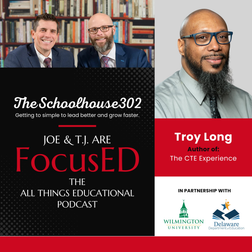
The CTE Experience with Troy Long
In this episode of FocusED, Joe and T.J. interview Troy Long, author of The CTE Experience. Troy makes the case that CTE is not an alternative pathway—it’s one of the most powerful ways to prepare students for both college and careers. Drawing on more than two decades in education, he explains how high-quality CTE programs create opportunity, transform communities, and redefine student success. Troy says one of the biggest misconceptions about CTE is that it’s only for students who aren’t college bound. He explains that today’s programs include dual enrollment, industry credentials, articulation agreements, and college credit that allow students to graduate with a significant head start on postsecondary education while gaining valuable workplace experience. He argues that administrators must move beyond outdated perceptions of CTE and instead build pathways that align with workforce demands and student interests. According to Troy, when schools intentionally connect education to real careers, students graduate with more options, less debt, and stronger earning potential. Troy emphasizes that CTE succeeds because it answers one of education’s biggest questions: Why does this matter? He explains that hands-on learning, authentic projects, and industry connections help students see the relevance of their learning while increasing engagement, attendance, and motivation. He encourages elementary and middle school leaders to begin career exploration much earlier through exploratory programs, entrepreneurship experiences, and employability skills. Troy believes career awareness shouldn’t start in high school—it should grow alongside students throughout their educational journey. Looking ahead, Troy says schools must continuously evolve alongside industry. He discusses the growing impact of artificial intelligence, the importance of regularly updating programs based on workforce needs, and why strong partnerships with colleges, employers, and advisory boards are essential to keeping CTE relevant. Troy closes with a challenge for every educator: help change the narrative around Career and Technical Education. He believes schools, policymakers, and communities all share the responsibility of promoting CTE as an equal pathway that prepares students for meaningful careers, continued education, and lifelong success. This episode is sponsored by Bullseye. If you're walkthroughs aren't improving instruction fast enough, you need Bullseye.
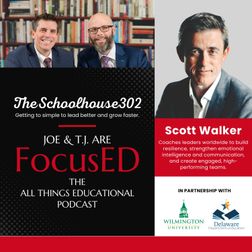
The Negotiation Skills Every School Leader Needs with Scott Walker
In this episode of FocusED, Joe and T.J. interview Scott Walker, author of Order Out of Chaos. Scott shares powerful lessons from hostage negotiations that every leader can apply to difficult conversations, conflict, and high-pressure decision-making. Drawing from years of navigating life-or-death situations, Scott explains why chaos isn’t something to avoid—it’s often the starting point for growth and better leadership. Scott unpacks the concept of the “Red Center,” the internal ability we all have to stay grounded during tense moments. He explains how leaders can “observe without absorbing” emotion, regulate their nervous systems, and avoid reacting impulsively when pressure rises. He also shares a practical three-step process for staying calm under stress: interrupt the pattern, ride the emotional wave, and ask better questions. Throughout the conversation, Scott emphasizes that the biggest mistake people make in conflict is turning every conversation into something about themselves. Instead, he argues that great negotiators—and great leaders—lead with curiosity, not assumptions. According to Scott, the key to influence is seeking to understand before trying to be understood. Scott also challenges common myths about negotiation, including the idea that someone has to “win.” He explains that the best outcomes come from cooperation, empathy, and emotional self-regulation—not dominance or control. He reminds listeners that leadership is less about proving a point and more about building trust and long-term collaboration. One of the most impactful parts of the conversation centers on “Level 5 Listening,” where Scott explains how leaders can move beyond simply hearing words to understanding emotion, beliefs, and perspective. He shares why the best negotiators aren’t the best talkers—they’re the best listeners. Scott closes with a practical strategy leaders can use immediately: PRC—Pause, Reflect, Choose. It’s a simple habit designed to help leaders reset throughout the day, stay grounded, and respond intentionally instead of reacting emotionally. If you lead people, navigate difficult conversations, or want to become a calmer and more effective communicator, this episode delivers practical tools you can apply immediately. This episode is sponsored by Bullseye. If you're walkthroughs aren't improving instruction fast enough, you need Bullseye.
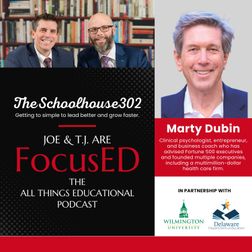
Learning to See What's Holding You Back as a Leader with Marty Dubin
Our guest for this episode of FocusED is Marty Dubin, author or Blindspotting: How to See What's Holding You Back as a Leader. Marty explains that his book emerged from reflecting on a diverse career and realizing that much of leadership effectiveness comes down to self-awareness rather than technical skill. He shares that leaders can read the same material and learn the same strategies, yet apply them very differently because of who they are. For him, the core of leadership is understanding personal tendencies—how one naturally thinks, reacts, and leads—and recognizing when those tendencies don’t match the situation. He emphasizes that blind spots are not weaknesses or skill gaps but moments when a leader’s strengths are overused or misapplied. Marty notes that highly successful leaders often rely on behaviors that have worked repeatedly, creating a positive feedback loop. The challenge arises when those same behaviors are used in the wrong context. Marty describes emotions as one of the most accessible entry points for identifying blind spots. He shares that feelings like anxiety, confusion, or frustration can signal that something isn’t working, prompting leaders to ask what role they might be playing in the situation rather than immediately blaming external factors. He also explains that blind spots don’t necessarily increase with authority, but leaders become less likely to notice them as they gain success. Marty says that as responsibilities grow, reflection often decreases, and leaders default more quickly to familiar patterns. To improve self-awareness, Marty suggests a practical exercise: identify core strengths and then consider what happens when those strengths are used “too much.” He explains that this simple shift helps leaders see how their best qualities can become liabilities in certain situations. Marty highlights that growth comes from small behavioral adjustments rather than major personal transformation. He shares that leaders don’t need to change who they are, but they can change how their traits show up in different situations. He compares this to elite athletes making small technical tweaks that lead to significant performance gains. He also discusses the importance of creating cultures where feedback is normal and safe. Marty explains that leaders must model vulnerability first by sharing their own blind spots, which builds trust and encourages others to do the same. He introduces a practical feedback method—Situation, Behavior, Impact—as a way to keep conversations specific and constructive, helping teams address blind spots without defensiveness. Marty connects blind spots to burnout by suggesting that unclear measures of success and overused strengths—like altruism—can contribute to exhaustion. He notes that leaders benefit from identifying meaningful indicators of success and recognizing when positive traits are being stretched too far. He adds that small wins and clear goals can help counteract burnout by providing a sense of progress and control. He frames self-awareness as a source of power, explaining that understanding one’s tendencies allows leaders to act more strategically. Marty gives the example of intentionally showing emotion in a moment that requires it, even if it’s not natural, to influence outcomes more effectively. Finally, Marty underscores that understanding oneself—across areas like traits, emotions, identity, and behavior—is essential for leadership growth. He argues that these concepts apply broadly, not just to formal leadership roles, and that greater awareness helps individuals navigate relationships, improve performance, and work more effectively with others.
The AI Shift in Education: Why Waiting Is the Biggest Risk with Dr. Stacie Chana
Dr. Stacie Chana explains that artificial intelligence must be treated as an urgent equity issue because, if schools do not intentionally teach AI skills, students without access will be left behind in a rapidly changing job market. She emphasizes that AI is accelerating faster than any previous technological shift and will transform society within the next decade, making it essential for schools to prepare students now. She states that school leaders must ensure all students understand both the conceptual foundations of AI and how to actively experiment with it, so they can succeed in future careers. She stresses that access to AI learning opportunities is critical and should not be limited to certain groups of students. Dr. Chana advises leaders to begin implementation by forming diverse teams that include multiple perspectives, including skeptics, to guide decision-making. She highlights the importance of reviewing existing policies, especially around privacy and student data protection, before introducing AI tools, and ensuring no personal identifying information is shared with AI systems. She explains that schools must establish clear guardrails and expectations for AI use through open dialogue with staff, students, and families. She emphasizes ongoing conversations around ethics, safety, privacy, and bias as foundational to responsible implementation. Dr. Chana recommends starting AI use with adults first, integrating it into professional learning so educators become comfortable and proficient before introducing it to students. She stresses that AI should not be taught as a standalone subject but embedded into existing curriculum and real-world problem-solving tasks. She highlights that early student exposure should focus on simple, low-risk applications, such as brainstorming, while more advanced learners can engage in tasks like coding or data visualization. She underscores that instruction should be developmentally appropriate, with younger students focusing on conceptual understanding and older students engaging directly with tools. Dr. Chana emphasizes the need to build a culture of experimentation where both educators and students feel safe to explore AI within established boundaries. She notes that AI cannot be avoided and compares its inevitability to electricity, stressing that schools must move with urgency even while maintaining thoughtful implementation. She advises that students should be trained on widely used foundational AI models because those are the tools they will encounter in the workforce, rather than relying solely on niche educational tools. She explains that AI can significantly enhance instructional leadership by supporting tasks such as strategic planning, rubric creation, data analysis, and communication, allowing leaders to work more efficiently while still applying professional judgment. Dr. Chana warns that critical conversations about bias, ethics, privacy, and safety are often missing in schools, despite being essential. She explains that AI systems can reinforce societal biases because they are trained on existing internet data, and educators must help students critically evaluate outputs. She raises concerns about emerging risks, including deepfakes, misinformation, cyberbullying, and the impact of AI on student identity and mental health, emphasizing the need for awareness and media literacy. For more conversations like this one, check out all of the FocusED episodes at theschoolhouse302.com.
Practical Productivity for School Leaders with Rich Czyz
The episode features Rich Czyz of Yardville Elementary, co-founder of 4oClockFaculty, and author of Autopilot: Practical Productivity for School Leaders. Rich explains that he wrote Autopilot after the pandemic as a response to school leader burnout, with a focus on helping leaders be more efficient, proactive, and meaningful in their work. He says the biggest challenge for school leaders is the constant stream of “daily fires” and administrative tasks that can pull leaders away from instructional leadership. A key sign of trouble, he says, is when a leader’s to-do list is mostly made up of other people’s problems and requests. Rich recommends several practical strategies: Time inventory and elimination of low-value tasks. Building “daily disaster downtime” into the schedule. Delegating more work instead of doing everything personally. Limiting email checking to set times rather than staying in the inbox all day. Using theme days to group similar leadership tasks together. He describes a “touch it once” approach to email and stresses that leaders should not feel pressure to respond instantly to every message. Rich also encourages leaders to shift from “multitasking” to “multi-asking,” meaning they should enlist others to help carry the load and develop leadership in others. He shares the example of training fifth graders to handle morning announcements, showing how delegation can build trust, leadership, and ownership across a school. Rich says effective delegation requires modeling, training, release, and acceptance that others may do the work differently than he would. He recommends reading outside education for inspiration and names Seth Godin, Austin Kleon, and Tanya Kattan as influences. He closes by encouraging listeners to eliminate or delegate one thing immediately and focus on doing more important work.
Becoming the BISON with Kim Gameroz
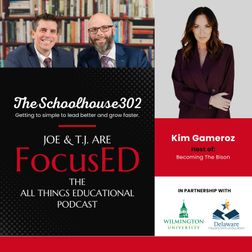
Our guest for this episode of FocusED is Kim Gameroz, author of Becoming the BISON. Kim starts by telling us about the reason she chose BISON as an analogy for leadership in schools. Bison head into the storm when it’s coming, not away from it like most other animals. She says that we need to teach social and emotional skills rather than expect them. This is true for students and staff. Kim says that when teachers are moving to a co-teaching model it’s an example of a transformation. This is just one example of the need for a mindset shift for educators to make a needed change to support kids. She says that when she talks to teachers she wants them to feel like they can do what she’s asking them to change. Listen to her top five tips for teachers. She tells listeners that teachers need to have strategies to help students support themselves so that it’s not all on the educators to support the students. When Kim talks to administrators, she asks them what they’re willing to do and where they are willing to start. Especially with resistant teachers, we need an entry point. Kim says that teachers want to come together, and she told us about the events that she runs. Check out Vibe EDU. She follows Mel Robbins. Find out why. She recommends a technology detox every night. She puts her phone away at a certain time and doesn’t return to it until the next day. Bonus--books she recommends: Fear is My Homeboy by The Let Them Theory by Mel Robbins The Art of Bouncing Back by Coach Dar Santory
1 de 11