
Fair Chance

Fair Chance

por Kevin Hasley
Temporada 4
Tour De France 2026 Summary
The 2026 professional cycling season was defined by record-equalling performances and a widening gap between elite and amateur physiological standards. Tadej Pogačar secured his fifth career Tour de France title, joining an elite group of record-holders by dismantling the field with a final winning margin of over six minutes. His performance was characterized by a lack of discernible weaknesses and an ability to dominate across all terrains, including a record-breaking ascent of Alpe d'Huez.In the 2026 Tour de France Femmes avec Zwift, Demi Vollering secured her second overall victory following a dramatic tactical battle with Katarzyna Niewiadoma-Phinney. The race was decided in the final 48 hours, highlighting the critical impact of short, steep "puncheur" climbs over traditional mountain passes like Mont Ventoux.Looking forward, the 2027 Grand Départ has been confirmed for Great Britain. This "British Trilogy" will mark an innovative three-nation start, traversing Scotland, England, and Wales.
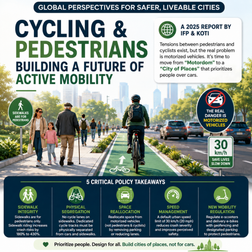
Cycling and the Relationship with Pedestrians
This briefing document synthesizes key findings from a 2025 report by the International Federation of Pedestrians (IFP) and the Korean Transport Institute (KOTI). The report addresses the urgent need for sustainable urban mobility by examining the complex relationship between pedestrians, cyclists, and motorized vehicles.The central takeaway is that while tensions often exist between pedestrians and cyclists in shared spaces, the primary source of danger and space inequity in cities remains the motorized vehicle. To foster safer, more liveable cities, urban planning must transition from a "Motordom" (car-centric) model to a "City of Places" model that prioritizes active mobility.
Temporada 3
Bike news roundup for July 2026

The 2026 cycling landscape is defined by historic professional milestones, a record-breaking pace in grand tours, and significant biomechanical safety breakthroughs. The professional circuit saw Demi Vollering achieve elite status by becoming only the second woman to win all three Grand Tours following her victory at the 37th Giro d’Italia Women. Simultaneously, the competitive field reached new technical heights, with the 2026 Tour de France recorded as the fastest in history, averaging over 43 km/h. In hardware and safety, the introduction of the Release Layer System (RLS) represents a paradigm shift in helmet design, utilizing a rolling-sphere mechanism to reduce the probability of brain injury by up to 86%. Meanwhile, the gravel sector has transitioned specialized technologies into the mainstream, with electronic shifting and sophisticated suspension becoming standard for endurance riding. The industry is also pivoting back toward accessibility, evidenced by patent filings for mechanical versions of direct-mount drivetrains and the emergence of high-performance 32-inch wheels.
Improving the Quality of Walking and Cycling in Cities

The transition toward sustainable urban environments requires a fundamental shift from car-centric "moto-normativity" to a human-centered mobility paradigm. This briefing synthesizes the findings of the International Transport Forum (ITF) regarding the improvement of walking and cycling quality in cities.
The Evolution of the Tour de France
The Tour de France has evolved from a 1903 newspaper marketing stunt into the world’s most prestigious cycling race, defined by a continuous pursuit of performance optimization. Historically, the race reached a peak of physical endurance in 1926 with the longest route in history and stages described as the "toughest ever." In the modern era, the competition has shifted toward extreme technical precision and data-driven physical conditioning.Key developments include a transition from fixed-gear steel bikes with wooden wheels to highly aerodynamic carbon fiber machines, a significant reduction in rider body fat despite stable heights, and the emergence of a era-defining rivalry between Tadej Pogačar and Jonas Vingegaard. This rivalry has pushed the sport into a "space race" of training and equipment, resulting in faster average speeds and the narrowest winning margins in the event’s history.
Motonormativity - The Hidden Bias Shaping Our Streets
This briefing document analyzes the phenomenon of "motonormativity"—a pervasive, shared bias that prevents societies from judging motorized transport with the same objective and moral standards applied to other activities. The underlying research establishes that motonormativity is not merely an individual preference but is deeply rooted in a social-ecological framework composed of nested environmental influences, ranging from immediate social circles to national cultural norms.
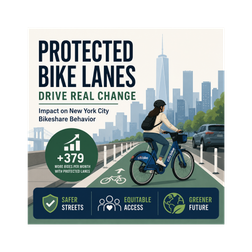
The Causal Power of Protected Bike
A comprehensive analysis of 72 million Citi Bike trips in New York City between 2013 and 2024 reveals that protected bike lanes are the only infrastructure type that demonstrates a direct causal link to increased bikeshare ridership. While correlational data shows growth across all lane types, rigorous statistical modeling indicates that painted lanes and "sharrows" provide no statistically significant ridership benefit over having no bike lane at all.
Bike news roundup for June 2026
The global cycling landscape in June 2026 is defined by a convergence of elite competitive drama, significant infrastructure investment, and controversial regulatory shifts. In professional road racing, the Tour Auvergne-Rhône-Alpes (formerly the Critérium du Dauphiné) serves as a volatile final test for the upcoming Tour de France, marked by a high-stakes General Classification (GC) battle and high-consequence crashes. Simultaneously, the ultra-endurance world has commenced the 2026 Tour Divide , with approximately 200 riders traversing the 2,700-mile Great Divide Mountain Bike Route.Beyond the races, municipal shifts in Paris and London underscore a massive commitment to active transportation, while the UCI has introduced new regulations on GPS head unit sizes, sparking debate over the balance between safety and technological innovation.
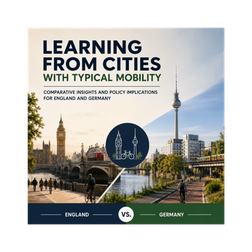
Learning from Cities with Typical Mobility

This briefing document synthesizes research conducted by LSE Cities and the RAC Foundation comparing transport patterns in "typical mobility cities" across England and Germany. Unlike traditional research focusing on exceptional "cycling cities," this study examines mid-sized urban areas (50,000–1,000,000 residents) whose travel behaviors represent national averages.
The Rise and Impact of National Bike Month
National Bike Month, observed annually in May, has evolved from a mid-century youth safety initiative into a global movement centered on health, environmental sustainability, and urban transportation. As of 2026, the event encompasses a full month of activities, including National Ride a Bike Day and Bike to Work Week.While the United States accounts for a significant population of occasional cyclists—with 112 million Americans riding at least once in 2024—the country’s primary commuting average remains low at 0.6% compared to global leaders like the Netherlands (30%). However, specific domestic hubs like Davis, CA, and Boulder, CO, demonstrate high levels of adoption. The sector has recently experienced a "generational tailwind," evidenced by a significant surge in youth participation and a 620% increase in inflation-adjusted household spending on bicycles between 2020 and 2023. Beyond transportation, cycling offers profound public health benefits, including a 51% reduction in mortality risk from heart disease, and substantial environmental impact, with regular commuters avoiding approximately 750kg of CO2 emissions annually.
1 de 4