Building Africa Podcast Insights Smart Investments in Africa

Building Africa Podcast Insights Smart Investments in Africa

por Investment Bank Of Africa

Understanding Investing Models

IBA creates this to help Africans to understand what they need to establish effective investment ready systems and businesses for IBA and across all investment platforms

Brief Project Submission Requirements

The IBA Project Information Submission Form is a investor-grade intake document designed by Investment Bank Of Africa to guide project sponsors, founders, companies, SPVs, institutions and mandate applicants through a structured project submission process. The document provides a clear framework for submitting projects, businesses, assets, SPVs, investment opportunities or partnership proposals for professional first-stage review. It helps applicants present their projects in a way that supports proper screening, compliance assessment, due diligence, investment structuring and internal evaluation by IBA. The form covers all key areas required for a credible investment submission, including project identification, location, sector, project stage, problem being solved, proposed solution, development impact, market opportunity, business model, investment request, financial summary, use of funds, implementation plan, team structure, governance, legal status, compliance information, risk assessment, ESG considerations and supporting documents. It also sets out the supporting documents required for review, such as a pitch deck, financial model, company registration documents, shareholder and beneficial ownership records, licences, permits, land or asset ownership evidence, contracts, tax clearance, bank confirmation, insurance documents and ESG or environmental impact reports where applicable. The purpose of the document is to help IBA receive project information in a professional, organised, verifiable and investment-ready format. It also makes clear that submission of the form does not automatically create funding approval, underwriting, a binding mandate, partnership, agency relationship or investment commitment. All projects remain subject to internal screening, legal review, compliance checks, due diligence, investment committee assessment, board approvals and formally executed agreements. Core brief: This document is a structured project-submission and investment-screening tool that helps IBA assess whether a project is credible, documented, compliant, financially viable, operationally ready and suitable for further investment consideration.

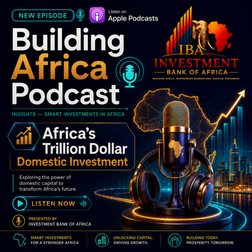
How Africa will create Trillion Dollar Domestic Economies

In this episode of the Building Africa Podcast: Insights - Smart Investments in Africa, we explore Africa’s Trillion Dollar Domestic Investment - the power of African capital, institutions, businesses, governments, pension funds, sovereign wealth funds, banks, asset managers, and private investors to finance Africa’s own development. The discussion highlights how domestic investment can unlock infrastructure, industrial growth, agriculture, energy, technology, housing, healthcare, logistics, and enterprise development across the continent. It also examines why Africa must strengthen investment-ready systems, credible project preparation, governance, transparency, due diligence, and partnerships to turn local capital into long-term economic transformation. This episode is designed for entrepreneurs, project sponsors, investors, policymakers, institutions, and development-focused stakeholders seeking to understand how Africa can build sustainable prosperity by mobilising its own financial strength. Africa has capital. Africa has opportunities. The future is in building the bridge between both.


Brief Description Of Investment Bank Of Africa

In this episode of the Building Africa Podcast: Insights -Smart Investments in Africa, we take a clear and practical look at Investment Bank Of Africa (IBA) -who we are, what we do, and how we are positioning ourselves as a pan-African investment institution focused on sustainable economic development. The discussion explores IBA’s purpose, investment approach, strategic focus, partnership model, and commitment to helping African projects, businesses, institutions, and stakeholders become more investment-ready. It also explains how IBA supports responsible investment through transparency, due diligence, credible project assessment, and long-term value creation. This episode is designed for entrepreneurs, project sponsors, investors, institutions, governments, private sector leaders, and development-focused stakeholders who want to better understand IBA’s role in connecting African opportunities with responsible capital and strategic partnerships. Understanding IBA means understanding a broader vision: building Africa through smart investments, stronger systems, and partnerships that create lasting impact.

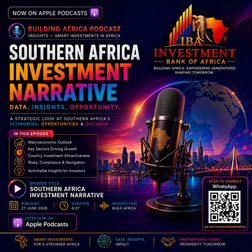
Southern Africa Investment Narrative

Building Africa Podcast: Southern Africa Investment Narrative -H2 2026 Southern Africa Investment Narrative -H2 2026 is a strategic investment discussion presented by Investment Bank Of Africa, focused on understanding Southern Africa as a collective investment region while clearly identifying the unique opportunities, risks and compliance requirements within each country. This episode explores the investment attractiveness of Southern Africa in the last half of 2026 using World Bank data and globally recognized investment indicators. It examines the 16 SADC-linked markets, including South Africa, Zambia, Tanzania, Namibia, Botswana, Mauritius, Angola, Mozambique, Zimbabwe, Malawi, Lesotho, Eswatini, Madagascar, Seychelles, Comoros and the Democratic Republic of Congo. The discussion goes beyond general market commentary. It provides a practical investment narrative on where opportunities are emerging, which countries are more attractive for capital deployment, what risks investors must understand, and how credible projects can move from informal proposals into structured, compliant and bankable investment pathways. The podcast highlights key sectors shaping Southern Africa’s investment future, including critical minerals, energy, infrastructure, agriculture, logistics, water systems, tourism, digital finance, manufacturing, financial services and climate-resilient development. A central focus of the episode is compliance. The discussion explains why mandate verification, KYC, KYB, beneficial ownership transparency, sanctions screening, environmental and social due diligence, legal review and country-specific regulatory mapping are essential before any serious investment engagement can take place. This episode is designed for governments, private-sector institutions, sovereign wealth funds, asset managers, project sponsors, investors, entrepreneurs, development organizations and stakeholders who want to understand Southern Africa’s investment landscape with clarity, discipline and practical insight. The core message is simple: Southern Africa has opportunity, but opportunity alone is not enough. Compliance creates the pathway. Due diligence protects the capital. Structure turns opportunity into investment. Building Africa Podcast - Smart Investments in Africa.

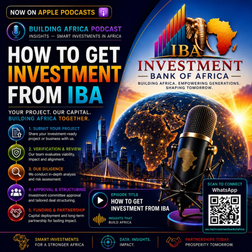
How To Get Investment From IBA

Understanding Investment Bank Of Africa Building Africa Podcast: Understanding Investment Bank Of Africa is a professional investment and development discussion presented by Investment Bank Of Africa. This episode introduces IBA’s purpose, vision, mission, investment narrative, strategic partnership model and its role in supporting Africa’s next phase of economic transformation. The podcast explains how Investment Bank Of Africa is positioning itself as a Pan-African investment institution focused on connecting credible African opportunities with responsible capital, institutional partners, governments, private-sector institutions, sovereign wealth funds, asset managers, investors, project sponsors and development-focused stakeholders. This episode provides a clear understanding of how IBA approaches investment through structure, compliance, due diligence, mandate verification, project review and responsible capital deployment. It highlights the importance of turning African opportunities from informal proposals into properly documented, bankable and investment-ready projects. The discussion also explores IBA’s focus on key sectors shaping Africa’s future, including agriculture and food security, energy, infrastructure, healthcare, education, technology, mining, manufacturing, logistics, real estate, financial services, telecommunications, tourism and sustainable development. A central message of the episode is that Africa does not only need capital. Africa needs structured capital — capital that is responsible, compliant, professionally reviewed, legally verified and aligned with long-term economic value. This podcast is designed for governments, entrepreneurs, project owners, private-sector institutions, investors, asset managers, sovereign wealth funds, development organisations and stakeholders who want to understand how credible African opportunities can be prepared, verified and connected to responsible investment pathways. Core message: Africa has the opportunity. Compliance creates the pathway. Due diligence protects the capital. Structure turns opportunity into investment. Building Africa Podcast — Smart Investments in Africa.

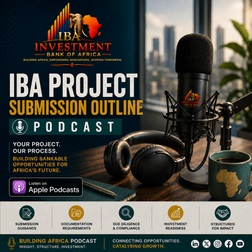
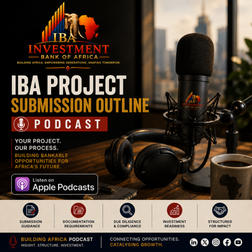
Master Project Submission Requirements

Master Project Submission Requirements: IBA Project Submission Outline is a practical guidance episode presented by Investment Bank Of Africa to help project sponsors, founders, companies, SPVs, institutions and mandate applicants understand how to prepare and submit investment opportunities for professional first-stage review. This episode explains the purpose of the IBA Project Information Submission Form, which is designed as an investor-grade project intake, screening, due diligence and investment-structuring template for project assessment and investment screening purposes. The form is strictly confidential and is used to collect the minimum information required for IBA to review a project, business, asset, SPV, investment opportunity or partnership proposal. The podcast walks listeners through the key areas required for a strong project submission, including project identification, sector classification, country and location, project stage, timeline, project description, problem statement, proposed solution, unique selling proposition, innovation, development impact, market opportunity, business model and investment rationale. It also explains how applicants should present their investment request, financial summary, funding gap, preferred instrument, expected return, use of funds, revenue forecast, profitability forecast, valuation and exit strategy. The episode makes clear that financial claims, market-size assumptions, asset values, ownership claims and funding requirements must be supported by evidence and should not be submitted as unverifiable statements. A central part of the discussion is investment readiness. The podcast explains why IBA requires information on implementation planning, operational capacity, procurement strategy, permits, approvals, monitoring, reporting, management experience, governance structure, shareholders and ultimate beneficial owners. These areas help determine whether a project is organised, credible, legally clear and ready for structured investment consideration. The episode also highlights the importance of legal, regulatory and compliance information. Applicants are guided to disclose company registration details, tax information, licences, regulatory status, material contracts, litigation, intellectual property, sanctions exposure, politically exposed person concerns and any financial-crime-related risks. This reinforces IBA’s position that credible investment engagement must be built on transparency, compliance and proper verification. The podcast further explains the supporting documents required for screening, including a pitch deck or investment memorandum, financial model, historical financial statements, company registration documents, shareholder and UBO register, director and management IDs or CVs, licences, permits, land or asset ownership evidence, contracts, offtake agreements, tax clearance, bank confirmation, insurance documents and ESG or EIA reports where applicable. A strong public-protection message is also included. Completion or submission of the form does not constitute funding approval, underwriting, a binding mandate, partnership, agency relationship or investment commitment by Investment Bank Of Africa. Any further engagement remains subject to internal screening, legal review, compliance checks, due diligence, investment committee assessment, board approvals and formally executed agreements. This podcast is designed for project owners, entrepreneurs, companies, institutions, governments, SPVs, asset owners, mandate applicants, investors and development-focused stakeholders who want to understand how to submit project proposals professionally through IBA’s structured investment screening process.

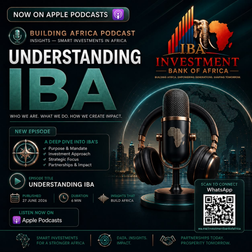
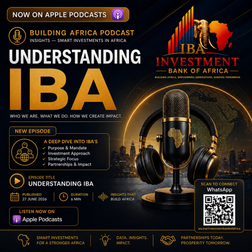
Understanding Investment Bank Of Africa

In this episode of the Building Africa Podcast: Insights -Smart Investments in Africa, we take a clear and practical look at Investment Bank Of Africa (IBA) -who we are, what we do, and how we are positioning ourselves as a pan-African investment institution focused on sustainable economic development. The discussion explores IBA’s purpose, investment approach, strategic focus, partnership model, and commitment to helping African projects, businesses, institutions, and stakeholders become more investment-ready. It also explains how IBA supports responsible investment through transparency, due diligence, credible project assessment, and long-term value creation. This episode is designed for entrepreneurs, project sponsors, investors, institutions, governments, private sector leaders, and development-focused stakeholders who want to better understand IBA’s role in connecting African opportunities with responsible capital and strategic partnerships. Understanding IBA means understanding a broader vision: building Africa through smart investments, stronger systems, and partnerships that create lasting impact.