Builders of the Broken Bazaar

Builders of the Broken Bazaar

por Dr. Tabish Zaman
Temporada 1

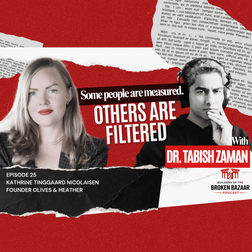
Some People Are Measured. Others Are Filtered

Episode 25: Some people are measured, others are filtered! Description: We treat the global digital economy as a level playing field, yet geography still dictates who is allowed to participate. What happens when world-class talent is trapped behind concrete walls and arbitrary blockades? In this episode of Builders of the Broken Bazaar, Dr. Tabish Zaman is joined by Kathrine Tinggaard Nicolaisen, the founder of Olives & Heather, a Palestinian marketing agency connecting local talent to global impact businesses. Kathrine challenges the standard "charity" narrative, arguing that Palestinians don't need more pity-based training—they need the same access to clients and trust as any other founder in the West. Together, they discuss the reality of leading a team where personal lives are defined by war and checkpoints, why professional rigor is a vital form of resistance, and how digital work has become the ultimate bridge into a world that often tries to filter Palestinians out. This is a conversation about work as dignity and building infrastructure that refuses to accept exclusion as inevitable. Because in a broken bazaar, some people are indeed measured, while others are simply filtered out—it’s time to change who gets to do the measuring. 🎙 “Solidarity opens doors, but it doesn't close deals. At the end of the day, work must be measured by excellence, not just sympathy.” 👉 Watch on YouTube: https://www.youtube.com/@buildersofthebrokenbazaar Host: Dr. Tabish Zaman Guest: Kathrine Tinggaard Nicolaisen (Founder, Olives & Heather) Editor: Liam Gadsby. Research and Impact Officers: Mohammad Alauthman & Sanskriti Sharma.

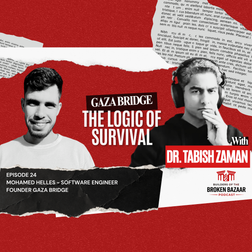
Gaza Bridge: The Logic of Survival!

What does it mean to be a "winner" in a situation where you have lost everything? For Mohammad Helles, it means turning systemic frustration into a roadmap for community survival. In this episode of Builders of the Broken Bazaar, Dr. Tabish Zaman is joined by Mohammad Helles, a software engineer in Gaza who transitioned from construction labor to global tech with nothing but a basic laptop and an iron will. Mohammad exposes the harsh reality of the digital economy in Gaza—a place where payment gateways like PayPal are blocked, and remote workers are forced to pay exorbitant fees just to access their own salaries. Together, they discuss Mohammad’s latest venture, Gaza Bridge, a platform designed to provide a dignified, direct link between global support and the families in Gaza who remain unreachable by traditional aid. This is not just a story about surviving a war; it is a conversation about the bravery required to build a new infrastructure of hope when the old one is in ruins. 🎙 “If I just drop my dreams, no one will come and achieve them for me. I have to keep trying until I make an impact.” 👉 Watch on YouTube: https://www.youtube.com/@buildersofthebrokenbazaar Host: Dr. Tabish Zaman. Guest: Mohammad Helles (Founder of Gaza Bridge & Software Engineer) Editor: Liam Gadsby. Research and Impact Officers: Mohammad Alauthman & Sanskriti Sharma.

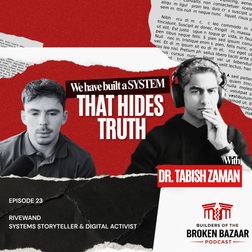
We have built a system that hides truth

Episode 23: We have built a system that hides truth! Description: We are surrounded by more information than any society in history, yet we have never felt further from the truth. Complex global events are stripped of context, corporate influence is hidden in plain sight, and trust in traditional institutions has evaporated. In this episode of Builders of the Broken Bazaar, Dr. Tabish Zaman is joined by Connor (Riverwand), a digital educator and investigative storyteller who is reclaiming the art of deep-dive research for the social media age. Connor dismantles the "myth of neutrality" in technology, exploring how Big Tech and state power have fused to create a system of techno-nationalism. Together, they discuss the power of "slow storytelling," the "Donation a Day" initiative for global mutual aid, and why digital literacy is now a vital form of civic self-defense. This is a conversation about moving from being a passive consumer of information to an active builder of understanding. Because in a world of 10-second clips, the most radical act is to stay in the conversation until you see the structure behind it. 🎙 “Before a system collapses, something else usually fractures first: the story we tell about how the world works.” 👉 Watch on YouTube: https://www.youtube.com/@buildersofthebrokenbazaar Host: Dr. Tabish Zaman Guest: Riverwand (Systems Storyteller & Digital Activist) Editor:Liam Gadsby Research and Impact Officers: Mohammad Alauthman & Sanskriti Sharma.

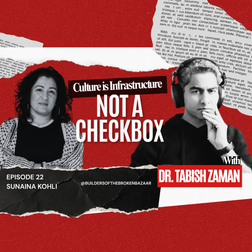
Culture is Infrastructure Not A Checkbox

Episode 22: Culture is Infrastructure, Not a Checkbox! Description: We treat Diversity, Equity, and Inclusion (DEI) as a compliance exercise—a set of optics to be managed in annual reports and strategy decks. But while the language of inclusion has become familiar, trust in our institutions is at an all-time low. In this episode of Builders of the Broken Bazaar, Dr. Tabish Zaman is joined by Sunaina Kohli, a Global Inclusion Strategist who has lived and worked across six countries and four continents. Sunaina challenges the standard DEI narrative, reframing culture not as a benefit, but as the essential infrastructure of any sustainable organization. Together, they discuss the Zulu philosophy of Ubuntu ("I am because you are"), the reality of the "trap door" for women in leadership, and Sunaina's unique "Professional Auntie" approach to radical truth-telling. This is an invitation to move beyond checkboxes and toward a leadership style grounded in humanity, safety, and the courage to unlearn the narratives of power. 🎙 “Organizations don’t have a diversity problem; they have a leadership and cultural problem.” 👉 Watch on YouTube: https://www.youtube.com/@buildersofthebrokenbazaar Host: Dr. Tabish Zaman Guest: Sunaina Kohli (a Global Inclusion Strategist) Editor: Liam Gadsby Research and Impact Officers: Mohammad Alauthman and Sanskriti Sharma

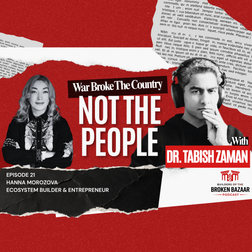
War Broke the Country. Not the People.

When war collapses a country, the systems fail, but the people remain. What happens when a high-level business leader is forced to become a "refugee," trading a boardroom for a production line in a salad factory? In this episode of Builders of the Broken Bazaar, Dr. Tabish Zaman sits down with Hanna Morozova, an Ecosystem Builder & Entrepreneur who is redefining what it means to rebuild after a catastrophe. From her background building Ukraine’s national garlic cooperative to her current work supporting over 600 refugee entrepreneurs and 120 veterans, Hanna shares the raw, human reality of displacement. Together, they discuss the psychological power of building a business to regain agency, the shift from competition to collaboration within displaced communities, and why the world needs to stop seeing refugees as victims and start seeing them as vital economic contributors. This is a conversation about the bravery it takes to start from zero—and the resilience that ensures you never really have to. 🎙 “Entrepreneurship isn't just making money, it's about having control again.” 👉 Watch on YouTube: https://www.youtube.com/@buildersofthebrokenbazaar Host: Dr. Tabish Zaman Guest: Hanna Morozova (Ecosystem Builder & Entrepreneur ) Editors: Liam Gadsby Research and Impact Officer: Mohammad Alauthman Keywords Ukrainian resilience refugee entrepreneurship veteran SMEs ecosystem building agency and identity economic assets collaboration over competition builders of the broken bazaar Dr Tabish Zaman

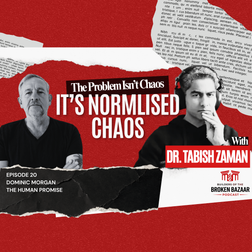
The Problem Isn't Chaos. It's Normalised Chaos

The world hasn't simply become more unstable; it has become normalized in its instability. We are told that global crises are being "managed" through summits, panels, and statements, yet 5 billion people have become poorer while displacement reaches record heights. In this episode of Builders of the Broken Bazaar, Dr. Tabish Zaman is joined by Dominic Morgan, the voice behind "The Human Promise." Together, they sit with a question most institutions avoid: What does responsibility look like when the harm is systemic and power is unequal? Dominic dismantles the idea that geopolitics is too "complicated" for the average person to understand, reframing the crisis as a moral misalignment. He introduces a simple but radical five-point commitment designed to act as a mirror and a compass for humanity. This is not a conversation about fixing the world through external power, but about moral alignment as the first step toward cultural change. It is an invitation to stay in the present longer than the system requires and to refuse to let responsibility dissolve into procedure. 🎙 “Outrage spreads faster than understanding... and opinion is loud, but responsibility is really quiet.” 👉 Watch on YouTube: https://www.youtube.com/@buildersofthebrokenbazaar Host: Dr. Tabish Zaman Guest: Dominic Morgan (co-founder of the Authentic Leaders initiative) Editors: Liam Gadsby Research and Impact Officer: Mohammad Alauthman

Mental Health is Infrastructure, Not Self-Care!

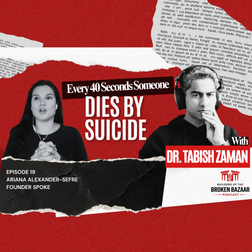
We are constantly told that mental health is an individual responsibility. That "self-care" is the solution. That if we just "optimize" our routines or download the right app, the pain will subside. But what if the real problem isn't a lack of clinical tools, but a resistance to help that doesn't sound like anything people recognize in their everyday lives? In this episode of Builders of the Broken Bazaar, Dr. Tabish Zaman is joined by Arianna Alexander-Sefre, founder and co-CEO of Spoke, to challenge the idea that mental health is merely an individual failing. Instead, they reframe it as a global systemic social issue that requires culture as infrastructure. Together, they explore the "silence" of young men, the capitalization of ancient healing practices into the "wellness industry," and Arianna’s journey in building a platform that integrates clinical psychology with music to reach underserved populations. This episode challenges the idea that clinical therapy is the only gateway to healing. Because care shouldn't require people to be coached or persuaded to access it. It should meet them where they already are. 🎙 “Sound is always there... it meets people without asking them to explain first.” 👉 Watch on YouTube: https://www.youtube.com/@buildersofthebrokenbazaar Host: Dr. Tabish Zaman. Guest: Arianna Alexander-Sefre Editor: Liam Gadsby. Research and Impact Officer: Mohammad Alauthman.
This AI is Built for Liberation: Not Just for Profit

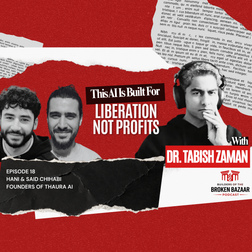
Episode 18: This AI Is Built for Liberation, Not Just for Profit We are constantly told that artificial intelligence is neutral. That data is objective. That algorithms simply optimise. That harm is an unfortunate side effect of progress. But what if the real question isn’t what AI can do but who it is built to serve? In this episode of Builders of the Broken Bazaar, Dr Tabish Zaman is joined by Said and Hani Chihabi, brothers and founders of Thaura AI, to explore what it means to build technology from the margins rather than for the market alone. This is not a conversation about AI hype or technical superiority. It is not about disruption for disruption’s sake. It is a conversation about power, dignity, and liberation. Drawing on their lived experiences and their work developing Thaura AI, Said and Hani reflect on what it means to build artificial intelligence that resists surveillance, extraction, and domination and instead centres justice, context, and human consequence. Together, they discuss: • Why most AI systems reproduce existing power structures rather than challenge them • How surveillance technologies disproportionately harm already marginalised communities • Why “ethical AI” often fails when it avoids politics and power • What it means to design AI from places shaped by conflict, occupation, and exclusion • How language, culture, and history are erased in dominant AI models • Why liberation must be a design principle, not a marketing claim • How entrepreneurship can be a tool for resistance, not just valuation • What responsibility looks like when technology operates at scale 🎙 “Technology is never neutral, it always reflects who had the power to build it.” This episode challenges founders, technologists, investors, and policymakers to reconsider what responsibility really means in the age of artificial intelligence. Because when AI is built without accountability, it doesn’t just optimise systems it decides who is seen, who is protected, and who is erased. And if AI is shaping the future, we must ask a harder question: Who gets to define that future and at whose cost? Host: Dr Tabish Zaman Guests: Said Chihabi & Hani Chihabi (Founders, Thaura AI) Editor: Liam Gadsby. Research and Impact Officer: Mohammad Alauthman.
Growth Is Not the Only Goal

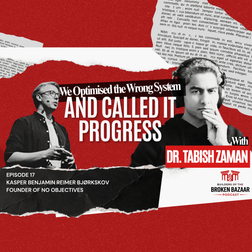
Episode 17: Growth Is Not the Only Goal We are constantly told that growth equals success. That scaling is progress. That innovation means moving faster, bigger, and further no matter the cost. But what if growth itself has become the problem? In this episode of Builders of the Broken Bazaar, Dr Tabish Zaman is joined by Kasper Benjamin Reimer Bjørkskov, Founder of No Objectives, to challenge one of the most deeply embedded assumptions in entrepreneurship, innovation, and design. This is not a conversation about sustainability as a checkbox. It is not about green growth or better metrics. It is a conversation about repair. Drawing on Kasper’s work in post-growth design, systems change, and collective action, the episode explores what happens when innovation stops chasing expansion and starts taking responsibility for the harm it leaves behind. Together, they discuss: • Why climate collapse and social collapse are the same design failure • How optimisation without empathy leads to extraction, not progress • Why growth has replaced meaning and what that has cost us • How systems are designed to concentrate power rather than distribute care • Why sustainability is an outcome, not a process • What regenerative design requires in a world already in overshoot • Why collective action matters more than individual heroics • How innovation should be measured by restoration, not valuation 🎙 “Not all innovation builds. Some of it repairs.” This episode challenges founders, designers, policymakers, and anyone working inside systems that claim to create value while quietly producing harm. Because if growth is not the goal, we are forced to ask a harder question: What are we actually building for and who does it serve? Host: Dr Tabish Zaman Guest: Kasper Benjamin Reimer Bjørkskov (Founder, No Objectives)

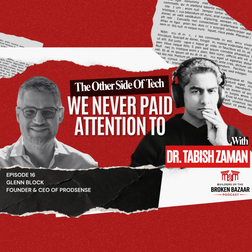
Ep 16: We Never Paid Attention to This Side of Tech

Technology Isn’t Neutral. It’s Cultural. We are constantly told technology is neutral. That algorithms are objective. That design is “just technical.” But technology doesn’t appear from nowhere. It is built by people, shaped by culture, and assembled through decisions, decisions that increasingly determine who gets a job, who gets a mortgage, and who receives medical care. In this episode of Builders of the Broken Bazaar, Dr Tabish Zaman is joined by Glenn Block (Founder & CEO, ProdSense) to unpack what the tech industry often refuses to name: Neutrality is not the absence of bias. It is often the protection of privilege. This is not a conversation about hype. It is a conversation about responsibility and what happens when innovation scales faster than care. Together, they explore: • Why “neutral technology” is a dangerous myth • How culture shapes design decisions long before launch • What product equity means in practice, not as a slogan • Why exclusion is often designed in, not discovered later • Who is missing from the rooms where products are imagined • How startup culture rewards speed, not accountability • Why accessibility and inclusion cannot be retrofitted after harm • And what responsible innovation should demand from entrepreneurs, designers, and institutions 🎙 “The bias isn’t in the zeros and ones it’s in how we assemble them.” This episode is a challenge to founders, innovators, and anyone building systems that touch other people’s lives. Because if technology reflects our culture, we have to ask: what kind of world are we building and for whom?
2 de 4