Campus Podcast @ Metro State University

Campus Podcast @ Metro State University

por Mr. Lucky — Educator, MAPL, M.S. Urban Education Student
Temporada 18

Black Learners Excellence — Take the Pledge
For My Book: www.weusoursluckybooks.com Email me for the PowerPoint Slides: radiotalklr@gmail.com 5E Learning Model Engage Students discuss a time they felt fully prepared—or unprepared—for class. Brief share‑outs highlight how preparation affects confidence and participation. Explore Students examine a short scenario of a highly prepared learner (reading ahead, annotating, asking questions). In groups, they list observable habits and why they matter. Explain Instructor clarifies the concept of conscientious learning: reading all chapters before class, annotating, preparing questions, engaging actively, and staying humble enough to say “I don’t know it all.” Elaborate Students apply the model by selecting a current course, outlining how they will prepare for the next class using the behaviors discussed. Evaluate (Formative Assessment) Students submit a one‑paragraph reflection describing one habit they will adopt immediately and why it will strengthen their academic identity. Contact: 773-809-8594

Mr. T Responds to Double Standards/Pity Da Fool

Learning Objective (with example) Objective: Students will be able to identify and explain a double standard presented in a comedic text about leadership behavior. Example: A student states, “The text shows a double standard because the mayor receives leniency that a man accused of similar conduct toward a woman would not receive.” Learning Outcome (with example) Outcome: Students will demonstrate understanding by citing one example of how humor is used to expose unequal treatment in the text. Example: A student writes, “The Mr. T line — ‘I pity the foo…’ — uses humor to highlight how a man would face harsher consequences.” 5E Learning Model Engage Read aloud a short excerpt from the comedic mayor article, especially one of the Mr. T lines. Ask: “Why does this line feel funny but also serious?” Explore Students highlight phrases in the text that show differences in how the fictional mayor is treated compared to how a man would be treated in the same situation. Explain Instructor defines double standard and models how the text uses humor to reveal unequal expectations in leadership accountability. Elaborate Students work in pairs to rewrite one Mr. T line in their own comedic style while keeping the double‑standard message intact. Evaluate (Formative Assessment) Students complete a one‑sentence exit slip: “Describe one double standard shown in the text and explain how humor helps reveal it.” Comments: radiotalklr@gmail.com

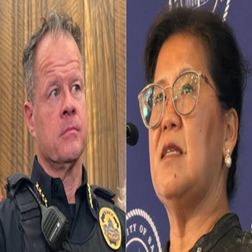
Samia Ali: Founder, People Forward Consulting
Order My Book at: www.weusoursluckybooks.com Ms. Ali's email: samia@peopleforwardmn.com Website: peopleforwardmn.com

Mr. Lucky ARRESTED -LOL- I Fooled Many with This Episode- LOL
Call With Legal Donations to 773-809-8594 Start a free Lucky Release and Snickers Movement Outside the Jail chanting "Free Mr. Lucky quicker — they jailed him for Snickers." I can hear you all now. "Free Mr. Lucky quicker — they jailed him for Snickers."

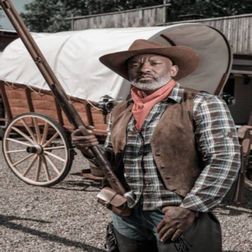
How Boy Became Cowboy: A Black Historical Reconstruction
Order My Book: www.weusoursluckybooks.com Lesson Plan: Black Origins of “Cowboy” Description: Students explore the true historical origins of the term cowboy, focusing on enslaved Africans’ role in early cattle ranching, the linguistic roots of “cow-boy,” and the later whitewashing of the cowboy identity in American culture. Learning Objective Students will explain how enslaved Africans shaped the early cowboy occupation and how the term evolved through racialized language and cultural appropriation. Learning Outcomes Students identify the role of enslaved Africans in early cattle work. Example: naming tasks such as herding, breaking horses, or driving cattle. Students describe how “get the cow, boy” contributed to the term cowboy. Example: explaining how commands to enslaved workers became occupational labels. 5E Learning Model Engage: Show two contrasting images—Hollywood cowboy vs. Black cowboy—and ask students what they notice. Explore: Students read short excerpts on African cattle expertise and early ranching. Explain: Class discussion on how language, labor, and race shaped the term cowboy. Elaborate: Students connect cowboy whitewashing to other examples of cultural erasure in U.S. history. Evaluate: Students write a brief explanation of the true origins of “cowboy.” Formative Assessment Students submit a 5–6 sentence exit reflection explaining how enslaved Africans influenced the cowboy identity and how the term changed over time. Contact: email radiotalklr@gmail.com or call 773-809-8594 You are appreciated for listening to this podcast and sharing episodes with others. Big Appreciation.

On Campus: Enforcing the 1965 Voting Rights Act in 2026
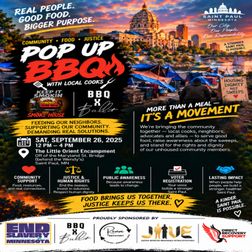
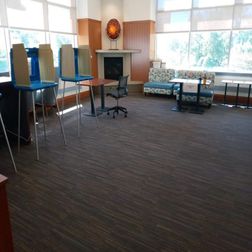
For a copy of my book: www.weusoursluckybooks.com Today, the Library’s first‑floor lounge at Metro State University was transformed into a hands‑on demonstration of enforcing the 1965 Voting Rights Act. The space operated as an educational enforcement zone where students, staff, and community members experienced how the protections guaranteed by the Voting Rights Act are upheld in real time. Volunteers greeted participants and walked them through the federally protected steps of the voting process — emphasizing equal access, nondiscrimination, and the removal of barriers that historically prevented many Americans from voting. Representatives from the St. Paul League of Women Voters were present to provide non‑partisan guidance, answer questions, and share resources on voter protections and civic participation. In alignment with the Voting Rights Act’s commitment to expanding access, attendees who were not yet registered to vote received assistance completing their voter registration. This reinforced the principle that voting is a protected right and that institutions have a responsibility to safeguard that right for every eligible voter. Participants also engaged in a light‑hearted ballot featuring Minnesota “hot‑take” questions, demonstrating how accessible voting procedures work from check‑in to ballot submission while highlighting the importance of barrier‑free elections. Hosted by: Metro State University Library & Information Services Community and Civic Engagement Center St. Paul League of Women Voters Contact this Podcast at 773-809-8594

PSA: Josh McMillen - Reaching Out for Our Community
See My Book www.weusoursluckybooks.com Visit the End Slavery Minnesota Coalition: mnendslavery.org To be a guest on this podcast and share something that you are doing call 773-809-8594 or email radiotalklr@gmail.com

Black Nurses: Untold History

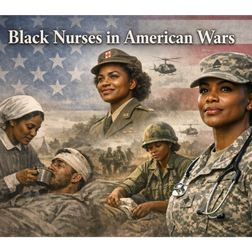
For My PowerPoint Black Nurses in American Wars email: radiotalklr@gmail.com For My Book: www.weusoursluckybooks.com Lesson Plan: Black Nurses in American Wars Thesis Statement Black nurses have served with courage and skill in every major American war, shaping military medicine and advancing civil rights through their unrecognized labor, leadership, and legacy. Learning Objectives 1. Identify key contributions of Black nurses across American wars Example: Students will name three wars where Black nurses served and describe their roles in each. 2. Analyze the impact of military service on civil rights progress Example: Students will explain how WWII nursing assignments influenced desegregation in the U.S. military. Learning Outcomes 1. Students will create a timeline of Black nurse service from the Civil War to Iraq/Afghanistan Example: Timeline includes Harriet Tubman, WWII assignments, and modern leadership roles. 2. Students will write a reflection on how one nurse’s legacy inspires their own leadership or academic goals Example: A student reflects on Susie King Taylor’s courage and connects it to their nursing aspirations. 5E Learning Model Engage: Show image of Black nurses in uniform across eras; ask “What do you see?” Explore: Students research one war and report how Black nurses served Explain: Instructor presents key figures and turning points (e.g., WWII quotas, Vietnam trauma care) Elaborate: Students connect nursing service to civil rights and leadership Evaluate: Students complete a formative assessment (below) Formative Assessment Students will submit a short-written response: “How did Black nurses in one war change the course of military medicine or civil rights?” Responses must cite one historical figure or event. To be a guest on the podcast sharing what you are doing and/or to help with my audience research call and leave your name, where you are listening from at 773-809-8594

BLACKS Started Ambulance EMS

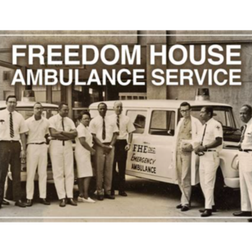
Order my book at: www.weusoursluckybooks.com Lesson Plan: Freedom House Ambulance Service — The Birthplace of Modern EMS Thesis Statement The Freedom House Ambulance Service revolutionized emergency medical care in the United States by proving that marginalized Black citizens—once labeled “unemployable”—could become the nation’s first professionally trained paramedics and set the national standard for modern EMS. Learning Objectives Students will identify the historical significance of the Freedom House Ambulance Service and its role in shaping modern emergency medical systems. Students will analyze how racial inequality influenced both the rise and dismantling of Freedom House, and how its legacy continues to impact EMS today. Learning Outcomes (with Examples) Outcome 1: Students will be able to explain how Freedom House pioneered modern paramedic training and prehospital care. Example: A student might describe how Freedom House paramedics learned advanced airway management, CPR, and on‑scene medical decision‑making long before these skills were standard nationwide. Outcome 2: Students will be able to connect the story of Freedom House to present‑day EMS practices and equity issues. Example: A student might compare Freedom House’s community‑based model to today’s EMS systems and discuss how racial bias still affects healthcare access and emergency response. Short 5E Learning Model Engage Show a photo of a modern ambulance and ask: “Who do you think invented the paramedic profession?” Most students will guess incorrectly—this opens the door. Explore Students read a short overview or watch a brief clip about Freedom House’s founding, training, and impact. Explain Teacher clarifies how Freedom House paramedics—Black men from Pittsburgh’s Hill District—became the first highly trained EMS professionals in the nation. Elaborate Students compare Freedom House protocols to today’s EMS procedures (e.g., cardiac care, trauma response, airway management). Evaluate Students complete a short-written reflection or exit ticket: “How does knowing this history change the way you view paramedics today?” Challenge to Think Each time you see paramedics racing through the city—lights flashing, sirens cutting through traffic—remember that the very system they use was built by Black pioneers whose brilliance was nearly erased from history. Ask yourself: How do we honor their legacy today, and what inequities still need to be confronted in emergency care? Help with my audience research by calling 773-809-8594 leaving your name and where you are listening form. THANKS

Trailblazers in Black Psychology

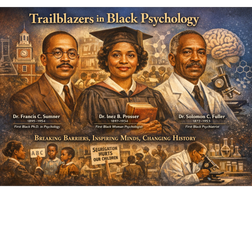
Order My Book: www.weusoursluckybooks.com -Psychology students stand on the shoulders of pioneers who proved that brilliance and perseverance can break every barrier. The stories of Francis Cecil Sumner, Inez Beverly Prosser, and Solomon Carter Fuller remind us that knowledge is not confined by race or circumstance—it is expanded by courage. Their legacy calls today’s students to study with purpose, lead with integrity, and use psychology to heal, uplift, and transform communities. The history of Black psychology in America begins with extraordinary determination against systemic barriers. Dr. Francis Cecil Sumner, known as the Father of Black Psychology, became the first African American to earn a Ph.D. in psychology in 1920 from Clark University. Largely self‑taught due to segregated schooling, Sumner passed special entrance exams, graduated valedictorian from Lincoln University, and later founded the psychology department at Howard University. His work on race, bias, and educational inequality shaped the discipline and mentored scholars like Dr. Kenneth Clark, whose research influenced Brown v. Board of Education. Dr. Inez Beverly Prosser, the first Black woman psychologist, earned her Ph.D. in 1933 from the University of Cincinnati. Her research examined the emotional well‑being of Black children in segregated and integrated schools. Prosser found that Black students often experienced stronger self‑esteem and academic support in all‑Black schools with Black teachers. Her findings informed early civil rights debates about education and remain foundational in educational psychology. Dr. Solomon Carter Fuller, the first Black psychiatrist in the United States, worked directly with Alois Alzheimer in Germany. Fuller’s research advanced understanding of neurodegenerative disease and challenged racist pseudoscience with empirical evidence. Together, these pioneers built the intellectual foundation for Black psychology, opened pathways for future scholars, and reshaped national conversations about race, education, and mental health. Lesson Plan: Trailblazers in Black Psychology Learning Objectives Students explain who Sumner, Prosser, and Fuller were, using examples of their contributions. Students analyze how their work challenged racial barriers and advanced psychology. Learning Outcomes Students summarize each pioneer’s achievements clearly and accurately. Students connect each figure’s work to civil rights and educational reform. Assessment Students write a short reflection explaining how one pioneer’s work influences modern psychology or education. Responses demonstrate comprehension, historical reasoning, and application. 5E Learning Model Engage Begin with a discussion: “What barriers might early Black scholars have faced in higher education?” Show portraits of Sumner, Prosser, and Fuller to spark curiosity. Explore Students read short biographical excerpts and identify common themes of resilience and innovation. Explain Facilitate a class conversation linking each pioneer’s work to broader social change and civil rights history. Elaborate Students create a mini‑poster or digital slide highlighting one pioneer’s legacy and its relevance today. Evaluate Use the written reflection and group discussion to assess understanding and connection to modern psychology. Help with my audience research. Call and let me know where you are listening from: 773-809-8594
1 de 12