BSPE Legal Marketing Podcast

BSPE Legal Marketing Podcast

por Viktoria Altman
Temporada 4

Motion To Enforce Vs. Petition For Rule In An Illinois Divorce - Russell D. Knight

From Law Office of Russell D. Knight – Motion To Enforce Vs. Petition For Rule In An Illinois Divorce explores the crucial differences between two enforcement mechanisms available to parties navigating post-judgment issues in Illinois divorce proceedings. This episode provides a deep dive into how a motion to enforce contrasts with a petition for rule to show cause, emphasizing when and why each option may be strategically employed to compel compliance with court orders. We unpack the practical and legal foundations for both actions, referencing key Illinois statutes such as 750 ILCS 5/511, 750 ILCS 5/510, and 750 ILCS 5/610.5. Listeners will learn how a motion to enforce offers a streamlined, non-confrontational route that can facilitate modifications without exacerbating post-divorce tensions—especially valuable when co-parenting is involved. The concept of “substantial change in circumstances” takes center stage as a gateway to revisiting and refining orders concerning child support, maintenance, and parenting time. Next, we examine the more elaborate petition for rule to show cause, also known as a contempt proceeding. Drawing on precedent from In re Marriage of Knoll, People v. Warren, and In re Marriage of Dunseth, the episode outlines the multi-step legal process, from initial notice through potential incarceration, and the critical role of a “purge” to rectify violations. Listeners gain insight into how indirect civil contempt unfolds and the burden-shifting dynamics that define this form of litigation. If you're struggling with post-divorce order enforcement, this episode clarifies the tactical and emotional stakes of choosing between a motion to enforce and a petition for rule. Don’t miss this essential guide for anyone dealing with enforcement in Illinois family law courts—presented by the trusted team at Law Office of Russell D. Knight. Law Office of Russell D. Knight 1165 N Clark St #700, Chicago, IL 60610, United States (773) 334-6311 https://www.google.com/maps?cid=13056420905624162796

New Castle Rideshare Accident Lawyer - Luxenberg Garbett Kelly & George P.C.

From Luxenberg Garbett Kelly & George P.C. - New Castle Rideshare Accident Lawyer explains why Uber and Lyft accident claims are often more complicated than other car accident cases, covering multiple insurance policies, questions about a driver's status in the rideshare app, and disputes over who is responsible for paying damages. Listeners who were injured in a rideshare accident in New Castle, Pennsylvania will learn how they may be entitled to compensation for medical expenses, lost wages, pain and suffering, and other losses. Lawrence M. Kelly of Luxenberg Garbett Kelly & George P.C., together with Joseph A. George, represents people injured in rideshare crashes throughout Western Pennsylvania, including clients in Lawrence, Butler, Beaver, Mercer, and Allegheny counties. The discussion covers who can be held liable after a rideshare crash, how Uber and Lyft insurance coverage periods work, and Pennsylvania's no-fault rules and filing deadlines. It also touches on common causes of Uber and Lyft accidents, such as driver distraction from the rideshare app or GPS, speeding, fatigue, and unsafe pickups or drop-offs. The episode walks through what to do after a rideshare accident in New Castle, from calling 911 and speaking with the police to screenshotting Uber or Lyft trip details and seeking medical attention, along with the importance of reporting the accident to an insurance company and speaking with a lawyer before giving recorded statements. It also breaks down how liability may depend on what the rideshare driver was doing at the time of the crash, whether the app was off, the driver was waiting for a request, a ride had been accepted, or a passenger was already in the vehicle, and how Uber or Lyft's insurance may apply even when a driver is an independent contractor. Listeners will also hear an explanation of Uber and Lyft insurance coverage periods, including how driving periods carry different insurance limits, from lower liability coverage when the app is on and waiting for a ride request to primary commercial liability coverage once a ride is accepted or a passenger is in the vehicle. The episode closes with an overview of Pennsylvania's no-fault insurance and minimum coverage rules, including how first-party medical benefits may pay certain medical costs first and how full tort or limited tort selection can affect the right to recover pain and suffering. Call Luxenberg Garbett Kelly & George P.C. at (724) 658-8535 to schedule a consultation. Luxenberg Garbett Kelly & George P.C. 315 N Mercer St, New Castle, PA 16101 (724) 658-8535 https://www.google.com/maps?cid=1349618312503922919

Life Insurance and Divorce in Illinois - Russell D. Knight

From the Law Office of Russell D. Knight – Life Insurance and Divorce in Illinois breaks down the intricate and often misunderstood relationship between life insurance policies and divorce proceedings within the state. This episode offers a deep dive into Illinois law, unpacking how beneficiary designations, maintenance, child support, and marital property allocations are affected once a marriage dissolves. Listeners will gain insight into Illinois' status as an "automatic revocation" state, where ex-spouses are typically removed as life insurance beneficiaries after a divorce—unless specifically reaffirmed in a decree or redesignated afterward. The conversation explores pivotal case law, including Richard v. Martindale and In re Marriage of Walker, clarifying the role of court discretion in enforcing or modifying life insurance obligations for both maintenance and child support. The episode also navigates complex legal scenarios involving whole life insurance policies as divisible assets, ERISA-governed group policies, and court-ordered obligations to maintain coverage. With direct references to statutes such as 750 ILCS 5/504(f) and 750 ILCS 5/505(a-3), we discuss how Illinois courts assess affordability, availability, and fairness when assigning responsibilities for existing or new life insurance policies. Finally, tune in as we address issues surrounding enforceability, substitution of beneficiaries, and the limits of court authority—especially in cases where maintaining a policy could be impossible or considered speculative. Whether you're navigating divorce now or planning for the future, this episode provides essential legal knowledge for protecting your financial interests and your loved ones in Illinois. Law Office of Russell D. Knight 1165 N Clark St #700, Chicago, IL 60610, United States (773) 334-6311 https://www.google.com/maps?cid=13056420905624162796
Long Island ETG Calculator - Jason Bassett

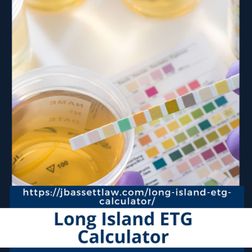
From Law Offices of Jason Bassett, P.C. — Long Island ETG Calculator explores how EtG testing factors into alcohol-related criminal defense on Long Island. In this episode, we break down how the ETG Calculator works, what exactly ethyl glucuronide is, and how law enforcement and courts may use it alongside or in place of BAC tests. You’ll hear practical scenarios tied to real Long Island and Suffolk County cases, and insights into how Jason Bassett approaches defending clients in DWI or DUI matters. We start by defining EtG (ethyl glucuronide) and contrast it with traditional blood alcohol content (BAC) measurements, discussing how EtG remains detectable in urine far longer than alcohol in blood. Then we dig into how variables like number of drinks, hours until test, weight, and gender can feed into the ETG Calculator to estimate test outcomes — what the “cutoff hour” means, and how a result above 500 ng/ml can put someone at high risk for failing. This segment helps demystify the science behind the test and the limits of its predictions. Next, we turn to the legal stakes: how ETG testing is used in DWI defense, probation compliance, alcohol dependency programs, and even license reinstatement efforts in New York. We’ll explore how false positives — due to mouthwash, hand sanitizer, auto-brewery syndrome, or other substances — can be raised in defense. Jason shares stories from his work as a Suffolk County criminal defense attorney and how he crafts strategies to challenge or contextualize EtG evidence in court. Finally, we close with listener Q&A and guidance: what to do if someone believes an ETG test is being used against them, how to choose representation in Long Island or Central Islip, New York, and when abstinence requirements or monitoring may come into play. If you’re interested in the intersection of science, law, and personal rights in alcohol-related cases, this episode is a must-listen. Law Offices of Jason Bassett, P.C. 320 Carleton Ave # 4200, Central Islip, NY 11722, United States (631) 259-6060 https://www.google.com/maps?cid=695024758410642184

Who Gets The Engagement Ring In Illinois? - Russell D. Knight

From Law Office of Russell D. Knight - Who Gets the Engagement Ring in Illinois? breaks down what really happens to engagement rings when love doesn't lead to marriage—or when it ends in divorce. This episode offers a clear look at Illinois law and how courts determine ownership of these symbolic and often valuable gifts when relationships end. We explore the concept of replevin—defined in Black’s Law Dictionary as a legal action to repossess personal property wrongfully taken or detained—and how it applies to conditional gifts like engagement rings. Drawing on cases like Vann v. Vehrs and Harris v. Davis, the episode explains that the key issue in Illinois isn’t why the relationship ended, but who ended it. That act alone often determines who keeps the ring. Listeners will also learn what happens when the ring has been sold or converted, triggering a different legal path that focuses on monetary compensation based on the ring’s market value, as clarified in Jensen v. Chicago & Western Indiana RR Co.. The nuances of inherited versus purchased rings also come into play, along with the role jewelers may play in documenting value. For couples who did marry, the conversation shifts to divorce proceedings and how engagement rings and wedding bands are treated under Illinois’ marital vs. non-marital property laws, including insights from In re Marriage of Wojcicki and In re Marriage of Schmidt. Whether you're newly engaged, considering divorce, or just curious about legal intricacies, this episode offers essential knowledge from Law Office of Russell D. Knight to help you understand your rights and options. Law Office of Russell D. Knight 1165 N Clark St #700, Chicago, IL 60610, United States (773) 334-6311 https://www.google.com/maps?cid=13056420905624162796
Defending A Petition For Attorney’s Fees In An Illinois Divorce - Russell D. Knight

From Law Office of Russell D. Knight – Defending A Petition For Attorney’s Fees In An Illinois Divorce dives into the high-stakes world of attorney fee disputes during divorce proceedings in Illinois. This episode guides listeners through the intricacies of statutes like 750 ILCS 5/508(a), 750 ILCS 5/501(c-1), and 750 ILCS 5/508(b), highlighting the differences between discretionary and mandatory fee awards, and offering real-world strategies for defending against petitions that could financially cripple one party. We unpack the challenges faced by spouses who may be court-ordered to pay the other’s legal fees simply due to income disparity or asset control. The Law Office of Russell D. Knight outlines how courts determine whether an interim attorney’s fee award is justified, including the key role affidavits and statutory factors play under Illinois law. Through case law examples like In re Marriage of Schneider and In re Marriage of Heroy, listeners will gain clarity on how courts weigh financial stability and the need for equitable access to legal representation. This episode also emphasizes the strategic advantage of successfully contesting interim fee petitions, offering insights into the non-evidentiary nature of pre-judgment hearings and how a detailed responsive pleading can turn the tide. Listeners will learn why accuracy in disclosing prior payments and challenging flawed affidavits can be crucial in protecting financial interests during litigation. Finally, we explore the unavoidable nature of 750 ILCS 5/508(b) awards, where courts must grant fees for enforcement actions absent compelling justification. With potential contempt findings and 9% annual interest on judgments under 735 ILCS 5/2-1303, the financial consequences can be devastating. The Law Office of Russell D. Knight urges clients to know when to push back and when to settle — because sometimes, as Kenny Rogers said, “you gotta know when to hold ‘em and know when to fold ‘em.” Law Office of Russell D. Knight 1165 N Clark St #700, Chicago, IL 60610, United States (773) 334-6311 https://www.google.com/maps?cid=13056420905624162796
Getting Divorced While Renting In Illinois - Russell D. Knight

From Law Office of Russell D. Knight — Getting Divorced While Renting In Illinois guides listeners through the often-overlooked complications that renters face when navigating a divorce. The article — and thus the podcast episode — addresses the legal, financial, and practical questions that come up when a couple divorces but doesn’t own the home they live in. In the first part, the podcast will explore “Who Keeps the Rented House?” Even though neither spouse owns the property, the lease itself becomes a binding obligation. The episode discusses how a marital settlement agreement can allocate responsibility for the lease and how courts decide who retains exclusive possession during the divorce proceedings. This reflects the article’s discussion on leases, exclusive possession motions, and court orders under Illinois statutes. Next, the podcast delves into Security Deposits, Rent, and Lease Breaks — what happens to the deposit if the divorce is finalized before the lease ends, how rent responsibility is assigned (including for periods before or after one spouse moves out), and whether one spouse can legally break the lease because of the divorce. The discussion also covers the option to sublease and the landlord’s role — noting that landlords do not need to be informed of the divorce and are not bound by a divorce decree. In the final segment, the podcast turns to Child Custody, Relocation, and Housing Strategy. It examines how proximity to children’s schools and the size of rental units matter in custody and parenting time disputes. The episode concludes with strategic advice: rather than buying while in the midst of a divorce, a spouse may be better off renting in a location that supports their custody goals — and later, after the parenting plan is set, move or purchase within permissible distance limits. Law Office of Russell D. Knight 1165 N Clark St #700, Chicago, IL 60610, United States (773) 334-6311 https://www.google.com/maps?cid=13056420905624162796
Compelling Discovery In An Illinois Divorce - Russell D. Knight

From Law Office of Russell D. Knight - Compelling Discovery In An Illinois Divorce dives deep into the critical legal strategies used when standard requests for evidence fall short during divorce proceedings in Illinois. This episode walks listeners through the nuances of compelling discovery under the Illinois Supreme Court Rules, highlighting when and how parties can enforce full disclosure using tools like subpoenas, interrogatories, and financial affidavits. When emotions run high and trust is low, discovery can become contentious. This episode outlines what happens when a spouse refuses to cooperate—whether they hide assets, ignore deadlines, or file evasive objections. Drawing from cases such as Williams v. A.E. Staley Manufacturing Co. and Locasto v. City of Chicago, we examine how courts address obstruction and how attorneys can utilize measures like the 201(k) letter to ensure procedural compliance and preserve civility in the courtroom. We also cover the essential role of motions to compel and the impact of judicial sanctions under Rule 219(c), including freezing proceedings or barring evidence. Listeners will learn the balance courts strike between enforcing discovery compliance and upholding due process, referencing landmark decisions such as Zagorski v. Allstate Insurance Co. and In re Marriage of Faber. Finally, the episode unpacks objections to discovery, affidavits of completeness, and the consequences of contempt of court when orders are ignored. Whether it's compelling a reluctant party to produce documents or facing jail time for defiance, Compelling Discovery In An Illinois Divorce reveals the legal power plays that determine who controls the narrative—and the assets—in a contested divorce. Law Office of Russell D. Knight 1165 N Clark St #700, Chicago, IL 60610, United States (773) 334-6311 https://www.google.com/maps?cid=13056420905624162796
Emergency Orders Of Protection In Illinois - Russell D. Knight

From Law Office of Russell D. Knight – “Emergency Orders Of Protection In Illinois” kicks off this episode by unpacking the critical legal mechanism known as an emergency order of protection under Illinois law. We walk listeners through how such orders can be issued ex parte, meaning without prior notice to the respondent, and how the courts balance urgency with due process. Drawing from 750 ILCS 60 (the Illinois Domestic Violence Act), we illustrate when and how courts may bypass usual procedures in the name of safety. Next, we explore in detail what must be proven to obtain an emergency order of protection: the nature of abuse (including harassment, physical harm, interference with personal liberty) and the standard of proof (“preponderance of the evidence”) required by Illinois law. We also explain how statutory definitions like those in 750 ILCS 60/103 and related sections form the backbone of a petitioner’s argument. In the third segment, we examine what happens after an emergency order is granted: its secret status (not publicly accessible until served), how law enforcement treats violations (including possible arrest), and the 21-day term of the order. We also discuss how extensions or transition to a plenary (regular) order of protection are handled under 750 ILCS 60/220 and 60/219. Finally, the episode brings these topics full circle by highlighting practical considerations for those seeking protection. We reference Russell D. Knight and his Chicago family law firm’s approach to emergency orders and family law matters. Listeners will learn how to recognize when an emergency order is needed, what to expect in court, and how to prepare for the hearing transitions ahead. Law Office of Russell D. Knight 1165 N Clark St #700, Chicago, IL 60610, United States (773) 334-6311 https://www.google.com/maps?cid=13056420905624162796
How Much Does an Expungement Cost in Michigan? - Paul J. Tafelski

From Paul J. Tafelski, Michigan Defense Law - How Much Does an Expungement Cost in Michigan? dives into Michigan's expansive Clean Slate laws and explains how these changes offer individuals a genuine chance to move beyond their past convictions. Featuring detailed insights from Michigan Defense Law’s Paul J. Tafelski and attorney David Goukassian, the podcast provides listeners with an overview of eligibility requirements, the financial and procedural aspects of expungement, and strategic advice to make the process seamless. The podcast explores the specific provisions of Michigan's Clean Slate Act, highlighting the possibility to expunge up to three felonies and unlimited misdemeanors by petition. It also clarifies reduced waiting periods and introduces the "one bad night" rule, simplifying complex legal jargon into practical advice for listeners. Through clear, accessible language, it breaks down critical information like automatic expungement eligibility and the types of offenses that qualify. Listeners will also gain insight into the cost structure of the expungement process, including fingerprinting fees, the required certified court documents, and Michigan's standard $50 filing fee. It offers practical tips such as batching document requests to minimize expenses and underscores how investing in professional legal assistance can help avoid common pitfalls, delays, and rejections. Ultimately, the episode emphasizes that while automatic expungement is beneficial, actively petitioning through a skilled attorney like Paul J. Tafelski can significantly accelerate the clearing of a record, delivering tangible financial and personal advantages years sooner. For those ready to reclaim their lives, this podcast serves as an essential guide on how to successfully navigate Michigan’s expungement process. Paul J. Tafelski, Michigan Defense Law 2525 S Telegraph Rd suite 100, Bloomfield Hills, MI 48302, United States (248) 451-2200 https://www.google.com/maps?cid=7441820969606749572
66 de 178