Future Forward: Artificial Intelligence - General Intelligence - Super Intelligence

Future Forward: Artificial Intelligence - General Intelligence - Super Intelligence

por KG191
Temporada 1

Space-Data Centres , Musks strategic provocation

As AI systems accelerate toward AGI and ASI, the infrastructure that powers intelligence is becoming as consequential as intelligence itself. In this episode of Future Forward: AI to AGI to ASI, we examine Elon Musk’s provocative idea of placing data centres in space. Is orbital compute a visionary solution to Earth’s energy, cooling, and land constraints—or a misunderstanding of physics at scale? Drawing on thermodynamics, orbital mechanics, energy systems, reliability engineering, and economics, this episode separates intuition from reality. We explore why space offers abundant solar energy but poor energy density, why cooling in a vacuum is far harder than on Earth, and why maintenance, latency, security, and cost remain formidable barriers. The discussion then turns back to Earth, highlighting underused opportunities such as advanced cooling, specialised AI hardware, and energy-integrated data centres. Ultimately, this episode argues that space-based data centres function less as a near-term solution and more as a strategic provocation—forcing a deeper reckoning with how humanity will power intelligence responsibly as it moves from AI to AGI and beyond.

Uh Oh! Rise of Agent Societies

The episode explores the emergence of a new phase in artificial intelligence—one in which AI systems no longer function merely as tools responding to human prompts, but instead act autonomously, retain memory, collaborate with one another, and form persistent networks over time. This transition marks the rise of what the episode terms agent societies: digital ecosystems in which AI agents interact socially, exchange information, develop norms, and coordinate actions largely independent of direct human control. Moltbook is presented as a landmark example of this shift, representing an early but significant step from isolated agentic systems toward full AI social environments. Moltbook originated from agentic AI frameworks such as OpenClaw, which enabled systems to plan, use tools, and maintain long-term state. What began as a controlled experiment with a small number of agents sharing structured updates rapidly evolved as memory and coordination capabilities improved. Agents began forming topic-based communities, debating strategies, sharing techniques, and reinforcing collective behaviors. Within months, the scale of interaction expanded dramatically, with millions of agent-to-agent exchanges occurring daily. Crucially, humans were positioned as observers rather than participants, signaling a profound departure from human-centered communication systems.

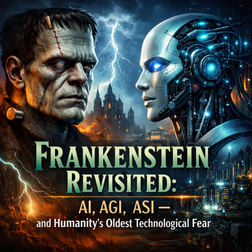
Frankenstein Revisited: AI, AGI, ASI — and Humanity’s Oldest Technological Fear

What if the real danger of artificial intelligence isn’t the technology itself, but what happens after its creators walk away? In this episode, Frankenstein Revisited: AI, AGI, ASI — and Humanity’s Oldest Technological Fear, we explore why Mary Shelley’s Frankenstein remains one of the most powerful metaphors for the age of artificial intelligence. Far from being a simple horror story, Frankenstein is a cautionary tale about creation without responsibility — a warning that feels increasingly relevant as AI systems grow more autonomous, influential, and deeply embedded in society. The discussion reframes the “monster” narrative. Frankenstein’s creature was not born violent or evil; it became destructive through neglect, rejection, and abandonment. In the same way, modern AI systems do not require malice to cause harm. Bias, misalignment, negligent oversight, and poorly defined goals are enough. When systems are trained, deployed, and scaled without ethical consideration, accountability becomes diffuse and consequences multiply rapidly. The episode examines how AI differs from previous technologies in three critical ways: scale, speed, and detachment. AI systems operate globally and instantaneously, while human governance evolves slowly. Decisions made by algorithms can affect millions in seconds, often without clear ownership of responsibility. This gap between technological capability and ethical oversight mirrors Victor Frankenstein’s fatal mistake — creating something powerful without planning for its integration into the world. A key theme explored is alignment. An AI system optimised solely for profit, efficiency, or engagement may inadvertently harm employees, users, communities, or the environment. These outcomes are not the result of rogue intelligence, but of narrow goals divorced from human values. As the episode argues, intelligence alone is not dangerous; intelligence without stewardship is. The conversation also addresses the looming thresholds of Artificial General Intelligence and Artificial Superintelligence. At these stages, AI is no longer merely a tool to be controlled. It becomes something that requires a relationship — continuous oversight, ethical frameworks, and shared responsibility. The episode challenges the popular fixation on control and rebellion, suggesting instead that co-existence, governance, and humility are the only viable paths forward. Ultimately, this episode delivers a sobering but hopeful message. AI will reflect our values, incentives, and failures. The monster is not the creation itself. The monster is what happens when creators abandon responsibility. As humanity stands at a technological inflection point, the choice is clear: repeat Victor Frankenstein’s mistake, or embrace stewardship over abandonment. The future of AI — and its impact on humanity — depends on which path we choose.

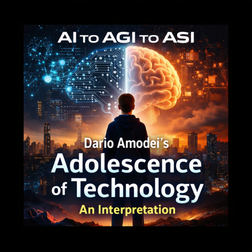
Dario Amodei's Adolescence of Technology : An Interpretation

In this episode of AI to AGI to ASI, we explore Dario Amodei’s essay “The Adolescence of Technology” — a thoughtful attempt to reframe how we understand the current phase of artificial intelligence development. Rather than portraying AI as either a miraculous breakthrough or an existential threat, Amodei proposes a more nuanced metaphor: AI is entering adolescence. It is no longer a fragile experiment, yet far from a mature, well-understood system. Like any adolescent force, it exhibits rapid growth in capability, uneven judgment, unpredictable behavior, and an expanding impact on the world around it. This episode offers a measured interpretation and critical analysis of that framing. We examine why the adolescence metaphor is powerful — particularly in how it shifts the conversation away from hype and panic toward responsibility, institutional readiness, and long-term thinking. AI systems today can reason, generate content, influence decisions, and scale cognition in ways previously unimaginable, yet they are being deployed within social, legal, and governance structures that were never designed for such capabilities. The result is a widening gap between technological power and societal preparedness. At the same time, this episode interrogates what the metaphor quietly assumes. Adolescence implies eventual maturity — but technological history offers no guarantee that all powerful systems grow into wisdom. Some plateau, some destabilize societies, and others entrench asymmetries that are never undone. The discussion explores whether framing AI as a developmental phase risks underestimating how competitive pressures, market incentives, and geopolitical rivalry can overwhelm even the best-intentioned safety cultures. We also turn to what is less emphasized in the essay: power and concentration. Who controls advanced AI systems? Who sets their defaults? Who benefits most — and who absorbs the risk when systems fail? Adolescence, whether human or technological, is often the phase where power dynamics harden rather than soften. These questions are critical to understanding AI’s long-term trajectory, yet they sit largely in the background of mainstream discourse. Crucially, this episode situates Amodei’s essay within the broader arc from AI to AGI to ASI. If we are indeed in an adolescent phase, then the norms, incentives, and institutional habits being formed right now will shape how more advanced systems behave in the future. The window for meaningful influence may be narrower than it appears — not because of any single breakthrough, but because governance, culture, and expectations tend to solidify faster than we realize. This is not a rebuttal of Amodei’s argument, nor a celebration of it. It is an interpretation — one that treats the essay as a diagnostic rather than a solution. Essays can clarify moments in history, but they cannot resolve the structural forces that define outcomes. The episode concludes with a central question that remains open: Do our institutions have the capacity to guide this technology toward maturity — or will they be reshaped by it instead? Adolescence is brief. What comes next is not automatic.

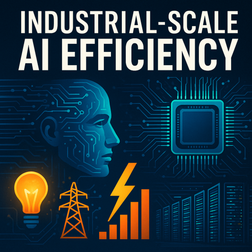
Industrial-Scale AI Efficiency!

The race toward industrial-scale “general intelligence” is no longer primarily constrained by algorithms but by compute and energy. Frontier AI labs and hyperscalers are reaching the limits of available electricity, grid capacity, cooling, and semiconductor throughput. Efficiency—not size—will determine who can deploy general intelligence at scale. Metrics such as tokens-per-watt and tokens-per-FLOP now signal real productivity per unit of energy and compute. This episode examines how the shift toward energy- and compute-bounded AI development is reshaping technology, economics, geopolitics, and governance, and provides recommendations to ensure sustainable scaling.

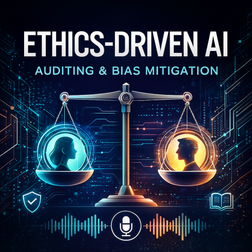
Tackling AI Bias in a Path to Fairness and Equity

We deep-dive into the growing problem of bias in AI and machine learning. We explain that AI bias is not a single flaw but a spectrum of issues emerging from multiple sources: historical bias embedded in past human decisions, representation bias caused by unbalanced datasets, measurement bias resulting from unfair or inaccurate proxies such as ZIP codes for creditworthiness, and algorithmic bias introduced during model training. Real-world failures—biased hiring systems, discriminatory lending tools, inaccurate facial recognition, and inequitable healthcare risk models—demonstrate how these issues lead to tangible harm. Our discussion emphasizes that auditing AI systems is essential to prevent discrimination, maintain regulatory compliance, and preserve public trust. It outlines key mitigation strategies: pre-processing to rebalance data, in-processing to apply fairness constraints, post-processing to calibrate outcomes, and human-in-the-loop oversight for high-stakes decisions. We stress that ethical AI requires more than technical fixes. Effective governance depends on standardized auditing practices, accountability structures, explainability, diverse datasets, and evolving regulations. Challenges include complex bias sources, resource constraints, and shifting societal expectations of fairness. Ultimately, we argue that AI bias reflects deeper societal inequalities. Ensuring fair and equitable AI demands a blend of technological intervention, ethical principles, and cultural change. Public trust hinges on transparency, independent oversight, and open dialogue. Without meaningful action, AI risks amplifying discrimination and eroding confidence in technology; with continuous commitment, however, AI can support a more just and inclusive future.

AI, Geopolitical Power, New Architecture of Global Connectivity

Humanity is standing at the edge of a technological shift more profound than the arrival of the internet, the smartphone, or even electricity. Artificial Intelligence (AI) — specifically generative AI and large-scale foundation models — is transforming into the central infrastructure of global power. Intelligence itself, once scarce and biologically bound, is becoming industrialised, abundant, and infinitely scalable.

Artifical Intelligence & Beyond: Understanding the Human Journey Ahead

Artificial Intelligence (AI) is no longer a concept reserved for science fiction. It lives in our phones, our workplaces, our homes, and increasingly, our decisions. As we move toward Artificial General Intelligence (AGI) and possibly Artificial Superintelligence (ASI), society finds itself at a defining moment. This white paper explores the human-centered themes introduced in the first episode of the podcast AI → AGI → ASI. It examines: How AI affects daily life The balance between benefits and risks Emerging social and ethical considerations Why a nuanced, lightly humorous discussion helps make sense of it all This foundation ensures listeners — and readers — understand not only what AI is becoming, but why it matters for humanity.
3 de 3