Around the Globe with Srini

Around the Globe with Srini

por Srinivasu Sala
Temporada 1

Uruguay: From World Cup Glory to Coastal Beauty

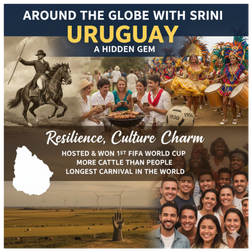
#Uruguay #Podcast #AroundTheGlobe #SouthAmerica #Culture #Travel #History #Geography #Montevideo #PuntaDelEste #Carnival #Mate #Fútbol #RenewableEnergy "In this episode of Around the Globe with Srini, we journey to Uruguay — a small South American nation with a big story to tell. Known as the hidden gem of the continent, Uruguay blends resilience, tradition, and progress in ways that make it truly unique. We’ll explore Uruguay’s history, from the indigenous Charrúa people and the fight for independence led by José Gervasio Artigas, to its turbulent civil wars and eventual rise as one of Latin America’s most stable democracies. Culturally, Uruguay bursts with life: the rhythms of candombe drumming, the dazzling Carnival celebrations, and the everyday ritual of sharing mate. We’ll dive into the national love for fútbol, remembering Uruguay’s historic World Cup victories in 1930 and 1950, and savor the traditions of asado, the beloved barbecue that brings families together. Meet the people of Uruguay, known for their warmth, hospitality, and strong sense of community. Discover how European immigration shaped the nation’s identity, while indigenous and African influences enriched its diversity. We’ll also uncover Uruguay’s economy, built on agriculture, livestock, and exports like beef and wool, while highlighting its global leadership in renewable energy. Then, we’ll travel across Uruguay’s geography and natural wonders — from rolling plains and fertile farmland to the stunning Atlantic coastline, with highlights like Punta del Este, Cabo Polonio, and Santa Teresa National Park. And of course, we’ll share some fun facts: Uruguay hosted and won the very first FIFA World Cup, has more cattle than people, boasts one of the highest literacy rates in Latin America, and enjoys the longest Carnival in the world. Uruguay’s story is one of resilience, culture, and charm — proof that even the smallest nations can shine brightly on the global stage. Join me as we uncover the traditions, people, and landscapes that make Uruguay unforgettable."

Argentina: Tango, Fútbol, and Resilience

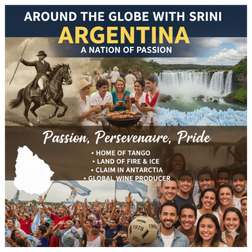
#Argentina #Podcast #AroundTheGlobe #SouthAmerica #Culture #Travel #History #Geography #BuenosAires #Patagonia #AndesMountains #Tango #Mate #Fútbol In this episode of Around the Globe with Srini, we explore Argentina — a nation of passion, resilience, and contrasts. From the fight for independence and the legacy of Perón to the triumphs of democracy, Argentina’s history is as dramatic as its tango. We’ll uncover the vibrant culture shaped by fútbol, music, and the beloved asado barbecue, while meeting the Argentine people whose warmth and pride shine through daily life. Journey across Argentina’s breathtaking geography — from the thunderous Iguazú Falls to the icy glaciers of Patagonia and the fertile Pampas plains. Discover how its economy, built on agriculture, wine, and industry, continues to evolve despite challenges. Along the way, we’ll share fun facts that make Argentina unforgettable, from its love of mate to its claim in Antarctica. Argentina’s story is one of passion, perseverance, and pride — a country that dances between tradition and modernity while leaving a lasting mark on the world.

Chile Unfolded: History, Culture, and People

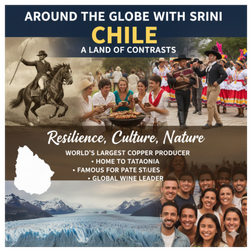
#Chile #Podcast #AroundTheGlobe #SouthAmerica #Culture #Travel #History #Geography #HiddenGem #WineCountry #AndesMountains #Valparaíso #Patagonia "Hello everyone, I’m Srini. Welcome to our journey across the world. Today, we’re heading to South America to discover Chile — a land of breathtaking landscapes, rich traditions, and fascinating history. Let’s dive into the wonders of Chile together." History: Resilience and Renewal Chile’s story stretches back thousands of years. Long before Europeans arrived, it was home to indigenous peoples like the Mapuche, who resisted foreign domination for centuries. In the 16th century, Spanish conquistadors began colonizing the region; Chile remained under Spanish rule until 1818, winning independence after a struggle led by figures like Bernardo O’Higgins. The 19th century focused on nation-building, while the 20th century brought both progress and turmoil. Chile became famous for natural resources, especially copper, but also endured political upheaval—most notably the military dictatorship of Augusto Pinochet (1973–1990). In recent decades, Chile has transformed into one of South America’s most stable nations, balancing its complex past with a vibrant democracy. Culture: A Rich Tapestry Chilean culture is a blend of indigenous traditions, Spanish colonial heritage, and European influences. At its heart are the Mapuche people, whose resilience shapes the national spirit. Iconic symbols include the huaso (cowboy) and the national dance, the cueca. Festivals like La Tirana are vibrant displays of religious music and dance. Food and drink are essential—Chile is world-renowned for its wine, seafood, and the national spirit, pisco. Culturally, the country is diverse: the north reflects desert traditions, the central region emphasizes folk music, and the south showcases German and Mapuche influences. People and Society Chile is home to nearly 20 million people. The population is a mix of indigenous groups, European descendants, and recent immigrants. Beyond the Mapuche, groups include the Aymara in the north and the Rapa Nui on Easter Island. Chileans are known for warmth and a strong sense of community. Family gatherings often revolve around food and music. While most speak Spanish, indigenous languages survive in specific regions. Today, Chile is a modern society with a median age of 37 and a high life expectancy, with most citizens living in urban hubs like Santiago, Valparaíso, and Concepción. Economy: Strength and Stability Chile’s economy is one of Latin America's strongest, defined by open-market policies and global connectivity. It has signed numerous free trade agreements with the U.S., China, and the EU. The backbone of the economy is mining. As the world’s largest copper producer, Chile provides about a quarter of global output. Beyond minerals, Chile thrives in agriculture—exporting world-class wines and fruits—while Santiago serves as a hub for finance and tech. With a GDP of roughly $363 billion, Chile ranks high on the Human Development Index, though it continues to work on reducing inequality and adapting to green energy.
3 de 3