AI Change Desk

AI Change Desk

por Michael Hanna-Butros Meyering

AI Change Desk | EP016: National Capacity Check

Bonus
This week is not really a feature week. It is a capacity week. Anthropic's compute expansion, Project Glasswing, and Microsoft's nation-scale AI commitments in Japan and Singapore all point to the same shift: compute, defense, and skills are starting to move together. Anthropic expanded its Google Cloud and Broadcom partnership to secure multiple gigawatts of additional TPU capacity starting in 2027. Anthropic launched Project Glasswing, a defensive cybersecurity initiative with more than 40 organizations, up to $100 million in credits over five years, and access to non-public defensive model support. Microsoft paired nation-scale AI infrastructure and workforce commitments in Japan and Singapore, including infrastructure investment, cybersecurity collaboration, and large-scale skills programs. If the serious players are organizing compute, security, and skills together, AI is no longer just another software category. That means leaders need to think about provider concentration, defensive coordination, and workforce readiness as one operating board instead of three separate conversations. Name your top two AI-provider dependencies. Identify one workflow where provider concentration is now a real operating risk. Confirm who owns external AI-safety or cyber-intake if a report lands. Check where AI training is actually happening, not just where it is theoretically available. Write down one future-access assumption your team is making without evidence. Anthropic: Google/Broadcom partnership on compute (link) Reuters: Anthropic expands Google and Broadcom partnership on AI compute (link) Anthropic: Project Glasswing (link) The Verge: Anthropic launches Project Glasswing (link) Microsoft: Japan AI infrastructure, cybersecurity, and workforce commitment (link) Microsoft: Singapore AI access and skills commitment (link) Reuters: Microsoft to invest $10 billion in Japan for AI infrastructure and skills (link) The Straits Times: Microsoft to invest more in Singapore and expand AI skilling (link) This is operational analysis, not legal advice. AI-assisted tools may be used in parts of the research and production workflow. Final editorial judgment, risk posture, and release approval stay human-led.

AI Change Desk | EP015: Retained Artifact Check

AI CHANGE DESK | EP015: RETAINED ARTIFACT CHECK AI work no longer disappears when the chat ends. This week's main episode looks at what changes when AI artifacts stick around: files stay in Library until deletion, model cutovers need verification after the deadline passes, open-model options are getting more credible, pricing shifts can show up as same-week variance, and outside-in safety reporting only helps if someone owns intake. EPISODE SUMMARY The point for EP015 is simple: once AI work survives the session that created it, convenience has already turned into ownership. That means retention, reuse, verification, deletion, cost review, and safety intake all need named owners instead of vague good intentions. WHAT CHANGED THIS WEEK • OpenAI's File Library guidance makes it clear that uploaded and created files can persist in ChatGPT until users delete them manually. • The GPT-4o Custom GPT cutoff is now past the April 3 line, which means teams should be doing post-cutoff verification instead of waiting for a migration window. • Google's Gemma 4 launch makes hosted-versus-open optionality more practical, not just theoretical. • OpenAI's built-in tool session pricing is now live, while the Safety Bug Bounty keeps outside-in reporting active. WHAT THIS MEANS FOR OPERATORS Treat retained AI artifacts like reusable work objects, not disposable prompt residue. If a file, prompt pattern, or Custom GPT behavior can carry forward into next week, it needs a retention tier, a deletion expectation, and a named owner who can answer for reuse. WHAT I'D DECIDE BY FRIDAY • Name one owner for retained-file policy in the workflows that matter most. • Run a post-cutoff verification pass on the Custom GPTs people actually depend on. • Check same-week cost variance on any workflow touching built-in tool sessions. • Name a real intake owner and SLA for outside-in safety or abuse reports. • Decide whether one open-model evaluation lane is worth running this quarter. LISTENER QUESTION What is your team currently keeping, reusing, or routing forward through AI systems without a named owner? SOURCES • OpenAI release notes: https://help.openai.com/en/articles/6825453-chatgpt-release-notes • OpenAI File Storage and Library: https://help.openai.com/en/articles/20001052-file-storage-and-library-in-chatgpt • OpenAI Business / Enterprise model limits: https://help.openai.com/en/articles/12003714-chatgpt-business-models-limits • Google Gemma 4 announcement: https://blog.google/innovation-and-ai/technology/developers-tools/gemma-4/ • Google for Developers coverage: https://developers.googleblog.com/en/gemma-4/ • OpenAI API pricing: https://openai.com/api/pricing/ • OpenAI developer pricing docs: https://developers.openai.com/api/docs/pricing • OpenAI Safety Bug Bounty: https://openai.com/index/safety-bug-bounty/ • OpenAI company announcements: https://openai.com/news/company-announcements/ DISCLOSURE AI-assisted tools were used in research, packaging, and production support. Final editorial judgment, release approval, and risk decisions remain human-led.
AI Change Desk | EP014: Commerce Surface Check

Bonus
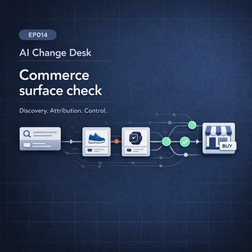
ChatGPT is becoming a product-discovery surface, not just a side assistant. This episode looks at what changes when shoppers start comparing products inside AI before they ever land on a retailer site, and what operators should measure before they confuse visibility with conversion. OpenAI upgraded shopping in ChatGPT on March 24, 2026 with richer product comparisons, image-based finding, and better data freshness and coverage. Shopify said millions of merchants can now sell in AI chats, with ChatGPT referral attribution and merchant-of-record control. Sephora launched an app in ChatGPT tied to beauty guidance, loyalty benefits, and future in-app checkout. A new surface matters when it changes where decisions begin. If discovery starts in AI before it starts on your site, your old reporting stack only sees the second half of the journey. That means product data quality, merchant attribution, and category readiness matter more than another generic “we show up in AI” status update. Pick one category where comparison behavior is already common. Audit titles, attributes, images, price accuracy, reviews, and availability. Define an AI-originated attribution view before the internal story turns into vibes. Decide whether you are optimizing only for discovery or for deeper merchant-side experiences too. Put one owner on the workflow. OpenAI: Powering Product Discovery in ChatGPT (link) OpenAI Help Center: ChatGPT Release Notes (link) Shopify: Millions of merchants can sell in AI chats (link) Sephora Newsroom: Sephora App in ChatGPT Brings a New Personalized Beauty Experience (link) OpenAI Help Center: Shopping with ChatGPT Search (link) This is operational analysis, not legal advice. AI-assisted tools may be used in parts of the research and production workflow. Final editorial judgment, risk posture, and release approval stay human-led.

AI Brief | EP010: Evaluation and Ownership Check

Bonus
If Episode 9 was about hardening controls, Episode 10 is about making those controls survive real handoffs. AWS published a stakeholder-focused guide for operationalizing agentic AI, reinforcing that ownership must be explicit before scale. YouTube expanded likeness-detection protections for civic leaders and journalists, signaling that identity-integrity response is now an operating requirement. Anthropic announced a Sydney APAC office expansion, reinforcing that control design must travel across regions without losing clarity. "Approved app" is no longer enough; action-level workflow gates are the unit of control. Detection tools are useful, but they fail without named routing, pause authority, and response ownership. Handoffs are the drift zone: reviewer ambiguity, escalation lag, and rollback uncertainty. Pick top two high-impact AI workflows. Assign four named owners per workflow: approver, pause owner, rollback owner, public-response owner. Add one hard gate: no owner, no launch. Run one impersonation tabletop and log decisions. Ship a one-page operator memo (changes, approvals, restrictions, exceptions, next review date). AI-assisted tools were used in parts of research and production support. Final editorial judgment and release approval remained human-led. This is operational guidance, not legal advice. https://aws.amazon.com/blogs/machine-learning/operationalizing-agentic-ai-part-1-a-stakeholders-guide/ https://blog.youtube/news-and-events/expanding-our-likeness-detection-tools-to-protect-civic-leaders-journalists-and-more/ https://techcrunch.com/2026/03/10/youtube-ai-deepfake-detection-politicians-government-officials-journalists/ https://www.anthropic.com/news/sydney-fourth-office-asia-pacific

AI Change Desk | EP009: Control Hardening Week

AI CHANGE DESK | EP009: CONTROL HARDENING WEEK EPISODE SUMMARY This episode translates this week’s control signals into one operator contract: • legal claim confidence, • monitoring evidence, • suite-level governance assumptions, • and fallback ownership. This is the bridge from: • Episode 5 (access control), • Episode 6 (continuity), • Episode 7 (security workflow contract), • Episode 8 (release validation). WHAT CHANGED THIS WEEK 1. OpenAI published a legal notice on unauthorized equity transactions (Mar 12, 2026). 2. Anthropic launched The Anthropic Institute and expanded policy posture signals (Mar 11, 2026). 3. NIST advanced practical guidance for monitoring deployed AI systems (Mar 6 + Mar 9, 2026). 4. Microsoft framed Agent 365 + E7 Frontier as an integrated intelligence/trust operating model (Mar 9, 2026). 5. Podbean switched off dynamic ad insertion in EEA/EU/UK, highlighting continuity dependency risk (Mar 10, 2026). OPERATIONAL TRANSLATION • If a vendor claim cannot be evidenced, treat it as risk until validated. • Monitoring must be release-adjacent and reconstructable, not dashboard-only. • Suite selection is an operating-model decision, not only a capability decision. • Continuity planning must cover policy/platform dependency changes, not just system outages. MONDAY ACTION BLOCK (45 MINUTES) 1. Triage this week’s legal/monitoring/suite/continuity signals. 2. Exposure-map top five workflows. 3. Lock owners for thresholds, exceptions, rollback, and communications. 4. Send one operator memo: changed / approved / restricted / exception path. 5. Set due dates and next review checkpoint. LISTENER QUESTION Where is your highest exposure this week: • claim confidence, • monitoring evidence, • or fallback ownership? WATCH + LISTEN • Episode hub: https://michaelhbm.com/AiChangeDesk • YouTube channel: https://www.youtube.com/@AIChangeDesk • RSS feed: https://media.rss.com/aichangedesk/feed.xml • Apple Podcasts: https://podcasts.apple.com/us/podcast/ai-change-desk/id1876677295 • Spotify: https://open.spotify.com/show/5X1sLLTeULqFCdt7aaisGD SOURCES • https://openai.com/policies/unauthorized-openai-equity-transactions/ • https://www.anthropic.com/news/the-anthropic-institute • https://www.axios.com/2026/03/11/anthropic-dc-presence • https://www.nist.gov/news-events/news/2026/03/new-report-challenges-monitoring-deployed-ai-systems • https://www.nist.gov/publications/challenges-monitoring-deployed-ai-systems-center-ai-standards-and-innovation • https://blogs.microsoft.com/blog/2026/03/09/introducing-the-first-frontier-suite-built-on-intelligence-trust/ • https://www.microsoft.com/en-us/security/blog/2026/03/09/secure-agentic-ai-for-your-frontier-transformation/ • https://podnews.net/update/podbean-switches-off-dai • https://www.reddit.com/r/podcasting/comments/1rozrcy/dynamic_ads_policy_change/ DISCLOSURE AI-assisted tools were used in parts of research and production support. Final editorial judgment, risk posture, and release approval remained human-led. This is operational guidance, not legal advice.
5 de 5