POSITIVE PEOPLE NEVER GIVE UP

POSITIVE PEOPLE NEVER GIVE UP

por Mr. Postive, M.A., MAPL — Graduate Student, M.S. Education
Temporada 17
I am Stupid — Please Help Me
Group Mini‑Lesson: “We Don’t Quit Here” Learning Objective Group members will identify one shared “quit message” and replace it with a collective resilience statement. Example: Quit message: “We always struggle with this.” Resilience statement: “We grow stronger together every time we try.” Learning Outcome Participants will demonstrate the ability to support one another by reframing negative group self‑talk into positive, action‑based language. Example: Negative: “We’re not good at finishing things.” Reframed: “We finish more when we help each other stay accountable.” 5E Learning Model (Group Version) Engage (2 minutes) Place the phrase in the center: “I Am Stupid — Can’t Learn — Please Help.” Ask the group: How does this statement feel when someone in the group says it? This opens empathy and connection. Explore (3 minutes) Each person shares one “quit message” they’ve heard in the group. Examples: “We’re not smart enough.” “We always mess things up.” “We never get things right.” This builds honesty and trust. Explain (4 minutes) Facilitator teaches: Groups often pass down quit habits without noticing. Failure is information, not identity. Groups grow stronger when they reframe together. Elaborate (5 minutes) As a group, pick one quit message and rewrite it into a group resilience statement. Example: Quit: “We give up too fast.” Resilience: “We stay in the fight because we don’t struggle alone.” Have each person say the new statement aloud. Evaluate (3 minutes) Group members share one way they will help someone else not quit this week. This shifts the lesson from individual to collective responsibility. Formative Assessment Group Reflection Card: Each person completes the sentence: “Today I learned our group becomes stronger when we…” Collected responses show: Understanding of resilience Ability to reframe Commitment to supporting one another
Receive Up to $110,000 Toward a Home
To Be a Guest on This Podcast Call 773-809-8594 Dreaming of owning a home in St. Paul but worried about the upfront costs? This episode is for you! Join Estrella Carter, The House Lady with The Stellar One Group at Coldwell Banker Realty, as she sits down with Kevin Murray, Mortgage Loan Originator with Planet Home Lending, to discuss the newly released St. Paul Down Payment Assistance Program and what it could mean for aspiring homeowners. In this episode, we cover: What the new program is and why it was created Who may qualify How much assistance may be available (up to $110,000) Down payment and closing cost assistance Home inspection reimbursement Whether first-time homebuyer status is required How this program can be combined with other assistance programs The application process and important timelines Common myths about down payment assistance Steps buyers should take now before funding is exhausted If you’ve been waiting for the right opportunity to purchase a home or know someone who has - this conversation is one you won’t want to miss. For more information call 651.338.4207 estrella.carter@cbrealty.com http://estrellacarter.com/

Treatment: Alcoholism/Drugs & Personal Power
Share This Episode with People That Need To Listen. 11 Ways to Choose God Instead of Relapse When You’re Alone 1. Remember God’s Love in the Moment of Temptation (John 3:16) When the urge hits, pause and remind yourself: God still loves me right now. Temptation grows strongest when a person forgets they are loved. Recalling God’s love interrupts the separation that leads to relapse. 2. Tell the Truth About the Struggle Instead of Hiding It (Romans 3:23) “All have sinned…” means you don’t have to pretend. Admitting the struggle out loud — even if only to God — breaks the secrecy that fuels relapse. Honesty is the doorway back to connection. 3. Use the Authority God Already Gave You (John 1:12) You have the right to choose differently. Speak it: I have authority to walk away from this. Authority unused becomes relapse; authority exercised becomes recovery. 4. Replace the Escape With a Scripture You Can Say Out Loud When the group show is gone, your voice becomes your weapon. Speak one line: “God so loved the world…” “All have sinned…” “By His wounds I am healed…” “He gave the right…” Speaking Scripture disrupts the mental pattern that leads to relapse. 5. Change Your Physical Position Immediately Relapse often begins with stillness. Stand up. Walk. Step outside. Move your body. Movement breaks the chain between thought and action. 6. Call One Person Who Knows the Real You Not the group version. Not the testimony version. The real you. Connection kills isolation, and isolation is where relapse grows. 7. Pray a Short, Honest Prayer Instead of a Long Religious One God doesn’t need performance. Say: God, I’m struggling. I need You right now. Honesty reconnects you faster than religious language. 8. Identify the Lie Behind the Temptation Every relapse begins with a lie: “I need this.” “I can handle this.” “No one will know.” Name the lie. Naming it breaks its power. 9. Choose a Healing Action That Matches 1 Peter 2:24 “By His wounds you were healed.” Healing requires action: Drink water Take a shower Read one verse Step outside Write one sentence Small healing actions reinforce the larger spiritual healing Christ already provided. 10. Remove the Object of Temptation From Your Immediate Reach Relapse is often proximity-based. If it’s near you, it owns you. Distance creates clarity. Clarity creates strength. Strength creates obedience. 11. Ask Yourself the Question That Defines Your Essay “The group show is gone. What are you going to do?” This question forces the person to confront the truth: Recovery is not what they say in the group. Recovery is what they choose when they are alone. John 3:16 — Remember God’s love Romans 3:23 — Tell the truth about the struggle 1 Peter 2:24 — Walk in healing John 1:12 — Use your authority Contact: radiotalklr@gmail.com
Elizabeth Brown is a Financial Educator and Pre-Planning Specialist
See My Book: https://www.barnesandnoble.com/w/relationships-the-power-of-illusion-lucky/1149325667?ean=9781663277930 To be a guest on the podcast call 773-809-8594 Elizabeth Brown is a Financial Educator and Pre-Planning Specialist who has worked with families across the United States to help them achieve financial security and peace of mind. Her primary base is Minnesota. As a financial educator and pre-planning specialist, Elizabeth works closely with individuals and families who are interested in learning more about financial protection, including the “new” life insurance, health insurance, pre-planning, retirement, and more—for both the present and the future. Elizabeth guides clients through the process, explains the short- and long-term benefits of strategic planning, and helps identify the best path forward for each unique situation. Please don’t hesitate to contact Elizabeth with any additional questions! https://clients.firstfinancialsecurity.com/JW1714 https://calendly.com/elizabethbrownffs/30min To be a guest on the podcast and share what you are doing call Mr. Positive- 773-809-8594
Professor: Dr. James Robinson-Introducing Black Studies
To Be a Guest on This Podcast call 773-809-8594 Lesson Plan: Black Studies & Voice — Featuring Dr. James A. Robinson Learning Objective (1) For the Worksheet That Goes with This Lesson Plan email: radiotalklr@gmail.com Students will analyze how Black Studies is defined, practiced, and shared by examining Dr. Robinson’s scholarship and the Metro State Black Student Achievers Podcast as parallel forms of knowledge production. Example: A student explains how Robinson’s research on Black railroad labor and the podcast’s student stories both recover voices often excluded from mainstream narratives. Learning Outcome (1) Students will identify one way Black Studies empowers communities and provide evidence from either Robinson’s work or a podcast episode. Example: “The podcast shows how Black students narrate their own academic journeys, which aligns with Robinson’s learner‑centered approach.” 5E Learning Model Engage Play a 30–45 second clip from the Metro State Black Student Achievers Podcast. Ask: Whose voices are centered here? Why does that matter? Explore Students read short excerpts from Dr. Robinson’s biography. In groups, they connect his work to the podcast’s mission: defining Black Studies, elevating community knowledge, and documenting lived experience. Explain Students answer: What is Black Studies? Where is it learned? They use evidence from Robinson’s research AND the podcast’s storytelling. Elaborate Students map the eight guiding questions onto the podcast: e.g., What do students learn in Black Studies? How does the podcast model that learning? Evaluate (Formative Assessment) Exit Ticket: “Using Dr. Robinson’s work or a podcast episode, explain why Black Studies is important for students and communities.”
Tia and Yolonda-Top 2 Bottom Fashions
For A Copy of My Book: www.weusoursluckybooks.com Top To Bottom Fashions - 763-951-2857 Visit the Location 3310 Brookdale Dr. N. Brooklyn Park MN 55433 763-951-2857 To be a guest on the podcast and share what you are doing call: 773-809-8594
Ms. Edget: Africa and Black USA Unity
For A Copy of My Book: www.weusoursluckybooks.com To Be a Guest on The Podcast call: 773-809-8594 Lesson Plan — “Tikar Sew” (Teddy Afro) Theme: Unity, justice, and national healing in Ethiopian society. Learning Objectives (with examples) Analyze how the song uses historical references to promote unity. Example: Students identify a lyric that references past conflict and explain how it calls for reconciliation. * Interpret the cultural symbolism in the song’s imagery. Example: Students explain how references to “the people” or “the land” symbolize shared identity. Learning Outcomes (with examples) Students will explain the song’s message about collective responsibility. Example: A student states how the chorus encourages citizens to care for one another. Students will connect the song’s themes to modern social issues. Example: A student compares the song’s call for unity to current community tensions or divisions. 5E Learning Model Engage: Play the opening section; ask students what emotions or images they immediately feel. Explore: Students discuss Ethiopia’s historical struggles and how artists use music to address national healing. Explain: Break down key lyrics and visuals from the music video, focusing on unity, justice, and shared humanity. Elaborate: Students create a short reflection, poem, or sketch showing how “Tikar Sew” applies to their own community’s challenges. Evaluate: Students share their work and explain how their piece reflects the song’s message of unity and responsibility. Formative Assessment One‑minute written response: “What message from ‘Tikar Sew’ is most important for society today, and why?” Evaluate for clarity, connection to the song, and evidence of critical thinking.
Temporada 15
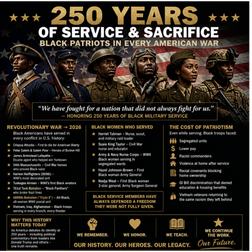
250 YEARS: BLACK PATRIOTS MATTER
Order My Book: www.weusoursluckybooks.com Contact; radiotalklr@gmail.com Lesson Plan: 250 Years of Black Military Service Objective 1: Students will explain how Black Americans have served in every U.S. war from the Revolution to today. Example: A student identifies the 54th Massachusetts, the Harlem Hellfighters, and the 6888th Battalion and states how each advanced American democracy. Objective 2: Students will evaluate how racism shaped Black veterans’ experiences during and after service. Example: A student explains how Vietnam veterans returned to racial covenants, GI Bill discrimination, and unequal access to housing and education. Learning Outcomes Outcome 1: Students will produce a short written or verbal explanation of how Black service members showed patriotism despite barriers. Example: A student describes how the 54th fought for a nation that denied them equal pay. Outcome 2: Students will connect past discrimination to modern debates about equity and national memory. Example: A student explains how GI Bill exclusion contributed to the racial wealth gap still visible today. Student Challenge (Instructor Must Complete) Students challenge the instructor to identify one overlooked Black military figure or unit not covered in class and explain their contribution in under 60 seconds. If the instructor cannot answer, students choose the next figure or topic for class exploration. 5E Learning Model Engage: Students examine images of Black soldiers from the Revolution, Civil War, WWI, WWII, Vietnam, and modern conflicts. Prompt: “What patterns do you see across time?” Explore: Students rotate through stations on the 54th Massachusetts, Harlem Hellfighters, Tuskegee Airmen, the 6888th, and Vietnam veterans facing discrimination. Explain: Students share findings. Instructor clarifies themes: service in every war, racism in the ranks, denied benefits, and the contradiction between service and citizenship. Elaborate: Students respond to: “How does recognizing 250 years of Black service change our understanding of American democracy?” They must use two historical examples. Evaluate (Formative Assessment): Exit Ticket: Name one Black military unit or figure and explain their contribution. Describe one form of discrimination Black veterans faced and its impact.
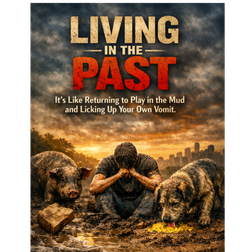
Bump The Past Bullshit
PERSONAL CHANGE WORKSHEET 1. What Part of My Past Keeps Pulling Me Back? Describe the habit, mindset, or behavior you keep returning to. 2. What Does “My Mud” Look Like? Identify the specific behavior that keeps you stuck. Example: snapping in anger, shutting down, avoiding responsibility. 3. What Is “My Vomit”? What harmful action or pattern do you keep returning to even though it hurts you? 4. What Trigger Pulls Me Back Into It? List the situations, people, or emotions that send you into the old cycle. 5. What New Behavior Will Replace the Old One? Be specific and realistic. Reality Therapy (WDEP) Self‑Assessment W – WANT: What do I truly want to change in my life? D – DOING: What am I doing right now that keeps me stuck? E – EVALUATE: Is what I’m doing helping me get what I want? □ Yes □ No Explain: P – PLAN: What is my next clean step forward TODAY? Comments: radiotalklr@gmail.com Order My Book: radiotalklr@gmail.com
507-593-9775 Call and Listen Now
Tell Another Positive Person About This Message Line Black History Is American History — No Permission Required Black People do not need consent to learn the truth about their own history. Learning about Black Patriots, Black brilliance, and Black resistance is not optional — it is essential to understanding America itself. Asking for “permission” to teach Black history sends the wrong message. It suggests that truth needs approval. It suggests that identity must be softened. It suggests that pride must be negotiated. We reject that. Stand tall. Stand informed. Stand honorable. Black USA, your history is not a side note — it is a foundation of this nation. Say it with your chest: “I’m Black and I’m proud.” And mean it every day. Tell Another Black American About This Podcast and Message Line. Comments: radiotalklr@gmail.com
1 de 10