Traversing the Strange World

Traversing the Strange World

por Isaiah Danberry
Temporada 5

The Good Life According to Viktor Frankl: Meaning, Freedom and Responsibility

What makes a life worth living when suffering cannot be avoided? In this episode of Monday Mornings with Peace, we take a focused look at Viktor Frankl’s philosophy of meaning and the system of psychotherapy he developed known as logotherapy. We explore freedom of will, the will to meaning, the three paths through which meaning can be discovered, and Frankl’s ideas of self-transcendence and tragic optimism. Frankl’s philosophy offers no promise of a painless life. Instead, it asks how we might live with purpose, love with greater attention, and remain responsible for who we become—even when we cannot control what happens to us.

From the Cave to the Stars: Civilization, AI & the Future of Humanity

IA
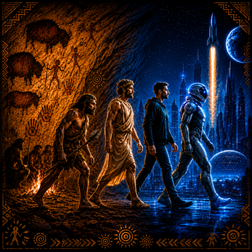
From hunter-gatherers and the first agricultural societies to artificial intelligence, biohacking, and the possibility of becoming a space-faring species, this episode traces the strange path of human civilization. We explore the Cognitive Revolution, agriculture, the rise of cities, Rousseau and Hobbes on human nature, industrialization, and the technological world we now inhabit. The central question is simple: what do we do with the knowledge we gain? Every new tool gives humanity more power, but power never tells us how it should be used. From the first stick lifted from the ground to AI, genetic engineering, and future spacecraft, the choice remains ours. History shows us what human beings are capable of. The future will show us what we choose to become.

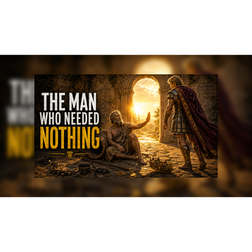
The Man Who Needed Nothing | Diogenes and the Good Life

IA
What if the good life begins by needing less from the world? In this episode of Monday Mornings with Peace, we explore the radical philosophy of Diogenes of Sinope, the ancient Greek Cynic who rejected wealth, status, luxury, social approval, and many of the conventions people around him treated as essential. We look at the original meaning of Cynicism, the famous story of Diogenes telling Alexander the Great to move out of his sunlight, his commitment to fearless honesty, living according to nature, freedom from social expectations, and the idea that unnecessary dependence can become a form of slavery. Diogenes lived with almost nothing, yet believed himself freer than kings. This episode asks a simple but uncomfortable question: How much of what we call a good life is actually ours—and how much was handed to us by society?

Escaping the Matrix: Freedom, Propaganda & the Patterns That Control Us

IA
What does it actually mean to be free? In this episode of Traversing the Strange World, we explore the Matrix not as a machine, but as the layers of influence that shape how we see reality: propaganda, political tribalism, family patterns, unconscious habits, identity, and inherited beliefs. Using Plato, Erich Fromm, Carl Jung, and Socrates, we ask whether freedom means escaping influence—or becoming conscious enough to examine it. Can we question culture without becoming contrarian? Can we leave one tribe without entering another? Can we break generational patterns without losing ourselves in the process? Maybe there is no final escape. Maybe freedom is the lifelong discipline of examining the code.

The Good Life According to Machiavelli | Power, Fortune & Virtù

IA
What does the good life look like through the eyes of Niccolò Machiavelli? In this episode of Monday Mornings with Peace, we explore Machiavelli beyond the stereotype of manipulation and ruthlessness. We examine his ideas of virtù, Fortuna, power, adaptability, courage, reputation, and survival—and ask what they can teach us about living well in an unpredictable world. Machiavelli believed that good intentions alone are not enough. To survive reality as it actually is, we must learn to see clearly, prepare for chaos, act decisively, and adapt when circumstances change. We’ll explore why Machiavelli admired capability over innocence, what he meant by the lion and the fox, and the uncomfortable question at the center of his philosophy: Can a person live a truly good life without becoming strong enough to survive the world as it actually is?

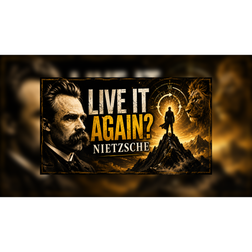
Live It Again? | Nietzsche on Will to Power, the Übermensch & Eternal Recurrence

IA
What if the real goal of life is not to escape struggle—but to become someone who would willingly choose the struggle again? In this episode of Traversing the Strange World, we explore Friedrich Nietzsche’s most powerful ideas: the Will to Power, the Übermensch, self-overcoming, ressentiment, the Last Man, the Camel, Lion and Child, amor fati, and eternal recurrence. Nietzsche saw humanity as unfinished. A bridge between what we have been and what we might become. So what happens when inherited beliefs collapse? When old values no longer hold? When certainty disappears? Do we retreat into comfort? Do we become consumed by resentment? Or do we become creators? This episode explores Nietzsche’s challenge to overcome the self, confront suffering, create meaning, and build a life so fully embraced that—even if every triumph, failure, heartbreak, ordinary morning, and hard-earned victory had to repeat forever—we could still look at existence and say: Again. Because perhaps the goal is not a life without suffering. Perhaps it is a life in which the suffering, adventure, failure, love, and struggle forge something worth becoming. The strange world does not become easier. You become more capable of traversing it.

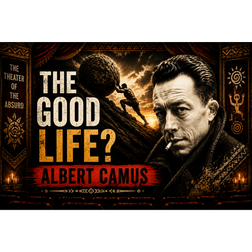
Albert Camus and the Good Life: The Absurd, Sisyphus & How to Live

IA
What does it mean to live a good life when you may never know why you’re here? In this episode of Monday Mornings with Peace, we continue our exploration of the good life through the philosophy of Albert Camus. Camus looked directly at what he called the Absurd—the collision between humanity’s hunger for meaning and a universe that may never provide us with an answer. But rather than surrendering to nihilism or despair, Camus discovered something surprisingly life-affirming within that uncertainty. Through lucidity, revolt, freedom, and passion, we explore what it means to stop waiting for existence to explain itself and begin participating fully in the life already in front of us. Finally, we climb the mountain with Sisyphus—the man condemned to push his stone uphill only to watch it fall again—and discover why Camus believed we must imagine him happy. Maybe the good life isn’t about finally discovering the meaning of existence. Maybe it’s about looking directly into the mystery, accepting that the stone will fall again… and choosing to walk back down the mountain.

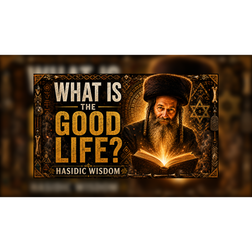
What Is the Good Life? | Hasidic Wisdom on Joy, Meaning & Presence

IA
What does it mean to live a good life? In this episode of Monday Mornings with Peace, we begin a new journey through that question by exploring the answer offered by Hasidic Judaism. Drawing from the teachings of the Baal Shem Tov, Rebbe Nachman of Breslov, and the wider Hasidic tradition, we explore four pillars of the good life: joy, attention, meaning in ordinary life, and honest self-examination. Hasidic thought does not imagine the good life as one free from hardship. Instead, it asks how we can remain fully alive within the life we have—how to take sorrow seriously without surrendering to it, how to guard our attention, how to make ordinary moments meaningful, and how to let the world around us become a mirror for our own growth. Each week in this new arc, we’ll ask a different philosopher, spiritual tradition, or culture the same question: What does the good life look like through their eyes—and what can we learn from it for our own lives? A reflective episode for anyone interested in philosophy, self-development, Jewish wisdom, spirituality, psychology, meaning, and the art of living well.

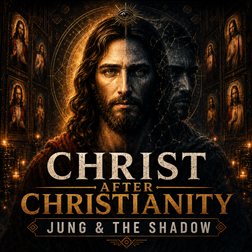
Christ After Christianity: Carl Jung, the Shadow, and the Self

IA
What remains of Christ after traditional faith and religious certainty begin to collapse? In this episode of the Thursday Journal, we explore Jesus through the psychology of Carl Jung—not only as the central figure of Christianity, but as an archetype of the Self, sacrifice, shadow, death, rebirth, and psychological transformation. The wilderness becomes a confrontation with temptation. The cross becomes the death of the false self. The resurrection becomes a symbol of what can emerge after suffering, deconstruction, and the collapse of an old identity. We also examine Jung’s warning about the Christian shadow: the pride, aggression, doubt, desire, and hunger for power that religious people may reject within themselves and project onto sinners, outsiders, and enemies. Can Christ remain meaningful after biblical literalism and institutional Christianity fall away? Can the symbol survive even when certainty does not? This episode is part of a five-part series exploring alternative paths after religious deconstruction through psychology, philosophy, spirituality, and the search for meaning.

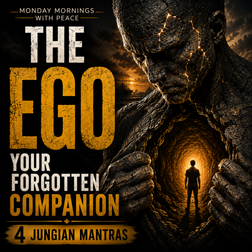
The Ego, Your Forgotten Companion: 4 Jungian Mantras for Seeing Yourself Clearly

In this episode of Monday Mornings with Peace, we explore Carl Jung’s view of the ego—not as an enemy to destroy, but as a wounded and necessary companion traveling beside us through life. Through four Jungian mantras, we examine how the ego shapes identity, builds the persona, seeks recognition, protects old wounds, and sometimes becomes loud when it feels unseen. We also explore the deeper relationship between narcissism, insecurity, the unconscious, and the lifelong process of becoming whole. This episode asks difficult but compassionate questions: When does confidence become ego inflation? When does identity become performance? Why does the loudest part of us often feel the most wounded? And what happens when we finally listen to the ego instead of either obeying it or hating it? Drawing from Jungian psychology, shadow work, self-awareness, and personal growth, this reflection offers a more complex way to understand your inner narcissist—and the forgotten companion that may have carried you through more than you realize. The goal is not to eliminate the ego. It is to bring it into consciousness, understand what it protects, and teach it that it no longer has to carry everything alone.

2 de 9