
The Void Dynamics Model Podcast

The Void Dynamics Model Podcast

por Justin Lietz
77. Cortex: The Mathematical Engine That Never Forgets
IA
Modern computing survives by forgetting. Files are overwritten, simulation states are discarded, and precision slowly erodes as systems advance. This episode explores a radically different possibility: a mathematical engine that preserves its history without drowning in memory, accumulating rounding error, or relying on an external clock. At its center is the QBL recurrence and the Orthad, a self-determining geometric architecture in which each state selects its own next operation, completed layers remain permanently embedded, and new complexity grows without erasing what came before. We trace the engine from its first primitive steps through Fibonacci growth, dual overlapping charts, exact billion-tick execution, compact wordless state, and the emergence of complex behavior from only three internal operations. Along the way, the discussion reaches beyond software into physics, engineering, biological memory, and a deeper question: What would computation look like if the past did not need to be destroyed to create the future? Cover Art Credits: Hajdú Gábor https://www.facebook.com/photo.php?fbid=10232942602619671&set=pb.1604049865.-2207520000&type=3
76. Mathematics: Phase Calculus and the Jacobian Paradox
IA
What looks like chaos may actually be the shadow of a system whose history has been discarded. This episode explores Phase Calculus, projection-loss accounting, and the surprising connection between deterministic physical systems and the 2026 Jacobian counterexample. It follows a single structural idea across physics and pure mathematics: distinct realities can collapse into the same visible state when orientation, branch history, completed turns, or sheet identity are removed from the record. The discussion moves from apparently unpredictable motion to lifted states, retained coordinates, reconstruction ladders, and the difference between local regularity and global recoverability. Three distinct mathematical inputs can produce the same visible output, just as orderly higher-dimensional paths can appear tangled and ambiguous when flattened onto a lower-dimensional surface. The central lesson is simple but far-reaching: unpredictability does not always indicate randomness. Sometimes the system remains exact, while the observer has thrown away the information required to reconstruct it. A deep dive into hidden structure, mathematical memory, formal verification, and the possibility that many forms of “chaos” are failures of bookkeeping rather than failures of order.
75. Cortex: When Mathematics Became the Universe
IA
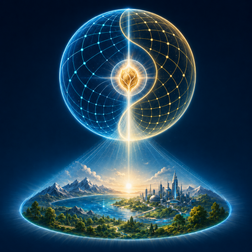
What if reality did not begin with particles, space, or even time? This episode follows a single retained mathematical object governed by three primitive operations as it builds increasingly complex structure from its own internal recurrence. Beginning with a flat line of exact relations, the system reaches a decisive transition where two-dimensional geometry opens, phase curvature propagates as light, and persistent topological defects form the first matter-like structures. From there, the same underlying geometry develops the symmetry patterns associated with the weak and strong forces, fractional charge structure, and confinement. Nothing is placed inside a pre-existing universe. The relations become space, their causal succession becomes time, their phase motion becomes radiation, and their retained knots become matter. It is a step-by-step exploration of a remarkable possibility: that the physical world may be the visible consequence of pure mathematics repeatedly acting on itself.
74. Cortex Engine: Building a universe on an Acer laptop

IA
What would it take to build a mathematically exact universe on a $400 Acer laptop? In this episode, we explore the architecture behind the Cortex Engine, a deterministic computational system created by Justin K. Lietz at Neuroca, Inc. Rather than treating a world as a giant database updated by a global clock, Cortex advances only the regions where something is actually happening. Inactive domains remain still, while active causal frontiers evolve independently. At the center of the engine is the Lifted Object, a recursively retained geometric state governed by three primitives: B refines the active geometry. Q rotates into a new phase position. L locks the completed layer and opens a new one. We examine how these operations allow history to remain embodied in present geometry instead of being stored as an enormous chronological log, how the Orthad reads that retained state, and how billion-tick histories can be reconstructed from compact seeds rather than preserved instruction by instruction. The conversation also moves into locally emergent time, exact rational arithmetic, non-sofic hidden memory, the Void Dynamics Model, and the possibility of building synthetic worlds governed by internal computational law rather than external scripting. This is a deep dive into a very different model of computation: one where memory is geometry, time is local, and a simulated world unfolds from within.
73. Orthad: Gravity Is Just Algorithmic Lag
IA
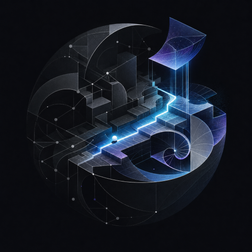
What if gravity is not a fundamental force, but the visible result of the universe slowing down under its own computational burden? This episode explores the Void Dynamics Model and its attempt to derive physical reality from a minimal set of primitive operations. Beginning without assumed space, time, geometry, or conventional physics, the framework asks whether quantum structure, dimensionality, gravity, black holes, and even Hawking radiation could emerge from a discrete algorithmic process. Follow the path from three foundational operators to a universe where matter is retained computational history, gravity is a gradient in local processing load, and black holes mark the point where a region of reality reaches its capacity limit.
72. Cortex: How Time Emerges in a World Engine Without a Clock
IA
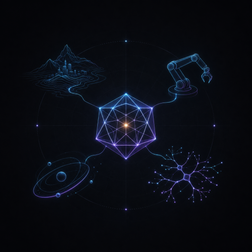
What if a simulated world had no clock and advanced only when something caused it to change? This episode enters the Cortex Engine, a deterministic world engine that rejects the global tick. Instead of repeatedly checking every object, it advances through admitted causes, sparse active frontiers, and atomic interactions. Dormant regions remain computationally silent. Local histories progress independently, then meet only when a real event binds them together. At its center is QBL Phase Calculus: B refines the active state, Q rotates into new capacity, and L extends the dimensional domain when no local move remains. Assembly executes the primitive mathematics, Rust guards the authoritative world state, and C provides the analytical harness. From a machine-level ABI proof to retained topology and multiple competing travelers by CP20, this is the story of a digital universe governed not by a heartbeat, but by causality.
71. Cortex: A Game Engine Built With Phase Calculus
IA
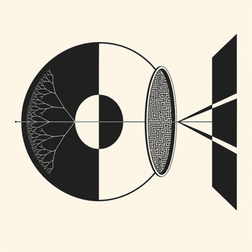
What if a simulated universe advanced only when something actually happened? This episode explores Cortex, a deterministic world engine that replaces the global simulation tick with explicit cause. We trace its clockless local time, transactional state changes, compact geometric memory, exact replay, and version-gated bridge to real-world hardware. From planetary open worlds and multiscale physics to robotics, operating systems, and connectome-based neural networks, Cortex proposes one foundation where physics, persistence, and learning become different expressions of retained causal history.
70. Orthad: The Mathematical Glitch That Birthed Reality

IA
What if reality began not with a physical explosion, but with an unresolved contradiction in pure logic? In this episode, we descend beneath space, time, matter, and geometry into Phase Calculus and the Void Dynamics Model. We trace how the sterile extremes of absolute nothing and undifferentiated totality give way to a primitive tension that cannot collapse into either. From that tension, distinguishability emerges, QBL dynamics accumulate a fully retained history, and a strange 7–8–9 boundary grammar reveals a system whose past cannot be compressed into any finite memory. We then explore the mirror of the origin: an exact relationship through which the system’s visible shadow re-expresses the deeper laws that generated it. Finally, we reach higher-order L, where saturation does not cause collapse. The completed history of one descriptive layer is retained as the foundation of another, forcing a new orthogonal dimension to emerge. The result is a provocative vision of geometry as compressed history and reality as a system that remembers, reflects, and builds sideways when it runs out of room. Along the way, we separate the framework’s formal mathematical claims from its broader implications for cosmology, black holes, agency, and consciousness.
69. Orthad: The Five Number Case of Quantum Expansion
IA
What happens when an exponentially expanding quantum system is governed by a correction term that can take only five values? This episode explores the QBL primitive system of Phase Calculus, where quarter-turns, balanced refinements, and dimensional extensions construct space from retained operational history. At the center of the investigation is a rigid defect alphabet of -2, -1, 0, 1, and 2, produced by a deeper three-state carry process constrained to 7,8, and 9. From dual-chart Orthad structure and dimensional doubling to non-sofic symbolic dynamics and prime-number gates, the discussion follows a striking possibility: immense geometric complexity may emerge from a microscopic arithmetic governor. It also examines the unique simultaneous prime event at domain 17 and the crucial distinction between arithmetic signals and fully derived quantum geometry.
68. Phase Calculue: Trying to prove chaos is deterministic ep. 3
IA
Episode 3 of testing the phase calculus orthad.
1 de 8