USCA Business Law Podcast

USCA Business Law Podcast

por Dr. Bryan McLeod
Temporada 1
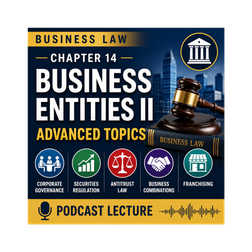
Business Law: Chapter 14 - Business Entities II
IA
Chapter 14 explores the advanced legal and strategic issues that shape modern business organizations. This episode examines corporate governance, the roles of shareholders, boards of directors, and officers, and the importance of fiduciary duties in corporate decision making. We also discuss securities regulation, investor protection, SEC disclosure requirements, insider trading laws, antitrust regulations, mergers and acquisitions, joint ventures, and franchising. Whether you are interested in entrepreneurship, corporate leadership, investing, or business strategy, this chapter provides a practical look at how businesses grow, raise capital, compete in the marketplace, and comply with important legal requirements.
Business Law: Chapter 13 - Business Entities
IA
Choosing the right business entity is one of the most important decisions an entrepreneur can make. In this episode, we explore the legal structures that businesses use to operate, grow, and protect their owners. From sole proprietorships and partnerships to LLCs and corporations, we examine how each entity differs in terms of liability, management, taxation, and financing. You'll learn why LLCs have become one of the most popular business structures in the United States, how corporations create separate legal identities, and what can happen when courts decide to pierce the corporate veil. We also discuss the role of state governments in business formation and the factors business owners should consider when selecting an entity. Whether you're planning to start a business or simply want to understand how organizations are structured, this episode provides a practical introduction to the legal foundations of business ownership.
Business Law: Chapter 12
Credit powers modern business, but it also creates legal obligations and financial risks. In this episode, we explore the legal foundations of credit, secured transactions, negotiable instruments, bankruptcy, and agency relationships. Learn the difference between secured and unsecured debt, how creditors protect their interests through collateral, and why UCC-1 financing statements play a critical role in commercial lending. We also examine checks, promissory notes, certificates of deposit, and the concept of a Holder in Due Course. The discussion then turns to bankruptcy law, including Chapter 7 and Chapter 11 filings, before concluding with agency law and the fiduciary duties that govern relationships between principals and agents. Whether you are managing a business, extending credit, or representing an organization, this episode provides essential insights into the legal structures that support modern commerce. Based on Chapter 12 of Business Law.
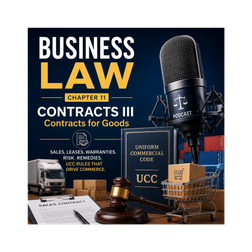
Business Law: Chapter 11
IA
In this episode, we explore the legal rules that govern the sale and lease of goods under the Uniform Commercial Code (UCC). Learn how the UCC differs from traditional contract law, why merchants are treated differently from consumers, and how contracts for goods can be formed even when some terms are left open. We'll discuss merchant firm offers, the Statute of Frauds, identification of goods, transfer of title, and risk of loss. You'll also learn about express and implied warranties, including the warranty of merchantability and fitness for a particular purpose, along with the rules for disclaiming warranties. The episode examines the UCC's Perfect Tender Rule, buyer and seller remedies for breach of contract, and the protections available when goods fail to meet contractual expectations. Finally, we introduce the United Nations Convention on Contracts for the International Sale of Goods (CISG) and the role of Incoterms in international commerce. Whether you're studying business law, preparing for an exam, or seeking a better understanding of commercial transactions, this episode provides a practical overview of the legal principles that govern the buying, selling, and leasing of goods in today's marketplace.
Business Law: Chapter 10 - Contracts II
IA
Chapter 10: Contracts II – Performance, Structure, Negotiation, and Sample Contracts What happens after a contract is formed? In this episode, we move beyond the basics of contract creation and explore what happens when parties must actually perform their obligations. We examine the legal principle of pacta sunt servanda, the circumstances under which performance may be excused, and the consequences of breach of contract. You will learn about monetary and equitable remedies, including compensatory damages, consequential damages, specific performance, and rescission. The episode also explores the practical side of contracts by examining contract drafting, contract structure, letters of intent, negotiation strategies, and common provisions found in business agreements. Finally, we discuss real-world contracts involving employment, insurance, leases, loans, and international business transactions. Whether you are negotiating your first employment offer or reviewing a business agreement, this episode provides valuable insight into the practical application of contract law.
Business Law: Chapter 9 - Contracts I
IA
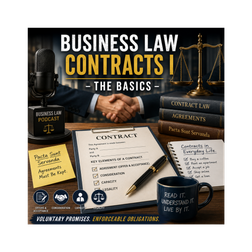
Episode Description Contracts are everywhere. From buying a cup of coffee to signing a lease, accepting a job offer, or launching a business, contracts shape nearly every aspect of modern life. In this episode, we explore the foundations of contract law and examine how legally binding agreements are formed. You'll learn the essential elements of a valid contract, including agreement, consideration, capacity, and legality. We also discuss offers, acceptance, counteroffers, the mirror image rule, the mailbox rule, and the principle of Pacta Sunt Servanda, the idea that agreements must be honored. Whether you are a future business leader, entrepreneur, or informed consumer, this episode provides a practical introduction to one of the most important areas of business law.
Business Law Chapter 8: Torts and Liability
IA
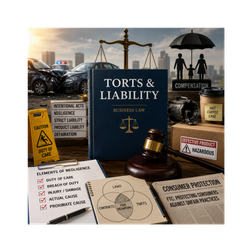
What happens legally when everyday life goes wrong? In this episode, we take a deep dive into the fascinating world of torts and liability in business law. From intentional harm and negligence to strict liability and massive corporate product liability cases, this conversation uncovers the invisible legal framework that governs nearly every interaction in modern society. We explore how the law assigns responsibility when someone causes injury or property damage, why civil lawsuits exist alongside criminal prosecutions, and how courts determine what a “reasonable person” should have done in a given situation. Along the way, we break down concepts like assault, battery, defamation, comparative negligence, respondeat superior, strict liability, and product defects in a way that connects directly to real-world experiences. The episode also examines landmark examples such as the Ford Pinto case, the evolution of consumer protection laws, and the growing challenges posed by artificial intelligence and autonomous systems. As technology increasingly makes decisions once controlled by humans, we ask a critical question: who is legally responsible when an algorithm causes harm? Whether you are a business student, future entrepreneur, or simply curious about how accountability works in society, this episode offers a practical and engaging look at the legal principles shaping our daily lives.
Business Law Chapter 7: Criminal Law
IA
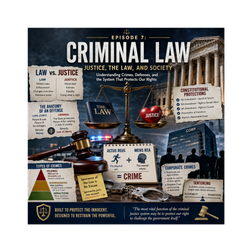
This episode introduces students to the foundations of criminal law and explains how society defines, prosecutes, and punishes criminal behavior. The discussion distinguishes law from justice, compares criminal and civil liability, and explains why one wrongful act can lead to both a government prosecution and a private lawsuit. The episode also explores key criminal law principles such as ignorance of the law, actus reus, mens rea, corporate criminal liability, white-collar crime, criminal defenses, civil disobedience, constitutional protections, burdens of proof, sentencing, and the death penalty. Students will come away with a clearer understanding of why criminal law is not just about punishing wrongdoing. It is also about limiting government power, protecting individual rights, and balancing society’s need for order with the citizen’s right to challenge unjust laws.
Chapter 6: Government Agencies and Admin Law
IA
This episode introduces government agencies and administrative law, two of the most important but often overlooked parts of the U.S. legal system. We walk through how agencies are created, why they exist, and how they operate at the federal, state, and local levels. You’ll learn how agencies act on behalf of the government to enforce laws, create rules, and resolve disputes that directly impact businesses and everyday life. We also break down the rulemaking process, the limits placed on agency power, and the role of judicial review in keeping agencies accountable. By the end of this episode, you’ll have a clear understanding of how administrative law works in practice and why it plays such a central role in the modern business environment.
Business Law Chapter 5: Dispute Resolution
IA
This episode takes a hard look at how dispute resolution really works in the modern legal system. Moving beyond the Hollywood version of dramatic courtroom battles, we break down the reality that most legal conflicts are resolved long before a trial ever begins. In fact, the vast majority of cases are settled through negotiation, mediation, or arbitration, making litigation less about theatrics and more about strategy, leverage, and risk management. We walk through the structure of the legal process, from the initial requirements to file a lawsuit to the financial and procedural barriers that shape decision-making. The discussion also highlights the role of alternative dispute resolution in the business world, where companies often avoid the public court system in favor of faster, more efficient, and more confidential outcomes. Along the way, we examine key concepts like standing to sue, the American rule on legal fees, statutes of limitations, and the critical importance of the pretrial phase, especially discovery. The episode also contrasts civil and criminal litigation, emphasizing the different burdens of proof and the constitutional protections that come into play when the government is involved. The goal is simple. To give you a practical, real-world understanding of how disputes are actually handled so you can think more strategically in both business and everyday situations.
1 de 2