Truth In The Arena

Truth In The Arena

por Nate Huffstutter
Temporada 1
Episode 16: Jim Malone—"True Leaders Lead Everyone”
What is the difference between holding a position of power and serving as a leader? Jim Malone—owner of Baseball Strength Academy and longtime Strength and Conditioning Coach with the San Diego Padres, New York Mets, Pittsburgh Pirates, Cleveland Guardians, Kansas City Royals and St. Louis Cardinals—joins the latest episode to discuss leadership lessons he’s learned from decades in the Bigs working with multiple Hall of Famers and Cy Young Winners as well as countless All-Stars. “True leaders across all domains have to lead everyone in their stead,” Malone says, making the point that great leaders in the dugout—from Trevor Hoffman to Adrian Gonzales—were not leaders for just part of the team, but the entire team. The discussion shifts from developing leaders on the ball field to the political arena, where the same should hold true, but often does not—with political leaders and office-holders choosing to serve their party base but not the entire population. The conversation also touches on honesty, consistency, and authenticity as core foundations of leadership and how the ideals of meritocracy from sport can be something that coaches and citizens as whole demand in the political realm. “Meritocracy is earned, right?” Malone says. “It’s opportunities earned.” Chapter List 00:00 Introduction to Coaching Values and Leadership 02:28 The Essence of Servant Leadership 07:27 Developing Internal Leadership in Teams 11:31 Authenticity and Consistency in Leadership 16:23 The Role of Honesty in Coaching 19:50 Meritocracy in Sports and Society 27:33 Leadership Qualities and Team Building 31:11 The Role of Sports in Community and Inclusion 32:29 Navigating the Media Landscape 34:58 Political Discourse and Leadership 39:07 Patriotism and Community Values
Episode 14: Todd Hamer—"Change the Community, Change the City, Change the Country”
Fire it up! Coach Todd Hamer re-tells a story from Barack Obama about how a spark of inspiration can be enough to change the energy in another person, which can change a room, which can change a community, which can change a city, which can change a country. In addition to over two decades of experience as a D1 strength and conditioning coach—with leadership roles at The Citadel, Marist, George Mason, Robert Morris University, and George Washington University—Coach Hamer walks it like he talks it. Not just because of his 595lb squat PR or 475lb bench, but by taking a true leadership role in his community by running for and holding a position on the City Council of Sewickley, PA. Coach Hamer begins the conversation by sharing his philosophy of servant leadership that is simultaneously empathetic and selfish—empathetic by making an effort to meet the individual needs of each athlete to improve their life and selfish because that ability to improve people’s lives…adds value to his own. “An athletic director once said to me ‘Your job is to make better athletes, stop worrying about building connections.’ And I said ‘If you don’t make connections, you can’t build better athletes.’” CONNECTIONS continue as a theme throughout the discussion—connecting from coach to athlete, connecting to community, connecting to nature, connecting to people who may not share identical ideas or priorities. Hamer shares what he has learned from his leadership role in the community, how that has impacted his view on other current events and issues, and how small actions can be the catalysts to create larger types of change. Chapter List 00:00 Introduction to Coach Todd Hamer 01:28 Defining the 'Why' in Coaching 07:25 Leadership Principles for Young Athletes 12:19 The Intersection of Leadership and Politics 17:34 Running for City Council: A Personal Journey 23:00 Human Rights and Community Leadership 25:00 Competence and Confidence in Leadership 26:22 Community Engagement and Cycling Safety Initiatives 30:23 Coaching, Leadership, and Community Responsibility 31:53 The Importance of Transparency in Governance 37:12 Perception, Reality, and Media Consumption 43:51 Patriotism, Accountability, and Finding Common Ground

Episode 13: Bob Remensperger—"Keeping the Joy in Competitive Youth Sports”
How can club and travel coaches make youth sports a fun, rewarding, and positive experience while still supporting highly competitive players through every level of their athletic journeys? Team sports are what you make them—YOU meaning coaches, players, families, communities, and organizations. While those critical of the youth sports system can point to issues with player burnout, high costs, extensive commitments, overuse injuries, and other problems, Legends FC SD-Del Mar ECRL Coach and College Liaison Bob Remensperger joins the podcast to discuss his player-driven approach and the ways that he teaches young players (and their parents!) to enjoy and thrive in their time playing soccer, all while still pursuing consistent development, competitive success, and potential opportunities to play beyond the high school level. The conversation begins with a discussion of core coaching principles, and Coach Remensperger discusses the importance he places on disciplined preparation, leading by example, and believing in his athletes so that they are comfortable taking risks and being brave. Based on well over a decade of coaching experience across multiple clubs and levels, Remensperger breaks down ways he prepares for his training sessions, how he interacts with athletes to set the foundation of a positive team culture, and ways he communicates with parents to make sure they are enjoying their child’s experience with the team (plus strategies to help parents turn the dreaded “car ride home” into actual quality time spent with their child). While much of the discussion focusses on establishing an engaging and welcoming environment on the field, Remensperger also shares practical insight for players looking to play at the college level and how their parents can best support those higher-level goals. As a former college player (and the parent of a current D1 volleyball athlete), Remensperger explains the importance of having the college recruiting process be player-driven, proactive, and realistic. He discusses some of the hands-on advice he provides players in his role as the club’s college liaison and tools and strategies players can leverage while pursuing a commitment to play at the university level. Chapter List 00:00 Introduction to Coaching Philosophy 01:48 Building Values and Expectations in Athletes 04:26 Leadership and Collaboration in Coaching 07:24 Encouraging Bravery and Risk-Taking in Players 10:58 Creating Joy in Youth Sports 18:28 Navigating the College Recruiting Process 27:03 Positive Parent-Child Dynamics in Sports
Episode 12: Devan McConnell— “Creating Trust & Building Inclusive Environments for Your Athletes”
Equality. Fairness. Respect. Coach Devan McConnell, High Performance Director for the NHL’s Utah Mammoth, joins the latest episode of the Truth In The Arena Podcast to discuss how those core tenets are essential for teamwork and developing a positive team culture. In addition to being vital in the world of sports, Coach McConnell also explains how inclusiveness and fairness are core principles he looks for at the community level and with national political leadership. Through the conversation, McConnell shares the roots of his coaching philosophy and how his outlook has been impacted by professional stops across the USA, with college coaching roles at Stanford and the University of Massachusetts Lowell and then positions at the pro level with NHL teams in New Jersey and Arizona. All this while also starting a family and raising kids of his own. Moving from Arizona to Utah, one of the ways he chose the neighborhood to move into was based on prevalence of Pride flags in the community, as he wanted to be in an area where inclusiveness was a fundamental part of the social fabric. “As coaches, I think it’s important that we create environments that our athletes, our staff members, the people in our organizations can feel safe being who they are.” Additionally, McConnell discusses his participation in the Strength Coaches for Harris group during the 2024 Election and his takeaways from stepping in to a more direct role in political advocacy. Finally, the coaches discuss the unique community culture in Utah and how patriotism is rooted in holding the country accountable to its ideals. Chapter List 00:00 Introduction to Coaching Values 02:47 Core Coaching Principles and Their Impact 05:19 Political Advocacy in Coaching 07:50 Navigating Diverse Political Landscapes 10:20 Instilling Values in Young Athletes 13:00 Creating Inclusive Environments 15:23 Media Literacy and Healthy Information Consumption 18:01 Defining Patriotism in Today's Context
Episode 11: Molly Binetti—“The Fight’s Not Over”
Overcoming adversity. Resilience. Taking a loss in stride and continuing to work towards a common goal. We understand how these qualities shape durable and successful teams, and in this episode Molly Binetti, the Director of Women’s Basketball Performance for the powerhouse University of South Carolina program, discusses how those same qualities have also been elemental in pushing forward against the political headwinds facing progressive policies and achievements. The conversation begins with a discussion of how USC head coach Dawn Staley empowers her players and staff to take leadership positions and speak out for what they believe in. Coach Binetti discusses the “People Principles” of empathy and authenticity that Coach Staley promotes, as well as Staley’s “look-sound-feel” approach to recognizing the look, sound, and feel of success while also being prepared to address and fix anything that intuitively looks, sounds, or feels wrong. Looking back on the 2024 Election, Binetti talks in depth about her involvement in the Strength Coaches For Harris group and shares the sense of community and fellowship she was able to find in that network of her coaching peers. “As demoralizing as the (election result) was, it’s still nice to be able to know that there are people that are still gonna fight. And the fight’s not over.” The coaches also discuss GOP attacks on women’s health and civil rights and how coaches can help their female players live their healthiest lives amid efforts to defund Planned Parenthood, the overturning of Roe vs. Wade, and threats to LGBTQ rights. They also dive into the Protect Women’s Sports movement and debate the exploitation of the issue as outrage-bait by those who generally are not that interested in women’s sports, except for those involving the tiny percentage of competitive trans athletes. That leads to a discussion on the prevalence of online propaganda as a tool to inflame and divide, and how Binetti tries to guide her athletes toward a healthy media diet as an element of their overall health. Finally, Binetti breaks down her definition of patriotism as based in the shared humanity that binds everyone together. Chapter List 00:00 Core Values in Coaching 06:03 The Human Element in Leadership 08:46 Political Advocacy in Coaching 11:40 Women's Health and Political Issues 17:33 Protecting Women's Sports: A Complex Discussion 21:16 The Politics of Women's Sports 24:38 Navigating Media Influence on Athletes 30:49 Defining Patriotism in Modern Society
Episode 10: Al Powell & Jim Place— “Win Little Battles—Tackling Racism and Social Justice Through Football”
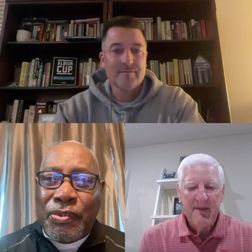
It started with a phone call—one man in a time of need. Summer, 2020. Following George Floyd’s murder and the aftermath of the global Black Lives Matter protests and ensuing backlash, Ohio High School Hall of Fame football coach Al Powell called his friend (and fellow Hall of Fame coach) Jim Place to express his despair at how the country was being torn apart. From that rare, authentic, and open conversation between a black coach and his white peer, the Miami Valley Football Coaches Association Social Justice 7v7 tournament was born. On the heels of a recent feature article in the Washington Post, Coach Powell and Coach Place join Nate Huffstutter on this episode to discuss that pivotal moment in which the foundation of the tournament was formed. From there, they detail how the event has continued to flourish and grow each passing year despite facing headwinds in the political landscape and the current US government’s hostility toward diversity, equity, and inclusion. Beyond the action on the football field, the tournament includes a workshop phase where athletes from different schools with different demographics are placed into small groups with a mix of white players and minority players and provided discussion prompts relating to racial understanding and—ideally—developing connection points to build trust among students from different backgrounds with a shared experience in high school football. Why does it work? “The kids want this, they want to talk about it,” Place says. “And the number one message I hear is this: we want a better world than the one that’s been given to us.” The question, of course, is how to make it happen. Powell (who is also an acclaimed author, speaker, and trauma recovery coach) and Place (who also consults with educators on developing servant leaders through social emotional learning curriculum) focus on that how and leverage their many decades of success on the gridiron as sources of inspiration. Football is a game of field position, sometimes gained in small increments, and the same can be true of progress towards social change. Chapter List 00:00 Introduction to Coaches and Their Mission 01:10 The Impact of George Floyd's Murder 05:54 Creating the Social Justice 7v7 Tournament 08:18 Core Values in Coaching and Diversity 12:04 Breaking Down Barriers in Sports 18:39 Workshop Experiences and Discussions 23:56 The Power of Selfies and Connections 29:51 Identifying and Addressing Racial Issues 37:21 Advice for Coaches on Promoting Inclusion 44:34 Defining Patriotism and Unity
Episode 9: Tyler Germain—“Meritocracy and Pursuing Excellence in Sport and Life”
Having passed the 20-year mark in his coaching career, Kalamazoo Central High School track coach Tyler Germain shares his perspective on his evolution as a coach & teacher and the values and principles he seeks to instill in both his athletes and students in an ever-changing information environment. In addition to highlighting teamwork, commitment, and overcoming adversity as core values, Coach Germain also focuses on the importance of equity and access in creating a program that serves as a “thriving community,” providing value for athletes at every competitive level within the sport. Coach Germain expands on how track represents a true meritocracy in sports, where there is no subjective debate or judgment on quality: the fastest, highest, or furthest wins. But, within that, one person’s success does not exclude or preclude another’s—everyone has the ability to compete against their own benchmarks and standards and find their own markers for progress and success. The discussion of meritocracy leads into examining the myth vs. reality of the American Dream and how attacks on expertise, science, ethics, and talent by the current GOP administration run counter to those meritocratic ideals. Digging further into the development of actual expertise, Coach Germain talks about the impact of AI in the classroom and negative impacts on critical thinking and the ability to wrestle with hard questions and come up with a unique answer. CHAPTER LIST 00:00 Introduction to Coaching Philosophy 02:05 The Role of Mentorship in Coaching 04:51 Creating an Inclusive Team Environment 06:42 Political Perspectives on Leadership 10:34 Balancing Competition and Personal Growth 12:38 The Nature of Track and Field as a Meritocracy 16:56 Defining Success Beyond Winning 20:45 Expectations of Greatness in Athletes 24:42 The Myth of the American Dream 30:05 The Political Responsibility of Coaches 36:42 Challenges of Pay-to-Play in Youth Sports 40:10 Access to Sports: The Financial Barrier 42:52 Reviving Community Sports Programs 45:50 The Role of AI in Education and Coaching 52:03 Critical Thinking in the Age of AI 58:07 Navigating Media Consumption and Authority 63:54 Redefining Patriotism and Community Values
Episode 8: Julio Salado—“Caring Enough to Make a Difference”
Serving on his city’s emergency response team. Flying to Poland and Ukraine on his own dime to prepare food and support humanitarian efforts for citizens displaced by the Russian invasion. Volunteering to provide health and fitness tools for underserved populations in his local community. Many coaches talk about servant leadership and human values; meanwhile, Coach Julio Salado demonstrates how to put those principles into local and global action. In this episode of the Truth In The Arena podcast, Coach Julio shares the simple principles that guide him each day: practice self-care & be kind. Those foundations—nurturing your own body & mind and choosing to be compassionate—pave the way for everything he’s able to do as a fitness coach, business owner, and volunteer. Through the course of the conversation, Coach Julio talks about the concept of “health equity” as a necessary means to compensate for systemic inequities and provide the basic building block of good health for populations that don’t have the same access to professional trainers, organic food, nutritional planning, or medical insight as more privileged groups. This also leads to a discussion of the importance of DEI, as diversity, equity, and inclusion are core American values needed across the fitness industry. Beyond his work in his home city of Malden, MA, Coach Julio details his humanitarian trips to Eastern Europe where he has volunteered for the World Central Kitchen and Lviv Volunteer Kitchen, peeling potatoes, shoveling mud, and engaging in the type of humble, “Sweep the Sheds” actions that most coaches recognize as a fundamental part of a productive group/team. Coach Julio’s own experiences at home and abroad have informed his perspective on the language and practice of dehumanization in the current targeting of immigrants in the USA. As he does elsewhere, Coach Julio shares his own practical experiences trying to counteract racism and offers practical suggestions for coaches, athletes, or anyone listening to make a difference by rejecting hate, misogyny, and fascism. Chapter List 00:00 Introduction to Coach Julio Salado 01:40 Core Values and Principles in Coaching 05:50 Community Involvement and Health Equity 11:19 Understanding Systemic Inequities 15:11 Humanitarian Efforts in Ukraine 21:22 Addressing Racism in the Fitness Industry 24:03 The Power of Peaceful Dialogue 26:06 Understanding Fear and Racism 28:08 Rejecting Hate and Misogyny as Patriotism 32:39 The Importance of a Healthy Media Diet 39:19 Redefining Patriotism for Today’s Era
Episode 7: Missy Mitchell-McBeth—“Modeling and Executing Your Core Values”
Credibility is crucial for coaches—so, how can coaches make sure they are walking it like they talk it? Longtime S&C Coach, speaker, and author Missy Mitchell-McBeth joins Episode #7 of the podcast to talk about ways to narrow down core values…and more importantly, promote values that you can model and execute. Coach Mitchell-McBeth discusses how consistency and transparency are her foundational principles, which then support countless other important qualities: hard work, integrity, honesty, and more. With an extensive professional background to pull from, she explains how she learned from her mistakes as a young high school coach, how expertise and deep knowledge can be sources of credibility in place of surface factors, and how she emphasizes the concept of “embracing discomfort” as a key part of the growth and development process. For Mitchell-McBeth, that growth process has taken her from the D1 coaching ranks to now balancing a professional day job and her own entrepreneurial career, all while still training competitive club volleyball athletes. Those values of consistency of transparency also come into play as Coach Mitchell-McBeth discusses some of the routine professional challenges facing entrepreneurial coaches: managing their content on social media platforms, setting professional boundaries for when to say yes and when to say no, and recognizing how to draw the line between answering questions for an inquisitive younger coach or peer and when that time/expertise needs to be invoiced as a paid professional consult. Chapter List 00:00 Introduction to Coach Missy Mitchell-McBeth 01:42 Intrinsic Motivation in Coaching 04:11 Modeling Values as a Coach 10:28 Balancing Professional and Personal Life 15:55 Getting Comfortable with Discomfort 20:52 Setting Boundaries as a Coach 33:13 Effective Communication for Coaches
Episode 6: Erik Becker—"We Must Never Lose Touch With Our Better Angels"
Erik Becker, Head Football Coach and Sports Nutrition teacher at his alma mater, Daniel Hand High School in Madison Connecticut, joins Episode 6 to reflect on 25 years in the coaching field and how he views his “why” as a mission to develop capable, positive, healthy, and well-rounded young men. Coach Becker quotes John Dewey in believing that the role of schools are to equip and prepare students to participate in a democracy, and he sees athletics and sports as a crucial vehicle in that effort. Speaking from the heart, Becker discusses how his job involves teaching athletes to bravely face risk, to be willing to grow at the edge of their comfort zones, and to rise to the demands of being leaders on and off the field. Becker also emphasizes the importance of embracing those same values in the social and political sphere. He shares his faith in the noble ideas America aspires to, believing in Ronald Reagan’s ideal of the shining city on the hill and the words on the Statue of Liberty, “give me your tired, your poor, your huddled masses yearning to breathe free.” And in striving for the ideals of a “more perfect union,” he expresses that we as a nation must never lose touch with our better angels. Chapter List 00:00 Introduction to Coaching Philosophy 01:41 The Importance of having a 'Why' in Coaching 04:11 Education and Democracy: A Coach's Role 07:05 Risk and Bravery in Sports 12:10 Modeling Leadership and Accountability 15:48 Patriotism and Shared Values in Coaching
1 de 2