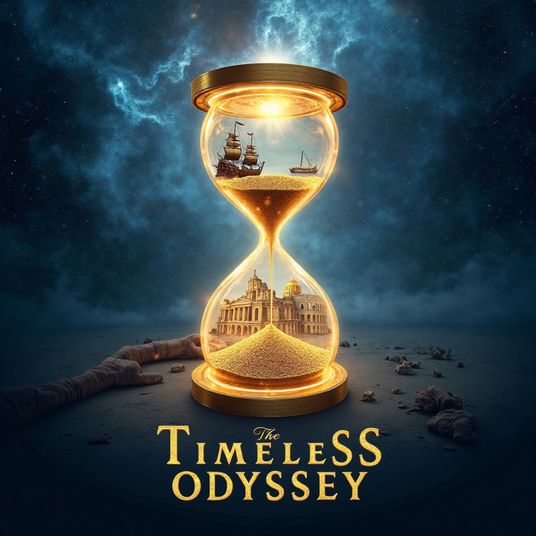
The Timeless Odyssey

The Timeless Odyssey

por Jodie Flett
The Watch That Ran Backwards Only Sometimes
A woman buys an old mechanical watch at a flea market and soon notices that it occasionally ticks backward for a few seconds. Each time it happens, small events around her subtly change — allowing her to avoid minor accidents or react to things just before they occur. As she tracks the phenomenon, she realizes the watch doesn’t truly reverse time, but briefly gives reality a chance to correct itself. One night the watch spins several minutes backward, warning her of a dangerous gas leak in her apartment. Later she discovers an engraving on the back: “Second Chances Only.” Eventually the watch stops working, leaving behind the unsettling idea that time itself may sometimes allow small corrections — but never forever.
The Key That Opened No Existing Door
A mysterious antique key is discovered hidden inside an old desk, bearing symbols that slowly change over time. Though it fits no ordinary lock, the key seems to guide its owner toward an unseen destination, growing warm near forgotten or sealed doors. Eventually, it leads him to a narrow alley where a door briefly appears—one that matches the symbols on the key. Before he can use it, the door opens from within, revealing that the key was never meant to open doors, but to locate them. When the door vanishes, the key disappears as well, leaving behind the unsettling sense that some locks exist beyond normal reality, waiting for those who unknowingly carry the means to find them.
The Painting That Slowly Changed
Residents of an apartment building notice subtle changes in a hallway painting — trees shift, water rises, colors change, and eventually a mysterious figure appears and slowly moves closer over time. Photos confirm the painting evolves day by day, independent of reality outside. When the figure finally reaches the foreground, reflections inside the painting begin to mirror the hallway itself. The residents stop documenting it, but unsettling sounds suggest whatever exists inside the painting may now be approaching the real world.
Time and Forgiveness — Rewriting the Past Without Changing It
A seemingly ordinary object becomes the center of unease when small inconsistencies begin to surface around it. What first appears to be coincidence slowly forms a pattern, suggesting that the item carries traces of events long forgotten. As people interact with it, memories they never experienced start to feel personal, and emotions surface without clear cause. The episode explores how stories can cling to places and things, blurring the boundary between imagination and inherited memory. In the end, the mystery remains unresolved — leaving the listener questioning whether the object truly held echoes of the past, or whether the human mind simply filled silence with meaning.
The Silent Years — When Nothing Seems to Happen, Everything Changes
This episode reveals how the most important changes in history and in human life often happen during long, quiet periods that receive little attention. While wars, revolutions, and discoveries dominate memory, real transformation is built slowly in classrooms, homes, workshops, and private thoughts. These “silent years” form the foundations that later make dramatic events possible. The episode shows how progress and collapse both grow invisibly. Scientific breakthroughs, cultural shifts, and social movements are prepared through years of unnoticed effort. At the same time, societal decline begins quietly through weakened education, fading trust, and ignored problems. By the time change becomes visible, it is usually already complete. On a personal level, the episode emphasizes that character is shaped in routine, not in crisis. Who we become is formed by small daily choices made without witnesses. Silence is presented as the space where mastery, resilience, and integrity are built. Ultimately, Episode 27 reframes quiet periods as preparation rather than failure. The “silent years” are not empty pauses, but essential stages where roots grow deep. By honoring patience, consistency, and invisible effort, individuals and societies create futures that can endure.
Beyond Time — What Remains When Moments Are Gone
This episode explores what continues to exist after individual moments, schedules, and lifetimes come to an end. Moving beyond clocks and calendars, it reflects on how human lives do not vanish when time passes, but instead transform into influence, memory, and quiet impact on others. Every word, action, and decision leaves invisible traces that shape future generations. The episode challenges the idea that legacy must be loud or famous. True legacy, it argues, is usually silent—found in habits passed down, values copied, courage borrowed, and kindness remembered. Through teachers, friends, strangers, and loved ones, each person becomes part of a long chain of influence stretching across history. Drawing from science, culture, and philosophy, the episode emphasizes that nothing truly disappears. Human lives continue through consequences and connections. Even ordinary choices contribute to larger change, reminding listeners that no life is insignificant. Ultimately, Episode 26 concludes that “beyond time” is not a distant place reached after death, but something built daily through sincerity, responsibility, and compassion. While calendars and deadlines fade, meaning endures through the lives we touch and the values we leave behind.
A Life in Time — The Meaning of Being Here
This final episode reflects on the deepest purpose of the series: understanding what it truly means to live within time. Rather than focusing on time travel or future technology, it turns inward, examining how every human life is shaped by moments that cannot be repeated. From birth to the final breath, time quietly records experiences, struggles, connections, and choices, offering each person the opportunity to create meaning within natural limits. The episode challenges the common belief that time is an enemy to be defeated. Instead, it presents time as a gift that gives life value through impermanence. Because moments fade, relationships end, and life is finite, every experience becomes precious. Drawing on philosophical and spiritual traditions, the episode emphasizes that life is measured not by length, but by depth, awareness, and presence. It also highlights the importance of human connection and quiet influence. Every interaction leaves traces, and true legacy is found not in fame, but in kindness, courage, and the impact left on others. Endings are reframed not as defeats, but as essential elements that make life meaningful. Ultimately, Episode 25 concludes that we do not need to escape time to live well. By choosing intention, compassion, and presence in each moment, we become active participants in our own journey. Time is not an enemy, but a companion—offering moments in exchange for awareness, and turning those moments into a story that truly matters.
The Future of Time — When the Clock Begins to Change
This episode explores the idea that time itself may be entering a period of transformation. What was once experienced as a natural, external force has become engineered, compressed, and accelerated by technology. Clocks, machines, and now algorithms have reshaped how humans experience duration, attention, and the present moment. The episode examines how artificial intelligence and predictive systems allow the future to leak into the present, challenging ideas of free will and uncertainty. At the same time, modern physics questions whether time is even fundamental, suggesting it may be flexible, reversible, or emergent rather than linear. Rather than focusing on control, the episode argues that humanity’s greatest challenge is ethical adaptation. As life speeds up, meaning risks disappearing unless slowness, presence, and intention are consciously preserved. The future of time, it suggests, may not be faster—but more deliberate. Ultimately, Episode 24 invites listeners to see time not as an enemy or a resource, but as a shared responsibility, asking whether humanity can evolve wisely as its relationship with time continues to change.
The Power of Memory — What We Choose to Remember, What We Allow to Fade
This episode explores memory as a living force that shapes how time is experienced, both personally and collectively. Rather than a fixed record of the past, memory is shown as a story continually rewritten, influenced by emotion, perspective, and the present moment. Each act of remembering subtly alters what is remembered, meaning the past evolves within us over time. On a personal level, memory forms identity—guiding choices, fears, and hopes long after events have passed. On a societal level, collective memory determines which histories are honored, which are ignored, and which voices are erased. Through monuments, traditions, and narratives, memory becomes a form of power that shapes destiny as much as any event itself. The episode also examines the modern challenge of digital memory, where almost nothing fades. While technology preserves cultures and voices once lost, it can also prevent healing by freezing people in past moments. The key, the episode argues, is conscious remembrance—choosing what to carry forward and what to release. Ultimately, Episode 23 suggests that while we cannot change what happened, we can change what it means. Memory, when handled with care, becomes not a chain to the past, but a compass guiding us toward a wiser future.

Lost Timelines — Futures That Never Were
This episode explores the unseen side of history — the futures that almost happened but never came to be. Instead of looking only at events that shaped the world, it examines possibilities erased by timing, chance, hesitation, or forgotten potential. Lost timelines include world-changing inventions that never took off, cultural paths derailed by conquest or suppression, economic policies that might have prevented disasters, and scientific breakthroughs buried or delayed for decades. They also include personal futures: relationships not pursued, talents never explored, risks not taken — entire versions of ourselves that remained unlived. The episode argues that history is not just what humanity achieved, but also what it failed to attempt, ignored, or allowed to disappear. Lost futures reveal how fragile progress is and remind us that inaction shapes destiny as much as action does. Ultimately, Episode 22 invites listeners to see possibility as a living force. The present moment holds countless branching futures, and every choice — even quiet ones — determines which survive and which vanish.
1 de 4