The Real Slim Fady Show

The Real Slim Fady Show

por Fady Hawatmeh
Temporada 2
The Most Dangerous Person In The Room
Three stories from back when I was running an outsourced CFO firm and getting pulled into other people's messes. The first one is a "CFO" who told a startup they had nine months of runway when they actually had three. The second is an exec with a perfect resume who locked me out of my own email, Slack, and bank account overnight. The third is a founder who was quietly skimming his own company while a partner at the fund covered for him. The thing all three had in common is that the most impressive guy in the room, the one with the best title and the best resume, was the actual problem. And the title is what kept everyone from looking too hard. I kept being the outside guy who got brought in to say the real number out loud, and the number itself was almost never the surprising part. It was always a person who knew and had a reason to stay quiet. These are wild and they're all true. And the people who blew up those companies mostly walked away fine. I'm not building to some ending where they get what's coming to them, because that's not what happened. If you're a founder, or you're about to hand your company off to somebody who tells you they've got it handled, this one's for you. Stop hiring the resume. Listen on Apple, Spotify, YouTube, Amazon, or wherever you get your podcasts.
If I Started My Company Over
Five things I would do differently if I were starting Clockwork from scratch tomorrow. None of them original. Almost none of them what any first-time founder actually does, including the version of me who started Clockwork. Hire a technical cofounder before you incorporate. Spend the first year on marketing, not on product. Stop overbuilding past the version the market would already buy. Stop hiding inside the codebase to avoid the part of the job you're not as good at, which is selling. And the contrarian one — admit that being too early is a problem unless you have the perseverance and the cash to outlast the wait. I made every one of these mistakes building Clockwork. Some of them cost me years. This episode is the honest version of what I'd tell year-one-me, not the LinkedIn version that flatters everybody involved. The cofounder admission is the most self-implicating. The "building was the easy part for me" lesson is the one I keep relearning. And the "we were too early" beat is the one I think founder media is dishonest about. Most companies that were too early died. Survival is what made the ones who didn't look like they had vision. If you're a founder, or you're thinking about becoming one, this is the advice I wish somebody had given me before I started. Listen on Apple, Spotify, YouTube, Amazon, or wherever you get your podcasts.
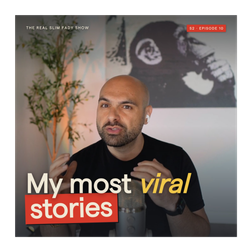
My Most Viral Stories
What if the posts you almost don't publish are the only ones that actually work? I went into my LinkedIn analytics and pulled my top ten posts of the last year. The result was uncomfortable. Three of the ten were confessions about what building Clockwork has cost me — 100 pounds lost, four years going broke, three years sober. One was me publicly picking a fight with the industry I came from. The thought-leadership posts I'm proudest of? Tier four. In this episode I walk through each of the top ten. Not by reading them back. By drilling into what was actually going on when I wrote them, what I left out, and what I think about them now that I've seen the data. The Outsourced CFO post that did ninety-one thousand impressions and broke into a comment-section war I wasn't sure I could survive. The hundred-pounds-lost post that became the highest-reaction post of the year. The "I went broke building Clockwork" post that sat on my drafts for two days before I hit publish, that almost didn't go up at all. And the question the data forced me to ask. Are you posting for the version of yourself you want to project, or for the version of you that's actually doing the building? Because at least in my case, the audience isn't interested in the projection. They want the build. A meditation on confession, self-implication, and the gap between the founder you're trying to be and the founder your audience keeps voting for. Listen on Apple, Spotify, YouTube, Amazon, or wherever you get your podcasts.
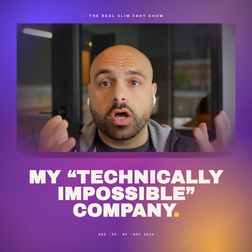
My "technically impossible" company
120 VCs told me no over four years. They said it was technically impossible. They said it wasn't venture-backable and I should just make it a lifestyle company at a million a year. They said finance was an art, not a science, and AI couldn't apply to it the way I was describing. Four years later, one of them came back asking me to pitch him. I said no. This is the story of those 120 rooms. Of being four years early. Of the texture of building when none of the people who call themselves AI investors can see it yet. And of the honest middle of this story I haven't told before. That I was the kind of stubborn founder I would have told to quit if I'd been advising me from the outside. Being early and being delusional look the same from the inside. I'm not telling anyone to keep going. I'm telling you the math is real, I'm an outlier, and the responsible advice would have been to stop. For anyone who's ever been told "this isn't possible" by someone who turned out to be wrong, this one is for you. Especially the part where they come back. The Real Slim Fady Show: Apple → https://podcasts.apple.com/us/podcast/the-real-slim-fady-show/id1640522523 Spotify → https://open.spotify.com/show/33udmtFwjLFt48pWSViwUz YouTube → https://www.youtube.com/playlist?list=PLW5rJOCqHMcDbHDCb5NZ693m7unzbUmGj TikTok → @therealslimfadyshow Fady: X → https://x.com/FadyHawatmeh LinkedIn → https://www.linkedin.com/in/fadyhawatmeh/ Clockwork → https://www.clockwork.ai/
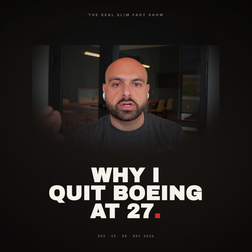
Why I Quit Boeing at 27
At 27, I was on the people-to-watch list at Boeing. Six months later, I walked out because I wouldn't accept the corporate game. This is the full story, the financial model my manager killed in 10 minutes despite never having built one, the performance review that turned out to be a math problem, and the phone call I got nine months after I quit that I still think about. It's also an honest answer to the question I get asked most: what's actually different about corporate vs. founder life? The short version, in corporate, you're a number. In a startup or small business, you ARE the number. The bell curve doesn't disappear when you become a founder. It just changes denomination. If you've ever sat through a calibration meeting wondering what was really happening to your career, this one is for you. Chapters: 00:00 The phone call I'll never forget 01:35 From Seattle to St. Louis 05:20 Building the model 08:30 Killed in 10 minutes 12:05 A meets-expectations review out of nowhere 14:35 The bell curve confession 17:35 Refusing to sign anything 23:00 "Maybe if you'd listened to him, he'd still be here" 25:30 The bell curve doesn't disappear when you raise 28:50 In corporate you're a number. In a startup you ARE the number. 30:00 Closer Connect: X — https://x.com/FadyHawatmeh LinkedIn — https://www.linkedin.com/in/fadyhawatmeh/ Clockwork — https://www.clockwork.ai/ If this hit, share it with one person who's stuck in their review cycle right now.
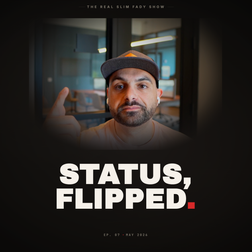
The New Rules of Status and Wealth
The flex changed and nobody told us. In 2015 the flex was a blue check. In 2020 it was a calendar link. In 2026 it's not having a smartphone. In this solo episode, Fady walks through three games — reachability, visibility, and effort — where the rules quietly flipped in the last decade. Why being unreachable is the new luxury (and who can't afford the flex). Why being un-Googleable is the new being seen. Why "I just threw this on" became the most labor-intensive aesthetic ever invented. And the one move nobody is faking yet — why earnestness is the only real flex left. We're all still playing 2018 and wondering why we feel behind. Nobody's going to send you that memo. You have to write it yourself. — The Real Slim Fady Show: Apple → https://podcasts.apple.com/us/podcast/the-real-slim-fady-show/id1640522523 Spotify → https://open.spotify.com/show/33udmtFwjLFt48pWSViwUz YouTube → https://www.youtube.com/playlist?list=PLW5rJOCqHMcDbHDCb5NZ693m7unzbUmGj TikTok → @therealslimfadyshow Fady: X → https://x.com/FadyHawatmeh / LinkedIn → https://www.linkedin.com/in/fadyhawatmeh/ / Clockwork → https://www.clockwork.ai/
The Ambition Trap
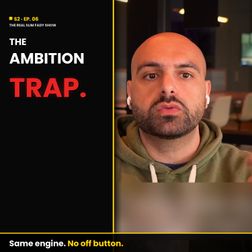
Once I get the promotion. Once I close the deal. Once I lose the weight. Once. Once. Once. In August 2022, four months after closing the seed at Clockwork, I sat in this chair and told you I had it figured out. I'm coming back to that episode four years later — not to say I was wrong about VC, but to say what I was actually doing the whole time I made it. I was inside the ambition trap. This episode is what the trap actually is — the gap between what we expect achievement to deliver (arrived, done, okay, worthy) and what it actually delivers (a week of dopamine and a quiet voice that says: what's next). Same mechanic as addiction. Different drug. The drug is achievement. I walk you through three rooms — Boeing, bootstrapping Clockwork, and the round itself. Same engine. Same trap. The room never mattered. Both columns of the ledger: 306 pounds and broke on one side; a hundred pounds gone, a company built, real love in my life on the other. Same switch the whole way. The trap isn't ambition. The trap is inheriting the engine and never being taught where the off button is. If you've ever chased the thing that was supposed to fix it and woken up thirty days later with the goalpost already moved — this one's for you. — The Real Slim Fady Show is a podcast about founders, failure, identity, and what it actually costs to build something real. Hosted by Fady Hawatmeh, founder of Clockwork. Follow: https://open.spotify.com/show/33udmtFwjLFt48pWSViwUz Connect with Fady: https://x.com/FadyHawatmeh | https://www.linkedin.com/in/fadyhawatmeh/ #ambition #burnout #founder #podcast
Fitting in is the quietest kind of lonely
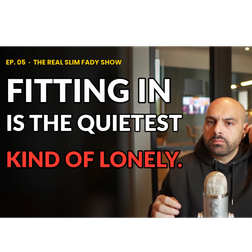
The worst loneliness isn't being kept out of the room. It's being let in, as someone you're not. For the majority of my life, I was a chameleon. I'd change my color for anyone, the pronunciation of my name, the drink in my hand, the version of me that walked into the room. People called me that and I took it as a compliment. What nobody told me was that the "you" people accept when you shrink is never actually you. The performance gets the love. The real you disappears. This episode is about the watered-down version of ourselves, the softer, quieter, easier-to-swallow edit we write so we can be loved without being seen. It's about the difference between fitting in and belonging, and what happens the first time you stop performing. If you've ever been well-liked and lonely in the same breath, this one's for you.

3 Unbelievable Stories I've Never Told
I've been sitting on these stories for years. Not because I was scared to tell them. Because I wasn't ready. In this episode, I tell three stories I've never shared publicly before. The first is about the time I got fired — recruited to take over a company at 25 and sabotaged by the guy who was supposed to be my ally. The second is about my best friend of 12 years who I hired at Clockwork, and how he formed a mutiny that nearly destroyed everything I built. The third is about a well-known VC who killed my deal the moment he found out I was Arab. Three different people. Three different rooms. Three different years. Same bet against me. Same result. I'm still here. This one's for anyone who's been fired, betrayed, or told they don't belong. You're not the only one.
306 - the number that changed my life
That's the number I saw when I finally stepped on a scale after years of refusing to look. Three hundred and six pounds. I was building Clockwork, closing deals, showing up for everyone except myself — and I didn't even realize how far gone I was. I bought bigger clothes instead of asking harder questions. I skipped meals or ate whatever was fastest. I told myself health could wait until after the next fundraise, the next launch, the next quarter. There was always a next thing. This episode is the story I've never told in full — how I got to 306 without noticing, the moment that number broke something open in me, and the nearly 100-pound journey that came after. It wasn't a montage. It was the hardest thing I've ever done. And the hardest part wasn't the gym or the food — it was giving myself permission to matter as much as my company. If you're a founder running on caffeine and cortisol telling yourself you'll deal with it later, this one's for you. There is no later.
1 de 4