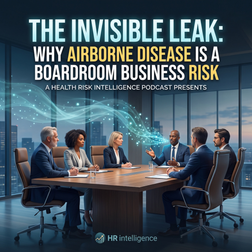
The Invisible Leak: Why Airborne Disease Is a Boardroom Business Risk
If your Chief Information Security Officer warned you of a silent, undetected data breach draining company resources, you wouldn’t hesitate to act. Yet when it comes to airborne biological threats like tuberculosis (TB), many global organizations relegate the risk to an HR footnote or a local public health problem—leaving a massive blind spot on their central risk register. In this episode of The Health Risk Intelligence Podcast, we examine why airborne disease management is not corporate charity, but an urgent operational imperative for global business continuity. Focusing on high-density operational hubs such as call centers, tech campuses, and manufacturing sites in rapidly growing markets like Nigeria, we unpack the intersection of physical infrastructure, financial liability, and corporate workplace policy. In this episode, we cover: The Operational Cascade: How aerosolized transmission of Mycobacterium tuberculosis in shared indoor air quietly drives presenteeism, specialized team depletion, and long-term business disruption. The Modern Design Paradox: Why tightly sealed, energy-efficient corporate buildings with high-recirculation HVAC systems inadvertently act as automated distribution networks for airborne pathogens. The Layered Defense Architecture: Practical engineering interventions—from optimizing outside-air ratios and MERV 13/HEPA filtration to deploying upper-room germicidal UV (UVGI)—without needing full structural overhauls. Why Culture Trumps Engineering: The failure of PPE-only mandates, the financial friction of presenteeism, and why paid medical leave and non-punitive symptom screening are critical to business survival. Future-Proofing the Business Model: How integrating airborne health defense into corporate ESG governance shields global operations against the next inevitable respiratory crisis.