St. Mary Magdalene Orthodox Church Bible Study

St. Mary Magdalene Orthodox Church Bible Study

por Fr Stephen Osburn
Temporada 2026
July 12th, 2026: Men and Women Were Not Created to Be Rivals
Saint Paul’s teachings about men and women are often quoted without their biblical and historical context. This sermon examines difficult passages concerning headship, women speaking in church, head coverings, marriage, and worship. It asks whether Paul viewed women as inferior or whether his true concern was restoring order and communion within divided Christian communities. The sermon begins with the Orthodox Christian understanding that men and women share one human nature and equal dignity before God. The Orthodox Church does not teach that men and women must compete for power. Masculine and feminine gifts are distinct, yet they are meant to work together in love. Saint Paul’s language of headship cannot be separated from sacrificial responsibility, mutual submission, and service. Christian authority never gives anyone permission to dominate, humiliate, or abuse another person. The sermon also considers why Paul discusses women praying, prophesying, wearing head coverings, and remaining silent during worship. These passages addressed specific questions of order within early Christian congregations. They should not be turned into weapons for shaming women or dismissing their service to the Church. Women served as missionaries, teachers, martyrs, deaconesses, spiritual mothers, and witnesses to the Resurrection. This teaching matters because modern culture often encourages resentment between men and women. Orthodox Christianity offers another path grounded in repentance, prayer, sacramental life, and communion. Men and women are called to help one another grow in holiness rather than build identities around anger or suspicion. This sermon invites listeners to consider how the Gospel can heal distorted ideas about masculinity, femininity, marriage, authority, and Christian service.
July 5th, 2026: When Desire Becomes Your God
In this sermon, Fr. Stephen reflects on the Gospel account of the demon-possessed men and the swine. The passage shows more than a dramatic miracle. It reveals how the human heart can become attached to possessions, comfort, and control. Orthodox Christianity teaches that the spiritual life begins when our desires are turned back toward God. The people in the Gospel witness a man being healed, yet they focus on the loss of their swine. This reaction exposes a deep struggle that all Christians face. We can say God is first while still protecting our own plans, opinions, money, and pride. The Orthodox Church calls this kind of attachment a form of idolatry when created things take the place of God. This sermon connects the Gospel to repentance, confession, obedience, and parish life. Confession helps us stop justifying ourselves and begin seeking healing. Obedience helps free us from self-will. The spiritual life is not about shaping God around our desires, but allowing God to heal and reshape our hearts. The message invites listeners to ask a simple but serious question: what do I love most? The Christian life is a call to seek God above every earthly thing. When we learn to rejoice in healing more than we grieve our losses, we begin to see the world with the mind of the Church. This is the path of Orthodox Christianity, where prayer, repentance, and worship lead us toward salvation.
June 28th, 2026: Freedom Without Obedience Becomes Another Slavery
This sermon examines the healing of the centurion’s servant in Matthew 8 and what the encounter teaches about faith, authority, and obedience. The centurion understands that he is both under authority and responsible for others. He also recognizes the limits of his own power. His humility allows him to trust the divine authority that can bring healing. The sermon explains why spiritual authority exists within the Orthodox Church. Bishops, priests, parents, and other leaders are given responsibilities for the good of those entrusted to them. Christian authority is meant to be sacrificial rather than controlling. It should guide people toward God, protect the unity of the Church, and support their salvation. Orthodox Christianity does not teach blind obedience or claim that clergy are incapable of mistakes. Christians must never cooperate with sin, manipulation, or abuse. At the same time, spiritual growth requires the humility to receive correction even when it challenges our opinions. Prayer, repentance, confession, and life in a parish help heal the pride that makes us trust only ourselves. True Christian freedom is not the power to do whatever we desire. It is freedom from sin, pride, and the passions so that we may love God and one another. This sermon invites listeners to consider whether their choices are shaped by personal preference or by a sincere desire for God’s will. The life of the Orthodox Church gives us a community in which we can ask questions, receive guidance, and grow together in the spiritual life.
June 21st, 2026: Celebrate God, Not Pride
In this sermon, Fr. Stephen Osburn reflects on Matthew 6 and the command to “seek first the Kingdom of God.” The Gospel teaches that the heart cannot serve two masters. Orthodox Christianity understands this as a direct call to turn away from self-rule and place God at the center of life. This sermon asks a simple but serious question: are we seeking God first, or are we still trying to serve ourselves? The sermon explains the Lord’s teaching about the sound eye, the divided heart, and the danger of being ruled by pride, desire, and comfort. The Orthodox Church teaches that the spiritual life is not built on affirming every feeling or following every desire. It is built on repentance, prayer, fasting, obedience, worship, and healing. When the self becomes the center, darkness spreads, but when God becomes the center, the whole life begins to be filled with light. This matters because the Gospel is not only about what we believe in our minds. It is about how we live each day. Orthodox Christians are called to shape their homes, schedules, habits, and choices around the life of the Church. Coming to services, praying at home, fasting, confessing sins, and speaking openly about the faith are not extra religious activities. They are part of learning to seek first the Kingdom. This sermon invites listeners to think honestly about what is ruling their hearts. The path of salvation begins with a real turn toward God, even if that first step feels small. The spiritual life is a lifelong process, but it must begin today. The Orthodox Church offers a life of repentance, healing, and communion with God for all who are willing to come and see.
June 14th, 2026: The Parish Where Saints Are Formed
This sermon reflects on the Sunday of All Saints of America and what it means to become holy in Orthodox Christianity. The Orthodox Church does not teach that saints are only people from ancient times or distant lands. Saints are real people whose lives have been healed, changed, and filled with the grace of God. This sermon asks a simple but serious question: what story will our life tell? Through three personal stories, the sermon shows how repentance, suffering, prayer, and faithfulness can transform a person. One life shows the change from bitterness to kindness. Another shows zeal for the growth of the Church and the constant reminder that everything is about Christ. Another shows the deep repentance of a man in prison who longed for the Divine Liturgy and prayed for mercy. The message is not that every inspiring person is automatically a canonized saint. Rather, it is that the spiritual life is meant to make holiness visible in ordinary people. Orthodox teaching reminds us that repentance is possible, prayer matters, and salvation is not just an idea, but a life lived in the Church. Even difficult circumstances can become places where a person turns toward God. This sermon invites listeners to think about the people who have drawn them closer to the Orthodox Church, prayer, and the Gospel. It also invites each of us to ask whether our own life is helping others move toward God. The saints of America show that holiness can take root here, in our own land, parishes, families, and struggles. The call of the Christian life is not simply to admire the saints, but to become like them by the mercy of God.
June 7th, 2026: Born Into the Kingdom Through Holy Baptism
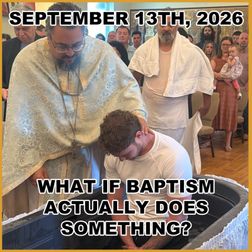
This sermon reflects on the meaning of Orthodox baptism and what it means to be brought fully into the life of the Church. At the heart of the sermon is Saint Paul’s teaching in Galatians: “As many as have been baptized into Christ have put on Christ.” Baptism is not treated as a private religious custom or a sentimental family moment. It is the beginning of new life, the restoration of the person, and entrance into the Kingdom of God. The sermon explains how baptism is connected to the whole worshiping life of the Orthodox Church. Through baptism, chrismation, tonsure, and Holy Communion, the newly baptized is received into the Body of Christ. The Church does not see these actions as empty symbols, but as real gifts of grace. The sermon also reflects on the royal priesthood of all believers and the ordered sacramental life of the Church. This teaching matters because baptism is not the end of Christian life, but the beginning of the spiritual life. Parents, godparents, and the whole parish are called to help the newly baptized grow in prayer, repentance, worship, and love. Orthodox Christianity teaches that salvation is lived in the Church, not as an isolated idea, but as a life of communion with God and one another. Baptism gives the gift, and the Christian life is learning to live from that gift. For those curious about Orthodox Christianity, this sermon offers a clear look at how the Orthodox Church understands baptism, salvation, and life in Christ. It invites listeners to see the Church not simply as a place of teaching, but as the place where the new creation is already being revealed. The sermon calls us to remember our own baptism and to live as people clothed in Christ. It is a pastoral reminder that the Christian life is meant to be received, nurtured, and lived within the worshiping Body of the Church.
June 7th, 2026: The Robe of Light
In this Orthodox Christian sermon, Fr. Michael Matsko reflects on the deep meaning of Holy Baptism and the “robe of light.” Baptism is not presented as a bare symbol or a private religious moment, but as the entrance into the life of the Orthodox Church. The sermon explains how the baptismal service reveals the Gospel through prayer, water, renunciation, confession, Chrismation, and the white garment placed on the newly baptized. It shows why Orthodox Christianity speaks of baptism as illumination, healing, and restoration. The sermon connects baptism to Adam and Eve, the fall, and the loss of humanity’s original beauty. In the Orthodox Church, baptism is understood as the beginning of the restoration of the human person. The newly baptized renounces Satan, turns toward the east, confesses faith in Christ, and receives the gift of the Holy Spirit. The robe of light shows that the person has been clothed in Christ and called to live a new life. This teaching matters because baptism is not only about what happens once in church. It shapes the whole spiritual life. Every Christian is called to live according to the grace received in baptism through repentance, prayer, worship, confession, the Eucharist, and love. Orthodox teaching reminds us that salvation is healing, not only forgiveness, and that the Church is where that healing life is given and nurtured. This sermon invites listeners to see baptism with fresh eyes. The prayers and actions of the Orthodox baptismal service show the beauty of the Gospel in a way that can be seen, heard, and lived. For those exploring Orthodox Christianity, this message offers a clear introduction to why baptism, Chrismation, and the life of the Church matter so deeply. The robe of light is not only something placed on the newly baptized, but a calling to walk in the light of God.
June 7th, 2026: Church is Not Optional
This sermon for the Sunday of All Saints reflects on what the saints teach us about priorities, worship, and the life of the Orthodox Church. In Orthodox Christianity, saints are not distant religious figures, but living witnesses of what happens when the grace of God heals and transforms a person. Their lives show that holiness is not reserved for the perfect, but is the calling of every Christian. The sermon also connects this feast with baptism, family life, and the responsibility to place God first. The central message is simple: the saints made Christ their priority. Some saints lived holy lives from childhood, while others had deeply sinful pasts and were changed through repentance. Their holiness was not based on comfort, status, or convenience. It came from a life turned toward God through prayer, worship, repentance, and faithfulness in the Church. This sermon also speaks directly to the everyday struggle of Christian life. Many people want faith to be important, but modern life constantly pushes worship to the side. The Orthodox Church teaches that Divine Liturgy, Vespers, feast days, confession, prayer, and the Eucharist are not extra religious activities. They are the way the soul is healed and trained to love God above all else. The Sunday of All Saints invites every listener to ask what truly comes first. The world pulls us in many directions, but the Church gives us a place of peace, healing, and communion with God. The saints show that a life centered on worship is not a loss of freedom, but the path to becoming fully alive. This sermon encourages us to come, pray, repent, and enter more deeply into the life of the Orthodox Church.
May 31st, 2026: The Orthodox Church Does Change?
In this sermon, Fr. Stephen reflects on Pentecost and what it means to become truly Christian. Pentecost is not only a feast about something that happened long ago. It is the revelation of the Holy Spirit forming the Church and changing ordinary people into saints. The sermon connects the ancient life of the Orthodox Church with the personal call to put on Christ and be made new. The sermon explains why many people are drawn to Orthodox Christianity today. People often come looking for something ancient, stable, and true, and that desire is good. But the Orthodox Church is not simply a place for religious nostalgia. It is the living Church, where the Holy Spirit continues to heal, teach, and transform the faithful. This teaching matters because the spiritual life is not only about becoming a nicer or more moral person. The Gospel calls us to repentance, prayer, forgiveness, service, and communion with God. The apostles were fishermen, laborers, and ordinary men, but by the grace of the Holy Spirit they became witnesses of the Kingdom. The same call is given to Orthodox Christians today. This sermon invites listeners to reflect on where they still need to change. Growth in the Christian life happens little by little, through the life of the Church and the work of God’s grace. Pentecost reminds us that Christianity is not just about looking back to the past, but about being changed now. The Orthodox Church continues to invite all people to come, pray, repent, worship, and become who God created them to be.
May 24th, 2026: We Guard the Faith by Living It Faithfully
This sermon reflects on the Sunday of the Fathers of the First Ecumenical Council and why the Orthodox Church teaches that truth matters. The sermon focuses on the warning of Saint Paul in Acts 20, where he tells the leaders of the Church to guard the flock. The danger he describes is not only outside persecution, but confusion that can arise from within the Christian community. This is a sermon about Orthodox Christianity, doctrine, spiritual vigilance, and learning to live the faith with humility. The Fathers of the First Ecumenical Council defended the Church against the Arian heresy, which denied the full divinity of the Son of God. Their witness reminds us that the Nicene Creed is not just a historical statement or a set of religious words. It is a confession of the truth that shapes prayer, worship, salvation, and the spiritual life. The sermon explains that Orthodox apologetics is not about online arguing, but about knowing what the Church teaches and living it faithfully. This matters because Christians can be weakened when they do not know the faith they claim to follow. If we only study Orthodoxy but do not pray, repent, and worship, our knowledge becomes empty. If we try to live the faith without learning what the Orthodox Church teaches, we can become confused and easily led away. The Christian life requires both knowledge and practice, both doctrine and repentance, both worship and understanding. The sermon invites listeners to take the faith seriously without becoming harsh or prideful. Orthodox Christians are called to grow through Scripture, the Divine Liturgy, prayer, confession, classes, parish life, and conversations with faithful guides. The goal is not to win arguments, but to become rooted in the life of the Church. When the faith is known and lived, the Church’s witness to the world becomes clearer, stronger, and more faithful.
1 de 17