Para Bellum

Para Bellum

por Anthony W Green
Temporada 2
John 1:1-5
Sunday worship message form the Church on Detroit in Bellefontaine, Ohio.
Genesis 2:15-25
This sermon brings us into the heart of Eden, revealing God’s original design for humanity—our work, our obedience, our relationships, and the covenant of marriage. In this passage, we see that man was created with purpose: to labor faithfully, to obey God’s Word, and to live in covenant fellowship with Him. At the center of the message is God’s provision in creating the woman as a perfect helper for the man, establishing the foundation of marriage as a covenantal, one-flesh union. This union is not merely social or practical—it is deeply theological, pointing forward to Christ and His relationship with the Church. The sermon highlights both the dignity and distinction of men and women, designed to reflect God’s glory together. The message also captures the beauty of humanity before the fall—“naked and unashamed”—a picture of perfect innocence, unity, and communion with God. Yet even here, it points forward to the need for redemption and the covering of sin that comes through Christ. Ultimately, this sermon calls us to live faithfully in our God-given roles, to honor His design for marriage, and to rest in the righteousness of Christ, who restores what was lost in Eden.
Genesis 2:4-15
This sermon moves from the broad scope of creation into the intimate, personal work of God in forming man and establishing his purpose. Genesis 2 reveals God not only as Creator, but as the covenant LORD who carefully shapes humanity, breathes life into him, and places him in a prepared environment designed for flourishing. At the center of the message is humanity’s identity and calling. Man is formed from dust yet filled with the breath of God—created for relationship, responsibility, and worship. Placed in the garden, Adam is given a sacred task: to work and keep it. This work is not merely physical labor but a priestly calling to serve God, guard His dwelling, and extend His rule throughout the earth. The sermon also highlights God’s provision and presence in Eden, showing that true life and flourishing flow from Him alone. Ultimately, it points forward to Christ—the greater Adam—who fulfills what Adam failed to do. In Him, our purpose is restored, our work becomes worship, and we are brought back into communion with God. This message calls us to live intentionally as those formed by God, placed by God, and called to reflect His glory in every area of life
Genesis 2:1-3
This sermon explores the completion of God’s creation and the significance of His rest on the seventh day. As Genesis concludes the creation account, it reveals a God whose work is perfect, complete, and lacking nothing—displaying His sovereignty, wisdom, and glory in all that He has made. At the heart of the message is the meaning of God’s “rest.” Not a rest from weariness, but a satisfied ceasing from His finished work. This divine pattern establishes the foundation for the Sabbath, calling humanity into a rhythm of work and rest rooted in trust, worship, and dependence on God. The sermon emphasizes that the Sabbath is both a gift and a calling—set apart as holy for renewal and fellowship with God. Ultimately, the message points beyond creation to Christ, where true Sabbath rest is fulfilled. Just as God finished His work in creation, Christ finished the work of redemption. In Him, believers are invited to cease striving and rest in His completed work. This sermon calls us to trust God’s sovereignty, honor His design for rest, and find our deepest peace in the finished work of Jesus Christ.
Genesis 1:24-31
This sermon walks through the sixth day of creation, revealing God as the sovereign Creator who brings all life into existence by His powerful Word. From the animals that fill the earth to the unique creation of humanity, the passage highlights both the order and intentional design of God’s world. At the center of the message is the truth that mankind is made in the image of God—distinct from all other creatures, bearing dignity, purpose, and responsibility. The sermon emphasizes that our identity is not found in the animal world or cultural definitions, but in our relationship to God as His image-bearers, created male and female for His glory. It also calls believers to live out their God-given role: to exercise faithful dominion, steward creation, and reflect God’s character in the world. Rooted in God’s blessing and provision, the message ultimately points forward to the hope of restoration through Christ, reminding us that the God who declared creation “very good” is making all things new.
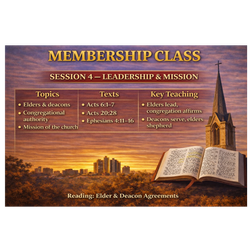
Session 4: Leadership & Mission
This session explores how Christ leads His church and what He has called it to do. We will examine the biblical roles of elders and deacons, seeing that elders are called to shepherd and teach while deacons serve and support the life of the church (Acts 6:1–7; Acts 20:28). We will also consider the role of the congregation, highlighting how members participate in affirming leadership and guarding the life of the church. Finally, we will look at the mission of the church in Ephesians 4:11–16—how leaders equip the saints, and how every member is called to build up the body and take part in the work of ministry. This session emphasizes that the church is both ordered and active: led by faithful leaders, supported by committed members, and sent into the world with the gospel.
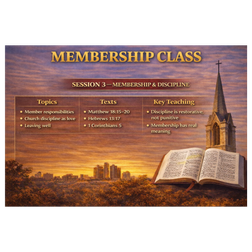
Session 3 – Membership & Discipline
This session explores what it truly means to belong to a local church. We’ll look at the responsibilities of church members, the biblical purpose of church discipline as an act of love and restoration, and what it means to leave a church in a healthy and honoring way. Together, we’ll see that membership is not casual—it carries real commitment, accountability, and care within the body of Christ.
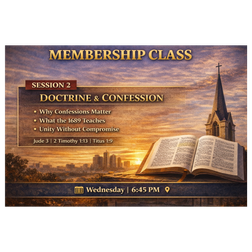
Session 2: Doctrine and Confession
This session focuses on why clear, biblical doctrine is essential for the life and health of the church. We will examine Scripture’s call to guard and pass on sound teaching (Jude 3; 2 Timothy 1:13; Titus 1:9) and consider how confessions serve as faithful summaries of what the Bible teaches. Looking at the 1689 Baptist Confession, we will see how it provides doctrinal clarity, unity, and accountability while remaining subordinate to Scripture. This session also addresses the importance of pursuing unity without reducing truth, emphasizing that members affirm the church’s doctrine and elders are called to uphold and teach it faithfully.
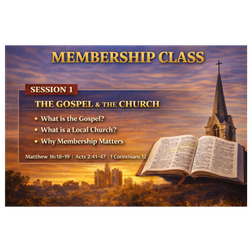
Session 1: The Gospel and The Church
This session lays the foundation for understanding the Christian life and the purpose of the local church. We will explore the message of the gospel—how God saves sinners through the life, death, and resurrection of Jesus Christ—and how that gospel creates a new people called the church. Looking at passages such as Matthew 16:18–19, Acts 2:41–47, and 1 Corinthians 12, we will see that the church is not merely a place people attend but a covenant community where believers are united to Christ and to one another. This session also introduces the importance of church membership, highlighting how biblical membership involves commitment, accountability, and shared life within the body of Christ.

Genesis 1:14-23
Sermon from the Church on Detroit in Bellefontaine, Ohio.
1 de 2