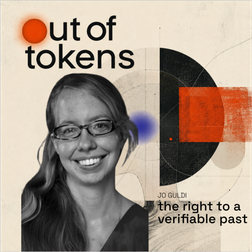
The Infrastructure of Truth: Why AI's Bottleneck Isn't Intelligence with Jo Guldi
Everyone agrees AI is about to get smarter. Jo Guldi thinks intelligence was never the bottleneck. The real constraint is something quieter and far harder to fake: the infrastructure that tells us what actually happened. Guldi is a historian who grew up coding on the Texas "Silicon Prairie," then became, in 2008, the first person ever to hold a faculty post in "digital history." She's now Professor of Quantitative Methods at Emory, a historian of capitalism and infrastructure, and the author of The Dangerous Art of Text Mining. She's spent her career on the seam between data science and the archive, which makes her uniquely clear-eyed about what large language models can and can't do. Her argument cuts against the moment. As AI becomes the way most people get their information, the scarcest resource won't be answers -- it'll be provenance: the ability to trace where a document came from and whether it's real. And the institutions that guard that have been quietly starved of investment for decades, right as we've gained the power to manufacture convincing fakes at scale. We get into: Why a document's "biography" may become the most valuable thing in the AI era, and how a genocide once hidden in an unmarked archive proves the stakes The "right to a verifiable past," and how losing it resembles life under an authoritarian regime Why the world's archives -- measured in shelf kilometers, much of it too sensitive to digitize -- won't be swallowed by the labs any time soon What her lab found mapping historical disagreement across 300+ languages of Wikipedia, and why "when did your country begin?" is a more loaded question than it sounds "White-box" history: using LLMs inside a pipeline you can actually inspect, instead of trusting a black box's version of the past Why, if AI can write the essay and the code, a liberal-arts education might be the job training nobody saw coming