Can Your Phone Really Detect Metal? The Science Behind Smartphone Metal Detection
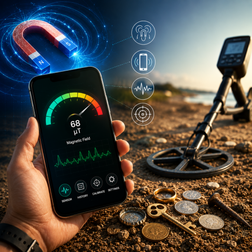
Can a smartphone really find metal? The answer starts with a small but powerful component inside many Android devices: the magnetometer. This sensor measures magnetic-field strength, allowing compatible phones to detect changes caused by nearby magnetic materials. In this episode of Magnetic Mysteries, we take listeners from the basics of Earth's magnetic field to the practical process of scanning for nearby metal. We explain what happens when a phone approaches an iron nail, steel object, pipe, or other ferromagnetic material and why the magnetic reading changes. The Metal Detector app turns these sensor measurements into an easy-to-follow scanning experience. Instead of simply showing raw sensor information, it presents magnetic-field strength through a gauge and signal-history graph while optional sound and vibration feedback can help users recognize changes during a scan. We begin by explaining the magnetometer. Think of it as a sensor that can measure the magnetic environment around the phone. Earth itself produces a magnetic field, and nearby ferromagnetic objects can disturb that field. When the phone detects a significant change, the reading can rise or fall depending on the object, distance, orientation, and surrounding environment. Next, we discuss how to perform a basic scan. Before searching, users should understand the surrounding magnetic environment and calibrate the device when necessary. The phone can then be moved slowly across the area being investigated. A changing gauge reading, graph signal, sound pattern, or vibration can indicate a magnetic-field disturbance. The app also provides X, Y, and Z magnetic-field readings, which can help users understand directional changes. The episode then explores sensitivity. A high sensitivity setting may make smaller changes easier to notice, but surrounding magnetic interference can also produce more signals. A lower setting can be useful in noisy environments. Learning to adjust sensitivity based on the environment is therefore an important part of getting useful readings. We also examine what smartphone metal detectors can and cannot detect. Ferromagnetic materials such as iron and steel are suitable targets because they strongly interact with magnetic fields. However, users should not assume that every type of metal will trigger the sensor. Non-magnetic materials such as aluminum, copper, and gold may not be detected in the same way. Detection accuracy also depends on the magnetometer installed in the particular smartphone.