Letters From Home

Letters From Home

por Hank Garner
Temporada 2
Letter 074 — The Address: Are You in the All? (Isaiah 53:6)
Support Letters From Home at https://buymeacoffee.com/lettersfromhome Donate via PayPal: paypal.me/authorhankgarner The verse says the iniquity of us all was laid on Him. Every clause insists on all. Does that include you? In this letter - The Hebrew emphatic in verse 6 - Belief versus living from what you believe - The six substitutions unpacked for your specific life - Why the intercession in verse 12 is ongoing - The honest question about what you are still carrying Scripture — Isaiah 53:4-6, 12; Hebrews 7:25; Romans 8:34; 1 John 2:1 The question to sit with Where in your life have you been carrying what has already been laid on Him? Coming tomorrow | The Whole Letter. > There'll be more mail tomorrow.
Letter 073 — The Story: The Iniquity of Us All (Isaiah 53)
Support Letters From Home at https://buymeacoffee.com/lettersfromhome Donate via PayPal: paypal.me/authorhankgarner The Servant is despised, rejected, silent at His trial, wounded, bruised, and buried with the rich. And the iniquity of us all falls on Him. In this letter - Walking verses 13 through 12 slow - Mareh and mishchat — appearance disfigured beyond human - Nazah — sprinkle, priestly word - The six substitutions in verse 5 - Paga (H6293) in verse 6 — the iniquity landing on Him - Asham — guilt offering - The two burial details fulfilled at the cross - Paga again in verse 12 — intercession Scripture — Isaiah 52:13-53:12 Hebrew word studies - paga (פָּגַע, Strong's H6293) — to fall on, to rush at, to meet, to intercede - makh'ov — pain, sorrow - choli — sickness, grief - asham — guilt offering Coming tomorrow | The Address. > There'll be more mail tomorrow.
Letter 072 — The Sender: The Fifth Gospel (Isaiah 53)
Support Letters From Home at https://buymeacoffee.com/lettersfromhome Donate via PayPal: paypal.me/authorhankgarner Isaiah preached across four kings of Judah. In the middle of his long book sits a passage that describes Jesus with such precision that most readers can't believe it was written seven centuries before Him. In this letter - Isaiah's context — eighth century BC, four kings - The book's structure — the Book of Comfort in chapters 40-55 - The four Servant Songs - How Isaiah 53 matches the crucifixion detail by detail - Acts 8 and Philip preaching Jesus from this passage Scripture — Isaiah 6:1; Isaiah 40:1-2; Acts 8:26-35 Coming tomorrow | The Story. > There'll be more mail tomorrow.
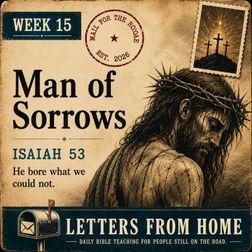
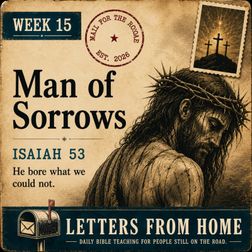
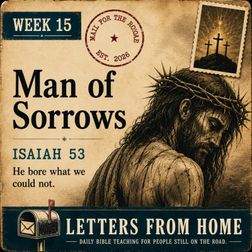
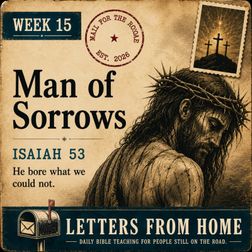
Letter 071 — The Envelope: Man of Sorrows (Isaiah 53)
Support Letters From Home at https://buymeacoffee.com/lettersfromhome Donate via PayPal: paypal.me/authorhankgarner Written seven hundred years before the man it describes was born. The clearest description of the crucified Messiah in the entire Old Testament. In this letter - A slow read of Isaiah 52:13-53:12 (NKJV) - The six-fold substitution in verse 5 - The Hebrew word paga teased for Friday - Why this passage is called the Fifth Gospel Scripture — Isaiah 52:13-53:12 Coming tomorrow | The Sender. > There'll be more mail tomorrow. Join me at hanksbiblestudy.com for more resources to help strengthen your faith.
Letter 070 — The Whole Letter: Devarim (Exodus 20)
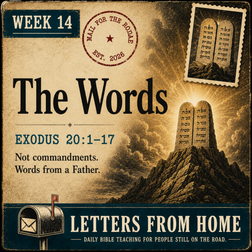
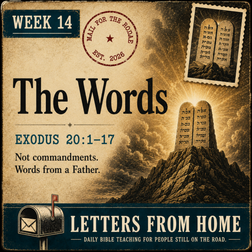
In Hebrew, the ten are not called commandments. They are called devarim. Words. And words are different from commandments. In this letter - Aseret hadevarim — the Ten Words - Dabar (H1697) as the singular - The three uses of the phrase in the Torah — Exodus 34:28, Deuteronomy 4:13, Deuteronomy 10:4 - Why the Latin decem praecepta shifted the frame - The ten walked one more time as words from a Father, not commands from a superior - Romans 13 — love as the fulfillment of the law - A direct pastoral landing for the burdened, the failing, and the frame-corrupted Scripture — Exodus 20:1-17 (full); Deuteronomy 4:13, 10:4; Exodus 34:28; Romans 13:8-10 Hebrew word studies - dabar (דָּבָר, Strong's H1697) — word. The name for the ten. - aseret hadevarim — the Ten Words Next week's letter | Isaiah 53 — Man of Sorrows. > That's this week's letter. We'll see you Monday with another. Support Letters From Home at https://buymeacoffee.com/lettersfromhome Join us at https://hanksbiblestudy.com for more resources to help strengthen your faith.
Letter 069 — The Address: You Are Reading the Wrong Frame (Exodus 20)
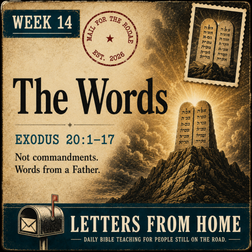
Most of us have been reading the Ten Commandments as a to-do list. As a test. As a standard we are supposed to meet. The Bible calls them words, not commandments. Today we ask what changes when the frame shifts. In this letter - The earn-it frame versus the rescued-life frame - Why the Sabbath is a gift, not a rule, under the right frame - Obedience as fruit, not root - The tradition of counting verse 2 as the first commandment - The rescue that precedes every response Scripture — Exodus 20:2-17 The question to sit with Which frame have you been reading the Ten under? A test to pass, or the shape of a life you have already been given? Coming tomorrow | The Whole Letter. > There'll be more mail tomorrow. Support Letters From Home at https://buymeacoffee.com/lettersfromhome Join us at https://hanksbiblestudy.com for more resources to help strengthen your faith.
Letter 068 — The Story: Ten Words, Walked Slow (Exodus 20)
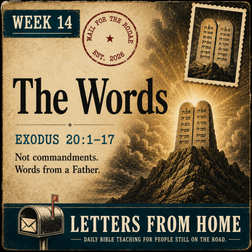
Ten items. Vertical first, horizontal after. Today we walk each one and notice what the Hebrew is doing. In this letter - The prologue in verse 2 - The first four vertical words — no other gods, no idols, no vain use of the name, Sabbath - The fifth as the hinge — honor father and mother - The last five horizontal words — do not murder, adulterate, steal, lie, covet - The Hebrew qanna (jealous) and shav (vain) - Why ratsach is murder, not all killing - Why do not covet goes inward Scripture — Exodus 20:1-17 Hebrew word studies - qanna — covenant-jealous - shav — vain, empty - ratsach — to murder, unlawfully kill Coming tomorrow | The Address. > There'll be more mail tomorrow. Support Letters From Home at https://buymeacoffee.com/lettersfromhome Join us at https://hanksbiblestudy.com for more resources to help strengthen your faith.
Letter 067 — The Sender: A Mountain That Shook (Exodus 19-20)
The words came out of thunder and smoke and fire. The mountain shook. The people trembled. And God spoke ten words to a people He had just rescued from four hundred years of slavery. In this letter - The rescue leading up to Sinai — plagues, Passover, Red Sea, manna - Exodus 19 — the setup, the covenant offer, the preparation - The theophany at Sinai — thunder, smoke, fire - Why the ten were given at this moment, to these people - How every command was a rejection of something in the Egyptian world Scripture — Exodus 19; Exodus 20:1-2 Coming tomorrow | The Story. > There'll be more mail tomorrow. Support Letters From Home at https://buymeacoffee.com/lettersfromhome Join us at https://hanksbiblestudy.com for more resources to help strengthen your faith.
Letter 066 — The Envelope: The Ten Words (Exodus 20:1-17)
They are the most famous words in human history. And they are not called commandments in Hebrew. They are called words. In this letter - The historical setting — Sinai, three months after the Exodus - A slow read of Exodus 20:1-17 (NKJV) - The prologue in verse 2 — the rescue before the commands - The vertical/horizontal structure — the first four toward God, the last six toward neighbor - The Hebrew name teased — aseret hadevarim, the Ten Words Scripture — Exodus 20:1-17 Coming tomorrow | The Sender. > There'll be more mail tomorrow. Support Letters From Home at https://buymeacoffee.com/lettersfromhome Join us at https://hanksbiblestudy.com for more resources to help strengthen your faith.
Letter 065 — The Whole Letter: Yada (Psalm 139)
The word for what God does to David runs through the whole psalm. Yada. Intimate knowing. The word for a husband and wife. The word for covenant. The word for the God who wove you before you were you. In this letter - The arc from alarm to invitation - Yada traced through the Hebrew Bible — Genesis 4, Amos 3, Jeremiah 1 - The four movements as a spiritual journey - Why the searching is not surveillance - A direct pastoral landing for the hiding, the afraid, the grieving, and the accidental Scripture — Psalm 139; Jeremiah 1:5; Amos 3:2 (referenced) Hebrew word studies - yada (יָדַע, H3045) — to know intimately (the Friday apex) - tsur (צוּר, H6696) — to hem in (carried from Wednesday) Next week's letter | Exodus 20:1-17 — The Words. > That's this week's letter. We'll see you Monday with another. Support Letters From Home at https://buymeacoffee.com/lettersfromhome Join us at https://hanksbiblestudy.com for more resources to help strengthen your faith.
1 de 8