Talking Machines (But Chill)

Talking Machines (But Chill)

por Joe Schlanger
Temporada 1
The Future of Property Claims Is Proactive, Not Reactive
IA
This week's conversation focused on one of the biggest shifts happening in our industry: moving from reactive claims handling to proactive claims management. We explored how artificial intelligence, real-time data, and human expertise are working together to transform the property claims experience. Some of the key takeaways: Predicting losses before they become larger catastrophes. Improving catastrophe response with better data and faster decision-making. Connecting with policyholders more quickly during their time of need. Empowering claims professionals with smarter insights—not replacing their expertise. The future of claims isn't about choosing between people and technology—it's about combining the strengths of both to deliver faster, more informed, and more compassionate service. Thank you to everyone who has listened and supported the podcast. Your engagement and feedback continue to shape these conversations. What was your biggest takeaway from this week's episode? Where do you see AI making the biggest impact in property claims over the next five years? #PropertyClaims #Insurance #ArtificialIntelligence #InsurTech #CatastropheClaims #Leadership #Innovation #ClaimsManagement #Podcast
AI Scales Catastrophe Insurance Claims
IA
Welcome to today’s episode, where we explore how artificial intelligence and drone technology are reshaping the insurance industry. From aerial imagery that makes property inspections safer and faster, to natural language processing that uncovers subrogation opportunities buried deep in claim files, insurers are shifting toward smarter, data‑driven decision‑making. These tools are reducing human error, fighting fraud, and accelerating recovery — all while lowering costs for carriers and policyholders. Let’s dive into how this digital transformation is redefining what modern claims handling looks like.
The Environmental Cost of Generative AI
Generative AI has a significant environmental footprint due to its high energy, water, and hardware demands. Training large models can consume several times more energy than typical computing tasks—sometimes enough to power over 100 homes for a year—while data centers also use substantial water for cooling. Rapid expansion often relies on fossil fuel-based electricity, increasing carbon emissions, and the production and frequent replacement of specialized GPUs contributes to electronic waste. Environmental impact varies by task, with image generation requiring more energy than simple text responses. Growing public concern has led experts to call for greater corporate responsibility, including renewable energy use, transparency, and smaller, more efficient AI models.
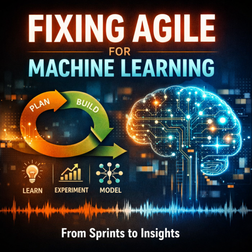
Fixing Agile for Machine Learning Development
Fixing Agile for Machine Learning explores why traditional Agile frameworks struggle in data science and AI—and what to do instead. Agile was built for predictable software delivery. Machine learning is anything but predictable. Models fail, data shifts, experiments dead-end, and “done” is never binary. When teams force ML work into classic Scrum rituals, the result is frustration, fake estimates, and broken trust with stakeholders. This podcast reframes Agile for the realities of machine learning. We dive into: Why user stories, velocity, and sprint commitments break down in ML How to shift from delivery-centric planning to learning-centric execution Redefining “done” for experiments, models, and data Separating research from production without losing momentum Making data quality, bias, and model risk first-class Agile concerns Communicating uncertainty without losing stakeholder confidence Whether you’re a product manager, Agile leader, data scientist, or executive trying to scale AI responsibly, this show offers practical guidance for building ML teams that learn faster, ship smarter, and stop pretending uncertainty can be planned away.