
Notas del episodio
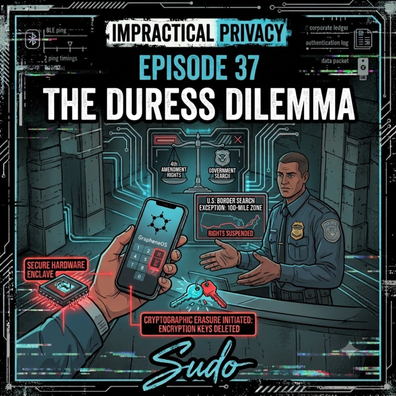
In this episode of Impractical Privacy, Sudo tackles a massive shift in how the government interacts with our digital rights at physical borders and international airports. By examining the recent July 2026 case of Samuel Tunick—the first known instance of federal prosecutors charging an individual for using a GrapheneOS "duress" password—the episode explores the chilling collision between brilliant privacy tools and aggressive, warrantless search policies.
Moving past legal theories, Sudo breaks down the architectural reality of cryptographic erasure and what the suspension of constitutional rights within the border zone means for your data. Packed with a practical survival guide, this episode provides actionable steps to secure your hardware, minimize your digital footprint, and safely cross international checkpoints without relying on legally perilous automated wipes.
📚 Chapters
- The Border Search Exception: Federal authorities routinely conduct invasive, warrantless electronic device searches at physical borders and international airports, operating in a constitution-free zone.
- Cryptographic Erasure: Instead of slowly overwriting data, modern duress features instantly delete the encryption keys from a secure hardware element, turning your flash storage into an undecipherable blob of random noise.
- The 100-Mile Zone: The legal environment allows Customs and Border Protection to bypass standard Fourth Amendment protections, effectively placing anyone clearing customs in a jurisdictional void.
- Tampering with Evidence: The federal prosecution of Samuel Tunick sets a dangerous precedent by attempting to classify the use of a defensive duress PIN as the criminal destruction of evidence.
- Securing Your Devices: Taking back custody of your data requires strict best practices like powering down devices to enter "Before First Unlock" (BFU) state, traveling with burner phones, and relying on data minimization rather than automated wipes.
🛠️ Resources & Tools
- GrapheneOS Duress Feature: A custom Android operating system feature that allows users to set a specific passcode that commands the secure hardware enclave to delete encryption keys.
- Burner Phones & Cloud Backups: Keep your primary "crown jewels" safe by traveling with secondary devices or factory-resetting your primary phone and restoring from a secure cloud backup only after safely clearing customs.
- Before First Unlock (BFU): Powering down your smartphone completely before approaching a border checkpoint ensures encryption keys are removed from the device's working memory, making forensic data extraction exponentially harder.
- Data Minimization: A legally safer alternative to using a duress PIN in front of law enforcement, focusing on keeping a device inherently clean during travel to avoid potential obstruction or evidence tampering charges.
🌐 Connect
- Website: https://impracticalprivacy.comThe tracker-free, telemetry-free hub for the show, now including Bitcoin and Monero support options.
- Patreon: https://impracticalprivacy.com/patreon