Here’s a podcast-friendly discussion between Ruby, Randy, and Agnes,

Here’s a podcast-friendly discussion between Ruby, Randy, and Agnes,

por Solomon Gameli
Temporada 1
After Abraham pleads for Ishmael
Narrows God’s covenant promises with sharp clarity. After Abraham pleads for Ishmael, God assures him that Ishmael will indeed be blessed and become a great nation, but the covenant itself will rest uniquely with Isaac—the son Sarah will bear within the year. God sets this timeline firmly, leaving no room for doubt. In response, Abraham obeys immediately: at ninety-nine years old, he circumcises himself along with Ishmael, who is thirteen, and every male in his household, just as God commanded. In short: these verses highlight both God’s precision and Abraham’s obedience. The covenant isn’t vague or generic—it’s tied specifically to Isaac, not Ishmael, and bound to God’s appointed time. Abraham models faith by acting without delay, turning divine promise into tangible obedience. It’s the moment covenant promise, and covenant sign unite, faithfully carried out in the real world.
Circumcision, Covenant Cut, and New Names
This chapter Explains the covenant sign in detail. God establishes circumcision as the lasting mark of His covenant: every male in Abraham’s household, whether born into the family or acquired as a servant, must be circumcised. This act will serve as a physical reminder of belonging to God and participating in His promise. God stresses the seriousness of this sign—any uncircumcised male will be cut off from the covenant people. Then, the focus shifts to Sarai: God not only includes her in this covenant plan but also changes her name to Sarah, signaling her central role in the promise of descendants and nations. In short: these verses tie God’s eternal covenant to a very tangible symbol—circumcision—binding Abraham’s household to Him in body as well as faith. At the same time, Sarah is lifted up as more than Abraham’s partner; she, too, is renamed and redefined as essential to God’s unfolding plan. Promise now has both sign and shared partnership, linking Abraham and Sarah together in covenant purpose.
Abraham's Covenant: Renaming, Promises, and the Sign
We continue the covenant revelation and sharpen its details. After renaming Abram as Abraham, God explains the depth of the promise: Abraham will be the father of many nations, and kings will come from his line. God establishes this covenant as everlasting—not just with Abraham, but with his descendants for generations to come. The promise includes the gift of the land of Canaan as their perpetual homeland. As a sign of this unbreakable covenant, God commands Abraham and his family to keep His covenant by practicing circumcision, making it a physical mark of belonging to Him. In short: these verses expand God’s promise from personal to generational, from land to nations, and from word to sign. Abraham isn’t just promised descendants; he’s promised legacy. Circumcision becomes the enduring reminder that this family is set apart for God. It’s big-picture destiny sealed with a very practical, personal sign—eternal promise meeting everyday obedience.
El-Shaddai Renames Abram: Covenant and New Identity
This marks a monumental moment in Abram’s story. At ninety-nine years old, Abram encounters God, who reveals Himself as El Shaddai—“God Almighty.” God calls Abram to walk faithfully and blamelessly before Him as He renews His covenant. The promise expands: Abram will be the father of many nations, not just one. To signify this transformation, God changes his name from Abram (“exalted father”) to Abraham (“father of many”), making his very identity a living reminder of God’s promise. In short: these verses are a turning point where covenant becomes personal. God isn’t just making promises; He’s reshaping Abram’s destiny down to his name. It’s as though God is saying, “Your life, your future, even your identity—I’m rewriting it to reflect My plan for you.” Faith meets promise here, and Abraham steps fully into the role of covenant bearer.
Ishmael's Birth: God Hears and the Covenant Unfolds
In short: these verses may sound like brief housekeeping, but they carry big meaning. God’s word to Hagar is fulfilled exactly, Abram acknowledges the child by name, and the timeline is carefully marked. It’s a quiet pause before the next chapter, reminding us that God’s plan is unfolding step by step—even through imperfect choices and complicated family dynamics.
Hagar's God: El-Ro'i and Ishmael's Destiny
Genesis 16:10–15 describes God’s remarkable promise to Hagar and its fulfillment. The angel of the Lord declares that her descendants will be too numerous to count and tells her she will bear a son named Ishmael (“God hears”), because the Lord has heard her misery. He also explains Ishmael’s future: he will live in conflict with others, a man of fierce independence. Hagar, overwhelmed by this encounter, gives God a new name—“the God who sees me”—testifying that in her pain she has been noticed by Him. She bears Ishmael, and Abram, now 86 years old, names the boy as the angel directed. In short: these verses transform a runaway servant’s despair into a story of divine attention and promise. Even as Abram and Sarai’s impatience created turmoil, God shows up for Hagar, proving that He sees and hears those overlooked by others. The birth of Ishmael becomes both a blessing and a foreshadowing of future tension—but above all, a testament that no one is invisible to God.
Hagar in the Wilderness: God Sees and Multiplies
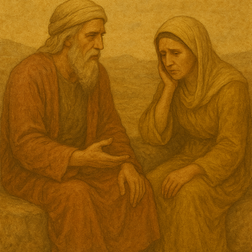
Unfolds the fallout of Sarai and Abram’s plan. After Hagar conceives, Sarai feels despised by her servant and blames Abram for her mistreatment. Abram, avoiding responsibility, tells Sarai to handle the situation as she sees fit, leading Sarai to treat Hagar harshly. Hagar flees into the wilderness, but there, to her amazement, an angel of the Lord finds her by a spring of water. The angel speaks with compassion and instruction, telling Hagar to return and submit to Sarai, while also promising that her descendants will be too numerous to count. In short: these verses reveal both human brokenness and divine kindness. Sarai and Abram’s attempt to control the promise collapses into strife, but God steps into the wilderness to meet a vulnerable, mistreated servant. Hagar, often overlooked by others, is seen, addressed, and promised a future. It’s an extraordinary reminder that God’s care reaches even the margins of the story.
Sarai, Hagar, and the Echoes of Eden
This introduces one of the most complex turns in Abram’s story. Sarai, still barren despite God’s earlier promises, feels the sting of disappointment and takes matters into her own hands. She proposes that Abram have a child through her Egyptian servant, Hagar—a practice acceptable in their culture but shortcutting God’s plan. Abram agrees, Hagar conceives, and suddenly the household is filled with tension. Hagar begins to look down on Sarai, and Sarai, hurt and angry, blames Abram for her distress, creating an atmosphere heavy with rivalry and resentment. In short: these verses show what happens when impatience mixes with human problem-solving. Sarai and Abram try to “help” God’s promise along, but the result is bitterness instead of blessing. The passage is both painfully human and profoundly relatable—an early reminder that God’s purposes can’t be hurried, and that shortcuts to His promises often lead to long-term complications.
Covenant Sealed: God's Grace in Smoke and Fire
This concludes God’s covenant vision with Abram. concludes God’s covenant vision with Abram. God promises Abram that he will die peacefully at a good old age, while his descendants will return to the land in the fourth generation—after the iniquity of the Amorites has reached its full measure. Then, in a dramatic scene, a smoking firepot and a blazing torch—symbols of God’s presence—pass between the pieces of the sacrificed animals. This act seals the covenant, showing that God Himself binds the promise. The covenant affirms that Abram’s descendants will receive a vast territory, stretching from the river of Egypt to the Euphrates, including the lands of many peoples such as the Kenites, Hittites, and Jebusites., while his descendants will return to the land in the fourth generation—after the iniquity of the Amorites has reached its full measure. Then, in a dramatic scene, a smoking firepot and a blazing torch—symbols of God’s presence—pass between the pieces of the sacrificed animals. This act seals the covenant, showing that God Himself binds the promise. The covenant affirms that Abram’s descendants will receive a vast territory, stretching from the river of Egypt to the Euphrates, including the lands of many peoples such as the Kenites, Hittites, and Jebusites.
Covenant, Dread, and Shalom
Continues the solemn covenant scene. Abram prepares the animals as God instructed, cutting them in half and laying them opposite each other, but he does not divide the birds. As he waits, birds of prey swoop down, and Abram drives them away, hinting at the struggles his descendants will face before the promise is fulfilled. Abram then falls into a deep, heavy sleep, and God reveals to him what lies ahead: his descendants will be strangers in a foreign land, enslaved and oppressed for 400 years, but God will ultimately bring them out with great possessions and justice against their oppressors. God also assures Abram that he himself will die in peace at a good old age, resting long before these hardships come to his family. In short: these verses shift God’s promise from pure hope to a sobering prophecy. Yes, Abram’s descendants will flourish, but the road there includes hardship, waiting, and deliverance. It’s a reminder that God’s promises are certain, but often unfold through trials. Abram is comforted with peace for his own life, while his children’s future becomes a testimony to God’s power to redeem even through struggle.
1 de 8