Foster Care Uncovered

Foster Care Uncovered

por Sarah Anderson & Louise Allen
Temporada 1
You're “Just” a Foster Carer
You're “Just” a Foster Carer & Revolving Door Failed Leadership; They Move Around. So Does the Damage. You’re “JUST” a foster carer. A word that tells you an awful lot about how foster carers are still viewed by parts of the care system. This week Sarah and Louise unpack the “just” that diminishes foster carers, the weaponisation of experience, and why carers are expected to behave like professionals while routinely being treated as though their knowledge, qualifications and expertise somehow count for less. But first, we’re looking at 112 care leavers who died last year, and asking the uncomfortable question: how many more reviews do we need before someone actually changes the system that keeps producing the same outcomes? Then we turn our attention to the revolving door of children’s services leadership. Leaders move from one authority to another, new strategies are announced, new improvement plans appear, and the language changes… but what happens to accountability when the people who made the decisions simply move on? Plus, the Naughty Step returns with a first-ever three-way tie for some truly spectacular examples of recruitment marketing that manages to make fostering look easy, fun and apparently requiring little more than a spare room. Useful Links JOIN FOSTERWIKI TODAY https://fosterwiki.com/register/ NFCQ: http://education.nfcq.co.uk Carer Hotline Contact Emails: info@fosterwiki.com louise@louise-allen.com If you'd like to chat about this episode or any of our past episodes, feel free to reach out to us at info@fosterwiki.com. We’d love to hear from you! All views shared in this podcast reflect the personal opinions of the hosts alone. They are not intended as factual assertions about any person or organisation, nor do they represent the views of any employer or professional body.
Big Brother or Accountability? CCTV, Body Cams
Big Brother or Accountability? CCTV, Body Cams and Someone’s Back on the Naughty Step This week, Sarah and Louise are back with the cynicism dial turned all the way up, and, for the first time, Sarah and Louise find themselves firmly on opposite sides of one of the biggest debates in fostering right now, and let’s just say, it gets lively! Do Sarah and Louise fall out or disagree agreeably? Westminster’s latest response to care leavers being pushed off a “dangerous cliff edge” to another round of reports, handbooks, carefully crafted quotes and political promises, they ask the increasingly uncomfortable question: is anyone actually fixing anything, or are we just getting better at talking about it? Somerset Council take the converted Naughty Step Award for a second time, with a Best Value Notice (no, that's not an award!) and a £7 million “transformation” programme, overseen by the very people who got them into this mess in the first place, not a resignation or sacking in sight. And can you really transform fostering by simply asking foster carers to do more? And finally, cameras. Should social workers wear body cams? Should foster carers have cameras in their homes? Sarah is firmly on the fence, but perhaps the more important question is why so many people now feel they need a recording device to prove what actually happened. When trust in the system has deteriorated to this point, are cameras the answer, or are they evidence of a much bigger problem? Useful Links JOIN FOSTERWIKI TODAY https://fosterwiki.com/register/ https://www.itv.com/news/2026-07-03/council-staff-told-to-delay-access-to-send-support-whistleblower-claims If you'd like to chat about this episode or any of our past episodes, feel free to reach out to us at info@fosterwiki.com. We’d love to hear from you! All views shared in this podcast reflect the personal opinions of the hosts alone. They are not intended as factual assertions about any person or organisation, nor do they represent the views of any employer or professional body.
The Rules Don’t Apply to Everyone
The Rules Don’t Apply to Everyone: Unchecked Power – Part 2 This week on Foster Care Uncovered, Sarah and Louise go from the supposedly boring world of new fostering standards to one of the most uncomfortable questions in children’s social care: what happens to the truth when one side holds most of the power? Can power create a culture where the truth becomes… flexible? Not necessarily because anyone is deliberately lying, but because when you hold the authority, do you become unconsciously more confident in your own version of events? What happens when conversations are remembered differently, records are disputed, explanations are dismissed, and the person with the professional authority gets to decide which version carries the most weight? We also get stuck into the new draft Fostering Quality Standards and ask whether they really change anything, whether foster carers are genuinely being recognised as professional partners, and why standards seem to demand so much from carers while accountability for services can feel rather more optional. Does power change how we see the truth? And when the people with the most authority are also the people judging whether they got it right, who is checking them? This one gets uncomfortable, and that’s exactly where Foster Care Uncovered likes to be. Useful Links JOIN FOSTERWIKI TODAY https://fosterwiki.com/register/ If you'd like to chat about this episode or any of our past episodes, feel free to reach out to us at info@fosterwiki.com. We’d love to hear from you! All views shared in this podcast reflect the personal opinions of the hosts alone. They are not intended as factual assertions about any person or organisation, nor do they represent the views of any employer or professional body.
Do Social Workers Have Too Much Power?
Do Social Workers Have Too Much Power? What Unchecked Power Does to Ordinary People. This week Sarah and Louise ask a difficult but important question: what happens when any profession is given significant authority without enough challenge, accountability or independent scrutiny? Before anyone jumps to conclusions, this is not an attack on social workers. Far from it. Thousands of dedicated social workers care deeply about children and families and do extraordinary work every day. But Foster Care Uncovered has always been about having honest conversations about the realities of the care system, including the uncomfortable ones. Sarah and Louise explore the psychology of power, how unchecked authority can affect decision-making, and why foster carers, adopters, kinship carers and birth families across the country have repeatedly described similar experiences of feeling unheard, dismissed or powerless when challenging professional decisions. They discuss the difference between criticising a profession and examining a system, the importance of accountability, and why questioning power structures is essential in any service where decisions have life-changing consequences for children and the people caring for them. Plus, there’s the usual Foster Care Uncovered mix of honesty, humour and a little “Word Salad Corner” - where Sarah and Louise attempt to translate professional language that sometimes manages to say very little while using a lot of words. A thought-provoking episode about power, accountability, human behaviour and why protecting children means being brave enough to look at the whole system. Listen, reflect, and join the conversation. Useful Links JOIN FOSTERWIKI TODAY https://fosterwiki.com/register/ If you'd like to chat about this episode or any of our past episodes, feel free to reach out to us at info@fosterwiki.com. We’d love to hear from you! All views shared in this podcast reflect the personal opinions of the hosts alone. They are not intended as factual assertions about any person or organisation, nor do they represent the views of any employer or professional body.
Who’s Been on the Blinis? Politics, PR and Exploitation
While the Westminster set enjoy salmon blinis, caviar and £100 bottles of Pol Roger, the people holding children’s social care together are exhausted, undervalued and walking away. This week on Foster Care Uncovered, Sarah and Louise look at the politics behind children’s social care reform, the arrival of new leadership, and whether the promise of listening to people beyond Westminster will finally reach the frontline. We ask whether glossy announcements, photo opportunities and symbolic reforms are replacing the difficult work of actually fixing a system in crisis. Then we tackle the uncomfortable conversation nobody likes to have: are foster carers being exploited by the very system that depends on them? From hidden costs and emotional labour, to fear, power imbalance and feeling disposable when things go wrong, we explore what happens when a workforce built on relationships is left without enough power, protection or voice. Plus… we investigate the important questions. Who was at the party? Who got the blinis? And has anyone remembered to ask the foster carers? If you'd like to chat about this episode or any of our past episodes, feel free to reach out to us at info@fosterwiki.com. We’d love to hear from you! All views shared in this podcast reflect the personal opinions of the hosts alone. They are not intended as factual assertions about any person or organisation, nor do they represent the views of any employer or professional body. Useful Links JOIN FOSTERWIKI TODAY https://fosterwiki.com/register/
The Exploitation of Foster Carers
The Exploitation of Foster Carers: How Has It Become Normalised? This week, Sarah and Louise begin by unpacking the latest fostering news, including the Government's latest announcement on Regional Care Co-operatives, what it really means for foster carers, and the proposed rewrite of the National Minimum Standards. Is this genuine reform, or simply another restructure that leaves the real problems untouched? Then they tackle one of the most uncomfortable questions the sector has ever faced: are foster carers being exploited? They explore whether decades of reforms have unintentionally created the conditions for exploitation to become normalised. As fostering has become increasingly professionalised, with more regulation, governance, commissioning and management, the role of the foster carer has remained remarkably unchanged, often still treated as though it belongs to another era. From hidden financial costs and emotional pressure to power imbalances and a system increasingly reliant on carers' goodwill, this powerful first part of a two-part series asks whether compassion has become something the system quietly depends upon and takes for granted. If you'd like to chat about this episode or any of our past episodes, feel free to reach out to us at info@fosterwiki.com. We’d love to hear from you! All views shared in this podcast reflect the personal opinions of the hosts alone. They are not intended as factual assertions about any person or organisation, nor do they represent the views of any employer or professional body. Useful Links JOIN FOSTERWIKI TODAY https://fosterwiki.com/register/ FosterWiki Parental Responsibility (PR): https://fosterwiki.com/wiki/parental-responsibility-pr/ FosterWiki Delegated Authority: https://fosterwiki.com/wiki/delegated-authority/ FosterWiki Delegated Authority – Decision Support Tool: https://fosterwiki.com/assets/uploads/2021/07/Delegated-Authority-Tool-Example-Published-07-2021.pdf
Profits, Power, and a System in Crisis
This week, Sarah and Louise examine the unprecedented warning from Scotland's senior social work leaders, who’ve exposed that children are being taken home by social workers because there are no available placements. They explore how years of ignored warnings have led to this point, and why the real crisis may be retention rather than recruitment. They also unpack the growing controversy around private equity in children's care, ask why foster carers continue to shoulder the financial risks of allegations and gaps between placements, discuss what the revised allegations toolkit really represents, and unveil The F Files, a new investigative series exploring the people, organisations and influences shaping foster care behind the scenes. If you'd like to chat about this episode or any of our past episodes, feel free to reach out to us at info@fosterwiki.com. We’d love to hear from you! All views shared in this podcast reflect the personal opinions of the hosts alone. They are not intended as factual assertions about any person or organisation, nor do they represent the views of any employer or professional body.
Tales from the kitchen table
Sarah and Louise take their irreverent look and roll back the curtains on another week in fostering. They start with leadership, language, and the familiar gap between what is announced and what is actually felt in foster families. From political reshuffles to sector promises, they ask what all the noise really means for children and carers on a Tuesday afternoon when support is needed, and someone has to answer the phone. We also turn to recent headlines that have shaken public trust and sparked uncomfortable questions about accountability, repetition, and why “lessons will be learned” still gets wheeled out as though it carries weight. Find out who’s won this week’s coveted Naughty Step Award… and who (and what) has qualified for Word Salad Corner. Then we head to the kitchen table itself, where fostering actually lives, not in frameworks or buzzwords, but in exhaustion, humour, repair, and relentless unpredictability. This week, we dig into what happens when theory meets real life: why behaviour is never just behaviour, why relationships carry the weight of everything, and why “good enough” is sometimes the most radical idea in the room. If you'd like to chat about this episode or any of our past episodes, feel free to reach out to us at info@fosterwiki.com. We’d love to hear from you! All views shared in this podcast reflect the personal opinions of the hosts alone. They are not intended as factual assertions about any person or organisation, nor do they represent the views of any employer or professional body.
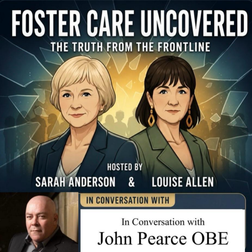
Foster Care Uncovered in conversation with John Pearce OBE
This week, Sarah and Louise are joined by John Pearce OBE for a wide-ranging and deeply reflective conversation about the state of children’s social care and where it may be heading next. John brings decades of experience at the forefront of children’s services leadership, including his time as Director of Children’s Services in Durham, and is widely known for his clear-sighted, often challenging analysis of system design, practice realities and reform. Together, they explore a central tension running through children’s services today: a system built for a different era, now stretched by the realities of modern childhood. The conversation moves beyond surface-level reform to ask whether we are repeatedly redesigning the same structures rather than confronting the deeper questions about demand, sufficiency and purpose. They discuss whether fostering, in its current form, has a natural ceiling; what recent reforms like Regional Care Co-operatives reveal about how policy translates into practice; and why systems so often behave differently in reality than they do on paper. The episode also looks forward, exploring whether new models of family-based care may be needed to meet the needs of today’s children and young people, and what a more honest conversation about markets, providers and leadership might look like. A thoughtful, challenging and at times uncomfortable conversation about what it will really take to build a system that works for children today. If you'd like to chat about this episode or any of our past episodes, feel free to reach out to us at info@fosterwiki.com. We’d love to hear from you! All views shared in this podcast reflect the personal opinions of the hosts alone. They are not intended as factual assertions about any person or organisation, nor do they represent the views of any employer or professional body.
When Systems Shape Minds: The Psychology Undermining Confidence and Care
This week, Sarah and Louise open with a candid, slightly irreverent look at what’s been making waves in the sector, the stories behind the headlines, the language being used, and the questions few people are saying out loud. At the heart of the conversation is a deeper exploration of how control shows up in subtle, often unspoken ways, and why some of the systems designed to support children and carers can end up creating the very tensions they are trying to avoid. They dig into the psychology sitting underneath it all, what drives it, what sustains it, and what happens when it starts to backfire. After the break, the discussion tightens. This is where things get more pointed: real examples, real dynamics, and the uncomfortable patterns that many will recognise but few will name. Expect challenge, reflection, and a few moments that will stay with you long after the episode ends, including who and what sits at the centre of this week’s spotlight. Links Interview: IWGB Foster Care Workers Branch Chair Sarah Anderson on Victoria Derbyshire: https://www.youtube.com/watch?v=pGZpLaTmOPo&list=PLWEgjIZKyJRoHb1uEe8IgW-GoRhEPgLzu&index=12 Government statements: Gov UK Fostering for the future: improving the foster care system: https://www.gov.uk/government/calls-for-evidence/fostering-for-the-future-improving-the-foster-care-system Gov UK Proposed changes to assessment and handling allegations of abuse: https://www.gov.uk/government/consultations/fostering-reform-proposed-changes-to-assessment-and-handling-allegations-of-abuse Foster Carers Mental Health: https://fosterwiki.com/wiki/foster-carers-mental-health/ NFCQ Foster Carers Mental Health and Wellbeing: https://education.nfcq.co.uk/nfcq-courses/foster-carers-mental-health-and-wellbeing/ Recourses: FosterWiki: https://fosterwiki.com/wiki/ If you'd like to chat about this episode or any of our past episodes, feel free to reach out to us at info@fosterwiki.com. We’d love to hear from you! All views shared in this podcast reflect the personal opinions of the hosts alone. They are not intended as factual assertions about any person or organisation, nor do they represent the views of any employer or professional body.
1 de 4