The Deep dive podcast

The Deep dive podcast

por Eric Demers
Temporada 2
AGI Development Trajectories and Global Safety Forecasting

IA
Artificial General Intelligence is no longer a distant thought experiment — it’s becoming a near‑term geopolitical and scientific reality. Across the world, leading labs are scaling compute, capital, and ambition at unprecedented speed, pushing AGI timelines earlier and earlier. Expert forecasts now cluster around the idea that systems capable of performing most economically valuable work at or above human level could emerge before 2030, a dramatic shift from mid‑century expectations. This rapid acceleration has triggered an equally urgent response from governments and international bodies. New AI Safety Institutes in the US, UK, and other nations are racing to evaluate frontier models for risks ranging from bioweapons assistance to autonomous cyber operations — risks that global collaborations like the International AI Safety Report emphasize are growing in real‑world evidence. Yet these institutes face steep challenges: limited resources, immature forecasting infrastructure, and no formal enforcement power, all while private labs surge ahead with massive investments and compute scaling. RAND CorporationRAND Corporation. Artificial General Intelligence Forecasting and Scenario Analysis: State of the Field, Methodological Gaps, and Strategic Implications | RAND The stakes have become so high that prominent scientists have signed historic statements placing AI‑driven extinction risks alongside nuclear war and pandemics — a signal that AGI is not just a technological milestone, but a civilizational inflection point. Meanwhile, global policy organizations warn that preparedness is lagging behind capability growth, urging nations to adopt “no‑regrets” actions and stress‑test scenarios before disruptive systems arrive. In this episode of The Deep Dive, we explore the tension at the heart of 2026: a world sprinting toward AGI with industrial momentum, and a safety ecosystem struggling to build guardrails fast enough. It’s a story of accelerating trajectories, fragile institutions, and the race to forecast — and shape — the future of intelligence itself. If you want, I can also craft a punchier teaser or a cinematic intro hook for this episode.
2026 National Defense Strategy: Peace Through Strength
IA
In this episode of The Deep Dive, we unpack one of the most consequential shifts in U.S. defense policy in decades. The 2026 National Defense Strategy—issued under Secretary Pete Hegseth—marks a decisive turn toward a revived Peace through Strength doctrine. At its core is a sharpened America First agenda, redefining how Washington intends to confront a more volatile world. We explore how the strategy elevates homeland security as the nation’s primary mission, treating domestic resilience as the foundation of global power. Then we dive into its hard line on China, outlining a deterrence posture built around Indo‑Pacific dominance and rapid military modernization. The document also calls for a sweeping revival of America’s industrial base, framing factories, shipyards, and supply chains as strategic assets. A major tension point emerges in its demand for allies to dramatically increase defense spending—setting a new, uncompromising standard for burden‑sharing. Gone are the days of open‑ended interventions and nation‑building. In their place: a leaner, more focused vision of U.S. power that prizes readiness, credibility, and overwhelming capability. We examine what this means for global stability, alliance politics, and the future of American prosperity. Is this a pragmatic recalibration for a dangerous century—or a gamble that reshapes the world order? Join us as we break down the stakes, the strategy, and the ideological shift behind America’s newest military blueprint. This is The Deep Dive—where policy meets power, and the future is never taken for granted.
CRA Cybersecurity Failures and the Heartbleed Breach Investigation
IA
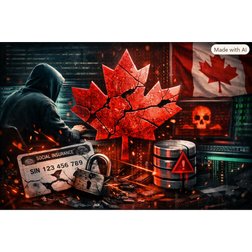
In this episode of The Deep Dive, we unpack a troubling history of cybersecurity failures at the Canada Revenue Agency. From the 2014 Heartbleed breach—where a critical vulnerability exposed the Social Insurance Numbers of 900 Canadians and led to the arrest of a 19‑year‑old student—to the wave of credential stuffing attacks that compromised over 42,000 accounts between 2020 and 2023, the CRA’s digital defenses have repeatedly fallen short. We explore what went wrong, how a major class-action settlement and damning reports from the Privacy Commissioner forced change, and whether mandatory multi-factor authentication is enough to restore trust. Finally, we look at what individual taxpayers can do—beyond hoping institutions get it right—to protect themselves in an era of relentless cyber threats.
The 2025–2026 North American Trade War

IA
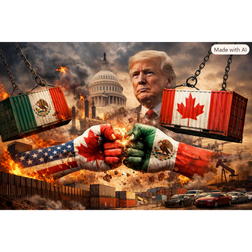
The 2025–2026 North American Trade War marked one of the most turbulent chapters in continental economics since the creation of NAFTA. In this episode, we unpack how a single set of executive orders from President Donald Trump ignited a cascading tariff confrontation across the United States, Canada, and Mexico. Beginning in early 2025, Washington imposed sweeping duties—25% on most Canadian and Mexican imports, 10% on energy—framed as tools to shrink trade deficits, curb illegal immigration, and disrupt fentanyl smuggling. Canada and Mexico struck back with their own levies, including a headline‑grabbing Canadian ban on U.S. alcohol in several provinces. Despite a one‑month delay and exemptions for USMCA‑compliant goods, tensions escalated through 2025 as both sides layered new tariffs on steel, aluminum, autos, and consumer goods. Diplomatic relations frayed further when Trump floated the idea of annexing Canada—an incendiary suggestion that deepened the political rupture. By early 2026, the conflict reached a constitutional breaking point: the U.S. Supreme Court struck down the administration’s use of emergency powers to sustain these tariffs, forcing a rollback of the most sweeping measures and triggering billions in refunds. This episode explores how the trade war reshaped supply chains, rattled markets, and tested the limits of executive authority. We trace the timeline, the retaliations, the legal battles, and the geopolitical fallout—revealing how a continental partnership built over decades was pushed to the brink, and what the aftermath means for the future of North American trade.
Future Frontiers: Texas Megafactories and Deep Space Observatories
IA
In this episode, we explore a moment when industry, energy, and space science all surge forward at once. Texas is transforming into a technological powerhouse as Tesla pushes a proposed $10‑billion solar megafactory and teams up with SpaceX on TERAFAB, an enormous AI‑chip manufacturing hub designed to supercharge the next generation of machine intelligence. Critics warn of an AI bubble, but the scale of these projects signals a new industrial era taking shape in the American Southwest. Meanwhile, across the Pacific, China’s robotics sector is celebrating a milestone of its own. Unitree, the rising star of humanoid and quadruped robotics, has made a profitable market debut in Shanghai, proving that advanced robotics is no longer a speculative frontier—it’s a booming business. On the global stage, the United Nations prepares for COP17, where environmental policy, industrial growth, and climate urgency collide. And far above Earth, NASA is readying the Nancy Grace Roman Space Telescope, a deep‑space observatory built to probe dark energy, map distant galaxies, and hunt for exoplanets with unprecedented precision. Together, these developments paint a picture of August 2026 as a turning point—a month where megafactories rise, robots go mainstream, nations negotiate the planet’s future, and humanity sharpens its gaze into the cosmic unknown.
The great presidential escape
IA
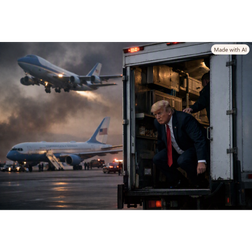
President Donald Trump’s dramatic escape from Air Force One during the NATO summit in Ankara becomes the centerpiece of this gripping episode of The Deep Dive. As tensions with Iran escalated and U.S. intelligence detected a credible assassination threat, the Secret Service executed an extraordinary covert maneuver: Trump was quietly moved off the presidential jet and into an airport catering truck, hidden from journalists, staff, and even senior Cabinet officials. From inside that unmarked truck, Trump was transported across the tarmac and slipped aboard a smaller Air Force C‑32A, while the original Air Force One took off as a decoy, carrying aides, reporters, and top officials who believed the president was still with them. Even Secretary of State Marco Rubio and Treasury Secretary Scott Bessent remained on the decoy aircraft as part of the ruse. This episode unpacks the full operation: the intelligence warning, the choreography of the switch, the secrecy surrounding the threat, and the political fallout that followed once the story broke. We explore how this unprecedented maneuver reflects the broader geopolitical volatility of 2026 — a world where assassination plots, proxy conflicts, and high‑stakes diplomacy collide. The Deep Dive brings you inside the moment the leader of the United States was hidden in plain sight, riding in a catering truck to evade a missile threat — a surreal snapshot of modern power, danger, and the fragile machinery of global security.
RAMageddon: The Global Memory Supply Crisis of 2025–2030

IA
he world didn’t expect memory — the most basic building block of modern computing — to become the defining choke point of the late 2020s. Yet by 2025, a perfect storm of AI acceleration, supply‑chain fragility, and geopolitical competition ignited what analysts now call RAMageddon, a global memory shortage reshaping every layer of the tech ecosystem. In this episode, we unravel how the explosive demand for High Bandwidth Memory (HBM) in AI datacenters triggered a massive reallocation of manufacturing capacity, leaving consumer DRAM and NAND flash in critically short supply. Prices spiked, inventories evaporated, and industries from smartphones to automotive found themselves forced into production delays, emergency redesigns, and in some cases, near‑shutdown scenarios. We explore the ripple effects: How memory compression and architectural redesign became survival strategies. Why Chinese manufacturers like YMTC and CXMT accelerated domestic fabrication to escape reliance on foreign suppliers. The legal storm brewing around alleged price manipulation and antitrust violations among the industry’s biggest players. And why experts warn that despite new fabs breaking ground worldwide, the supply imbalance may persist until 2028–2030. RAMageddon isn’t just a shortage — it’s a structural reckoning for global compute. This episode dives into the economics, the geopolitics, and the technological pivots defining one of the most consequential hardware crises of the decade.
Canada's Modernization and Renewal of the Submarine Fleet

IA
In this episode of The Deep Dive, we explore one of the most consequential military decisions Canada has made in decades: the full modernization and renewal of its submarine fleet. In July 2026, Ottawa selected Thyssenkrupp Marine Systems as the preferred builder for up to twelve next‑generation conventional submarines — a scale of ambition unmatched in Canadian naval history. These boats will be equipped with Air Independent Propulsion and lithium‑ion batteries, technologies that allow them to stay submerged for weeks, operating silently beneath the Atlantic, Pacific, and increasingly contested Arctic waters. We break down why stealthy, long‑endurance submarines have become essential for Canada’s sovereignty, intelligence gathering, and deterrence posture in a world defined by rising great‑power competition. The episode examines the strategic logic behind choosing advanced conventional submarines over nuclear‑powered alternatives — a debate that has divided experts for years. We look at how cost, timelines, industrial capacity, and Arctic operating realities shaped the government’s decision. Then we dive into the procurement process itself: a massive, multi‑year negotiation expected to conclude in 2027, with first deliveries slated for 2034. The project promises billions in industrial offsets, new shipyard activity, and a revitalized domestic maritime sector. But it also raises hard questions about Canada’s track record with defence procurement and whether this ambitious fleet can be delivered on time. We explore the geopolitical backdrop — from Russian under‑ice patrols to Chinese blue‑water expansion — that makes undersea capability more urgent than ever. And we unpack how these submarines fit into Canada’s broader defence transformation, from Arctic surveillance to continental security. This is more than a fleet replacement. It’s a generational bet on Canada’s role in the world’s oceans. Join us as we dive deep into the strategy, the technology, and the stakes behind the rebirth of Canada’s submarine force. Welcome to The Deep Dive
GPU Market 2026: Pricing, Benchmarks, and the New Performance Hierarchy

IA
The 2026 GPU landscape isn’t just evolving — it’s under pressure. This episode unpacks a market reshaped by unprecedented hardware shortages, soaring prices, and a global scramble for compute capacity. With HBM production bottlenecks and packaging constraints pushing lead times for top‑tier accelerators like the NVIDIA H100 past the one‑year mark, enterprises are being forced into a new era of strategic agility. Cloud orchestration, spot‑instance hunting, and multi‑region workload shifting have become survival tactics rather than optimizations. We break down how NVIDIA maintains its commanding lead with Blackwell and the incoming Rubin architecture, while AMD sharpens its position as the value‑driven contender — dominating pure rasterization and doubling down on open‑source tooling. Benchmark data reveals a widening gap between theoretical peak performance and what organizations can actually deploy in production due to VRAM scarcity and inflated procurement cycles. This episode also explores the rise of model optimisation and quantization as essential techniques for reducing memory footprints and keeping AI workloads viable amid the supply crunch. As the industry pivots toward flexible procurement and dynamic cloud mobility, we map out the new performance hierarchy — not just which GPUs are fastest, but which ones are realistically attainable. A market defined by scarcity, innovation, and strategic adaptation. That’s the GPU story of 2026.
The 2026 RAM Crisis: Surging Prices and Consumer Scams
IA
In 2026, the world discovered that even the smallest component can trigger a global tech crisis. This episode plunges into the heart of the DRAM shockwave, where memory prices have exploded by nearly 90%, ripping through the PC market and reshaping the entire hardware ecosystem. Fueled by insatiable AI datacenter demand, the surge has left consumers stranded in a perfect storm of shortages, inflated costs, and a booming underground of hardware deception. We explore how desperate buyers and opportunistic scammers collided on platforms like Reddit and Wccftech, exposing a new breed of fraud: counterfeit DDR5 modules built from older sticks dressed up with fake heat sinks and forged labels. These aren’t amateur scams — they’re engineered to fool even seasoned enthusiasts. As trust erodes, the community turns to digital truth‑serum tools like Windows Task Manager and Command Prompt to verify what’s really inside their machines. Industry analysts warn that relief is nowhere in sight. With AI demand accelerating and supply chains stretched thin, normalised pricing may not return until 2028, leaving builders and gamers navigating a volatile, high‑risk marketplace where every purchase feels like a gamble. This episode unpacks the economics, the psychology, and the digital sleight‑of‑hand behind the 2026 memory crisis — and what it means for the future of personal computing.
1 de 10