Clean Books, Strong Practice

Clean Books, Strong Practice

por Anthony Barge
The Inventory Cash Trap: Why Your Veterinary Practice Can Be Busy and Still Cash-Starved
# RSS Show Notes ## The Inventory Cash Trap: Why Your Veterinary Practice Can Be Busy and Still Cash-Starved A busy veterinary practice can have strong revenue and still feel short on cash. One often-overlooked reason is inventory: cash goes out before the item is used, sold, charged, collected, and reflected accurately in the financial statements. In this episode, Anthony “Marlo” Barge explains how to trace inventory through the full cash chain: cash paid, item received, item stored, item used or sold, charge captured, invoice collected, and margin reported. We look at practical examples involving pharmacy items, preventives, diets, laboratory supplies, and clinical supplies. We also walk through a four-view diagnostic that compares purchases, counts or valuation, practice-management-system usage and charges, and the general ledger. A mismatch is not proof of theft or misconduct. It is a signal to investigate the workflow. The cause may involve purchasing, receiving, storage, units of measure, usage recording, charge capture, pricing or item mapping, counting, accounting classification, or unclear ownership. The goal is not simply to carry the lowest possible inventory. The goal is to maintain the right level of inventory for patient care while protecting owner cash flow and practice profitability. Technology can improve visibility, but only when the underlying process, units, and responsibilities are clear. If your practice is busy but cash remains tight, request a complimentary 20-minute Practice Profit X-Ray conversation and Profit X-Ray score. We can help identify the first financial question worth answering and determine whether an Inventory Cash Trap Scan is appropriate. Presented by LAX Accounting Services. Website: https://www.laxaccountingservices.com Phone: 747-254-9033 Clean books create clear decisions. Clear decisions create stronger practices. Stronger practices protect the mission. #VeterinaryPractice #VeterinaryAccounting #CashFlow #InventoryManagement #PracticeProfitability #COGS #FractionalCFO
Curing the Veterinary Tax Panic: Deadlines, Payroll Benchmarks, and Cash Reserve Targets
Veterinary tax panic is rarely caused by the deadline itself. It develops when the books are behind, committed cash is mistaken for spendable cash, projections arrive too late, and nobody clearly owns the next action. In this follow-up episode of the Clean Books, Strong Practice Podcast, Anthony Barge, MBA—Founder and Fractional CFO of LAX Accounting Services and a veterinary accounting and profitability specialist—moves beyond general tax preparation and explains the numbers, benchmarks, and controls that veterinary practice owners should monitor throughout the year. For calendar-year taxpayers, the general 2026 federal estimated-tax payment dates are April 15, June 15, September 15, and January 15, 2027. However, putting a deadline on the calendar is not enough. The practice needs an earlier internal review date so the books can be closed, the exposure can be projected, the reserve can be evaluated, and the payment can be completed without a last-minute scramble. Anthony also examines veterinary payroll benchmarks. One AAHA compensation model places veterinarian and support-staff pay at approximately 40% of gross revenue. A separate VMG/KSM veterinary benchmark reports total labor and benefits of 45.5% for average practices and 40.1% for top-performing practices in its dataset. These percentages are diagnostic signals—not automatic instructions to reduce staff. Before taking action, owners must compare definitions and evaluate scheduling, pricing, doctor capacity, technician utilization, compensation structure, and local labor conditions. The episode also introduces Anthony’s practical 30-60-90 cash-reserve ladder: • 30 days: An initial operating-reserve floor • 60 days: A stronger working target • 90 days: A resilience target for practices seeking greater protection Tax reserves, payroll obligations, debt payments, and operating reserves should remain clearly separated. A large bank balance does not mean every dollar is available to spend. In This Episode, You Will Learn: • Why predictable tax deadlines continue to feel like emergencies • The difference between tax preparation, tax planning, and tax control • The four general federal estimated-tax dates for 2026 • How to interpret veterinary payroll benchmarks responsibly • Why payroll percentages should initiate investigation—not immediate staff cuts • How to calculate cash-buffer days using essential cash outflow • Why tax money should not fund equipment or ordinary operating expenses • The five parts of a dependable veterinary tax-control system • How to complete a four-week tax-control reset in 30 to 45 minutes per week • Why every financial recommendation needs an action, owner, required input, deadline, and confirmation step The central message is straightforward: A tax deadline should trigger a calm financial review—not a midnight rescue mission. Practice owners who want to identify their next responsible step can complete the private Veterinary Tax Strategy X-Ray: https://veterinarytaxstrategyxray.com/ Referenced Resources: IRS Publication 505: https://www.irs.gov/publications/p505 AAHA Veterinary Resources: https://www.aaha.org/resources/chart-of-accounts/

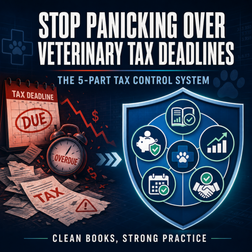
Stop Panicking Over Veterinary Tax Deadlines
A tax deadline should trigger a calm, routine review of your veterinary practice. It should not create a midnight rescue mission. In this episode of the Clean Books, Strong Practice Podcast, we examine why recurring tax panic is rarely caused by the deadline itself. Tax dates are predictable. The panic usually exposes a missing financial-control system: books that are behind, estimated payments based on outdated information, tax reserves used for other expenses, or important responsibilities left somewhere between the owner, bookkeeper, payroll provider, and CPA. Tax preparation reports what has already happened. Tax planning evaluates the options that may still be available. Tax control is the repeatable process that supplies reliable information, assigns responsibility, tracks deadlines, and confirms that the work is completed. In This Episode Why a profitable veterinary practice can still be unprepared for taxes How the operating-account balance can create a false sense of available cash Why buying equipment primarily for a deduction can become an expensive mistake The difference between tax preparation, tax planning, and tax control Three questions every planning conversation should answer A five-part system for replacing tax panic with financial control A practical four-week reset for busy veterinary owners How the Veterinary Tax Strategy X-Ray identifies the right starting point The Five-Part Veterinary Tax-Control System Keep the books current and reliable. Maintain visible tax reserves. Establish a regular projection rhythm. Build a decision and deadline calendar. Use written professional handoffs. The episode also explains a four-week reset that can be completed in manageable steps. Week one establishes the financial baseline. Week two identifies committed cash and potential tax exposure. Week three maps open decisions and deadlines. Week four completes the professional handoff so every issue has an owner, a required input, and a due date. Veterinary practice owners do not need to memorize the tax code. They need clean information, protected cash, timely projections, clear responsibilities, and qualified professionals who know what must happen next. Complete the private eight-question Veterinary Tax Strategy X-Ray readiness check: https://veterinarytaxstrategyxray.com/ The assessment identifies one of four starting paths: Strong X-Ray Fit, Records First, Specialist First, or Not the Right Engagement. Anthony Barge, MBA Founder and Fractional CFO, LAX Accounting Services Veterinary Accounting and Profitability Specialist Host, Clean Books, Strong Practice Podcast This episode is provided for educational and informational purposes and does not replace individualized accounting, tax, legal, investment, or financial advice from an appropriately qualified professional.
The Veterinary Tax Strategy X-Ray: Stop Guessing What Tax Season Will Cost Your Practice
A healthy bank balance does not necessarily mean every dollar is available to spend. For veterinary practice owners, part of that cash may already be committed to estimated taxes, payroll, debt, or other obligations. In this episode of Clean Books, Strong Practice, we examine the Veterinary Tax Strategy X-Ray from LAX Accounting Services—a structured advisory process designed to replace tax uncertainty with a documented projection, a short list of priorities, and clear implementation deadlines. The episode explains the difference between reactive tax preparation and proactive tax planning. Tax preparation reports decisions that have already been made. Tax planning identifies the decisions that may still be available before the relevant deadlines pass. You’ll learn: Why managing the practice by its bank balance can create a false sense of available cash How the private readiness check protects sensitive information and determines whether the service is appropriate The four possible readiness outcomes: Strong X-Ray Fit, Records First, Specialist First, or Not the Right Engagement How the seven-step process moves from an initial tax concern to ongoing financial control What the six written deliverables include: a federal and state projection range, scenario comparison, priority map, Tax Control Scorecard, deadline calendar, and professional handoff How equipment purchases, Section 179, entity structure, owner compensation, and estimated payments can affect planning decisions Why the X-Ray is designed to support an existing CPA or enrolled agent rather than replace them The founding-client engagement is structured around one owner household, one veterinary business entity, and one state. The fixed fee is $1,500, with a target delivery of seven business days after the secure intake is complete. The process concludes with a 60-minute review meeting to explain the findings and identify the appropriate implementation professionals. The Veterinary Tax Strategy X-Ray is an advisory and projection engagement. It does not include tax-return preparation, amended returns, bookkeeping cleanup, legal advice, audit representation, or a guaranteed tax reduction, refund, or outcome. If you are tired of wondering how much of the practice’s cash is actually yours to use, this episode provides a practical look at moving from reactive tax preparation to proactive financial control. Complete the private readiness check at: https://veterinarytaxstrategyxray.com/ Clean books create clear decisions. Clear decisions create a stronger practice.
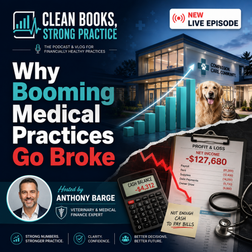
Why Booming Medical Practices Go Broke
Why Booming Medical Practices Go Broke A busy practice is not always a profitable practice. In this episode of the Clean Books, Strong Practice Podcast, host Anthony Barge examines a dangerous financial contradiction: how a medical or veterinary practice can experience rising appointments, increased revenue, a growing team, and strong demand—yet still struggle to pay its bills or run out of cash. Growth can create the appearance of financial strength while quietly increasing payroll, inventory costs, debt payments, equipment expenses, taxes, and other operating obligations. When those costs grow faster than available cash, the practice may become busier while becoming financially weaker. Anthony explains why practice owners must look beyond top-line revenue and understand what is actually happening beneath the surface of the business. In this episode, you’ll learn: Why high revenue does not automatically produce strong cash flow How rapid growth can expose weaknesses in bookkeeping and financial controls Why increasing payroll without measuring productivity can damage profitability How inventory, vendor costs, debt, taxes, and delayed collections consume cash Why owner compensation must be separated from the practice’s true profit How inaccurate or outdated financial records lead to poor decisions Why every growing practice needs a cash reserve and forward-looking financial plan Which financial indicators owners should review before hiring, expanding, or purchasing equipment The central lesson is simple: revenue may create activity, but financial systems create stability. A healthy practice should be able to clearly answer: How much cash is available today? How much of the revenue collected is actually profit? Are payroll and operating costs growing faster than production? Are taxes, debt, and upcoming obligations being planned for? Can the practice continue operating if collections slow down? When the books are clean, leadership can identify financial pressure before it becomes a crisis. When the numbers are unclear, even a booming practice can unknowingly move toward insolvency. This episode encourages practice owners to slow down, examine the numbers, and build a financial foundation capable of supporting sustainable growth. Clean books create clear decisions. Clear decisions create a stronger practice. Take the Free Practice Profit X-Ray Discover the strongest and most urgent areas within your practice’s financial systems through the free Practice Profit X-Ray assessment. Visit: https://www.practiceprofitxray.com/ About the Host Anthony Barge, MBA is the owner of LAX Accounting Services, a Fractional CFO, veterinary accounting specialist, author, and host of the Clean Books, Strong Practice Podcast. He helps independent veterinary practices strengthen their bookkeeping, cash flow, profitability, tax planning, and long-term financial decision-making. Internationally known. Nationally recognized. Locally respected.
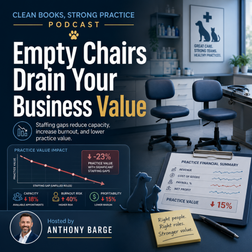
Empty Chairs Drain Your Business Value
An unfilled position in a veterinary practice is never just an empty chair. It can mean unanswered calls, delayed appointments, overworked employees, missed revenue, frustrated clients, and patients waiting longer for care. While practice owners can easily see the cost of hiring on a financial statement, the cost of not hiring is often hidden throughout the business. In this episode of the Clean Books, Strong Practice Podcast, Anthony Barge explains how long-term staffing vacancies can quietly weaken a veterinary practice’s profitability, operations, team morale, and overall business value. You will learn why every role in the practice should either generate revenue, protect revenue, increase capacity, reduce risk, or help other team members perform more effectively. This episode also explores how an empty chair can create bottlenecks in unexpected areas. A practice may believe it needs more marketing when the real issue is unanswered calls. It may appear that veterinarians need to work harder when the actual problem is insufficient technician support. More demand will not fix a capacity problem—and may make it worse. In This Episode: The hidden financial cost of vacant positions How staffing shortages affect appointment capacity Why burnout is a financial and business-value issue How vacancies can increase overtime and employee turnover The relationship between staffing stability and practice valuation Why owner dependence can reduce transferability How to compare the cost of hiring with the cost of remaining understaffed Early warning signs that your practice is reaching its capacity ceiling Questions to answer before opening a new position Hiring decisions should never be based solely on whether payroll will increase. Practice owners must also consider how much revenue, productivity, client service, and team stability may be lost when a necessary role remains vacant. The question is not only: “Can we afford to hire?” The better question may be: “Can we afford to continue operating without this person?” The strongest veterinary practices do not simply track what employees cost. They understand what the right employees make possible. Hosted by Anthony Barge Veterinary Profit & Growth Expert Fractional CFO | Tax Strategist Owner, LAX Accounting Services Host of the Clean Books, Strong Practice Podcast Helping veterinary practice owners improve profitability, strengthen cash flow, reduce financial risk, and build more valuable businesses.
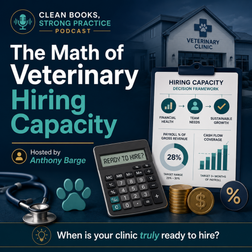
The Math of Veterinary Hiring Capacity
Your veterinary practice is busy. The schedule is full, the phones are ringing, overtime is increasing, and your team is exhausted. So, does that automatically mean it is time to hire? Not necessarily. In this episode of the Clean Books, Strong Practice Podcast, host Anthony Barge explains why veterinary hiring decisions must be based on more than workload, frustration, or a single payroll percentage. A clinic may desperately need additional support operationally but still lack the financial capacity to carry another permanent employee. On the other hand, refusing to hire because payroll has crossed an arbitrary threshold can increase overtime, accelerate burnout, restrict revenue, and force the practice owner to perform work that should be delegated. The real question is not simply, “Are we busy enough to hire?” The better question is: Can the practice support the complete cost of this position through its full cash-flow cycle while protecting patient care, team stability, owner compensation, profitability, and long-term practice value? In This Episode, You Will Learn: Why the commonly used 40% payroll-to-revenue threshold should be treated as a warning light—not an automatic hiring freeze How to calculate the true cost of an employee beyond wages or salary Why payroll taxes, benefits, overtime, paid leave, training, software, uniforms, equipment, and administrative support must be included How seasonal revenue and wellness-plan payments can distort hiring capacity Why overtime may indicate that the practice is already purchasing labor capacity at a higher cost How inaccurate bookkeeping can create false confidence about what the clinic can afford Why a rolling 12-week cash-flow forecast should be prepared before approving a new position How to account for onboarding, training, and the employee’s productivity ramp Why owner compensation and emergency reserves must remain part of the hiring decision How both overstaffing and understaffing can reduce profitability and practice value Before Hiring, Review: Whether the books are current and properly categorized The complete employment cost of the proposed position Payroll-to-revenue trends over several months Overtime, workload, and scheduling patterns Pricing, missed charges, discounts, inventory, and collections The clinic’s rolling 12-week cash-flow forecast The time required for the employee to become productive The effect on owner compensation and cash reserves Whether demand is temporary, seasonal, or sustainable Hiring should not be an emotional reaction to a difficult week. It should be a calculated decision supported by accurate financial records, realistic projections, and a clear understanding of how the position will strengthen the practice. Clean books create clear decisions. Clear decisions create stronger practices. Hosted by Anthony Barge Presented by LAX Accounting Services Clean Books. Strong Practice. Peaceful Profitability. This podcast is provided for educational purposes only and does not replace individualized accounting, tax, legal, lending, human-resources, valuation, or financial advice. #VeterinaryBusiness #VeterinaryPracticeManagement #VeterinaryFinance #VeterinaryAccounting #VeterinaryLeadership #PracticeProfitability #CleanBooksStrongPractice
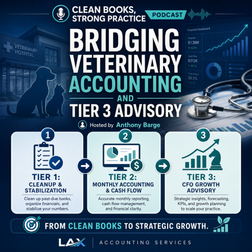
Bridging Veterinary Accounting and Tier 3 Advisory
Clean financial reports are important—but reports alone do not tell a veterinary practice owner what decision to make next. In this episode of the Clean Books, Strong Practice Podcast, host Anthony Barge explains how veterinary practices can move from reliable monthly accounting into strategic Tier 3 CFO advisory. The journey begins with a clear financial foundation: Tier 1 / Phase One: Cleanup and Stabilization Tier 1 repairs disorganized or unreliable books. This may involve historical cleanup, bank and credit-card reconciliations, payroll corrections, loan reviews, chart-of-accounts improvements, and the identification of unresolved financial issues. Tier 2 / Phase Two: Monthly Accounting and Cash-Flow Support Tier 2 keeps the financial foundation current through ongoing bookkeeping, reconciliations, month-end reporting, cash-flow monitoring, payroll oversight, tax-planning coordination, and owner-focused financial conversations. Tier 3 / Phase Three: CFO Growth and Profit Advisory Tier 3 uses the reliable information produced through Tier 2 to support forward-looking decisions involving cash, profitability, pricing, staffing, owner compensation, equipment, debt, expansion, and long-term practice value. Anthony also explains why an active Tier 2 engagement is required before and during Tier 3 advisory. Tier 2 and Tier 3 are separate services with separate scopes and pricing. Tier 3 does not replace monthly accounting, and Tier 2 does not become free when a practice moves into advisory. The two systems work together: Tier 2 produces and protects the financial truth. Tier 3 turns that truth into strategy. Without accurate and current accounting information, a forecast may be unreliable. A staffing model based on incorrect payroll information may create false confidence. A pricing analysis built on missing costs may mislead the owner. An expansion plan based on overstated profit may create debt the practice cannot safely support. In This Episode, You Will Learn: • The difference between veterinary accounting and CFO advisory • Why clean books are the foundation—not the finish line • How Tier 2 supports successful Tier 3 advisory • Why monthly accounting and strategic advisory must remain separate • How cash-flow forecasting supports stronger decisions • How practices can model hiring and compensation decisions • How pricing, equipment, debt, and expansion may be evaluated • Why profit and available cash are not always the same • How financial information becomes an actionable growth plan • Why the owner must remain the final decision-maker Strong veterinary ownership is not simply about receiving financial statements. It is about understanding what changed, why it changed, what may happen next, and what action the practice should take. You do not have to make every major financial decision alone. With current numbers, a clear process, and the right financial partner, your veterinary practice can move from reacting to financial pressure toward planning with clarity and confidence. Clean Books, Strong Practice Podcast Hosted by Anthony Barge Presented by LAX Accounting Services Educational content only. This episode does not replace individualized accounting, tax, legal, lending, human-resources, valuation, or investment advice.
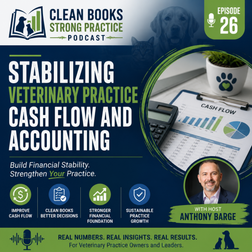
Stabilizing Veterinary Practice Cash Flow and Accounting
Stabilizing Veterinary Practice Cash Flow and Accounting Cash flow problems rarely happen overnight—they're usually the result of small financial issues that build over time. In this episode of the Clean Books, Strong Practice Podcast, host Anthony Barge discusses practical strategies to help veterinary practice owners create financial stability through accurate bookkeeping, disciplined accounting processes, and proactive cash flow management. You'll learn why profitable practices can still experience cash shortages, how timely financial reporting supports better business decisions, and which accounting habits help reduce financial stress while positioning your clinic for long-term growth. In This Episode Why cash flow matters more than revenue alone. The connection between clean books and confident decision-making. Common accounting mistakes that create unnecessary financial pressure. Simple systems that improve cash flow visibility. Building a stronger financial foundation for sustainable practice growth. Whether you're a practice owner, practice manager, or veterinary administrator, this episode provides practical guidance you can begin applying immediately to strengthen your clinic's financial health. Continue Learning If you enjoyed this episode, continue your financial leadership journey with the Clean Books, Strong Practice book series by Anthony Barge. Featured Book: Clean Books, Strong Practice – Volume 2 Amazon: https://www.amazon.com/dp/B0H6M11678 The book expands on many of the concepts discussed in this episode, including bookkeeping best practices, financial reporting, cash flow management, operational efficiency, and building a veterinary practice that is both profitable and financially resilient. Thank you for listening to the Clean Books, Strong Practice Podcast. If this episode helped you, please subscribe, leave a review, and share it with another veterinary professional who is committed to building a stronger practice—one clean financial statement at a time.
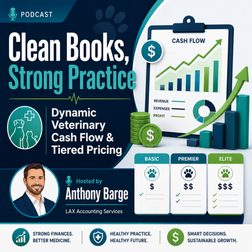
Dynamic Veterinary Cash Flow and Tiered Pricing
A veterinary practice can generate strong revenue and still struggle to maintain consistent cash flow. Why? Because revenue alone does not determine financial stability. Timing, pricing, payroll, inventory, operating expenses, debt payments, and owner compensation all affect how much cash is actually available. In this episode of Clean Books, Strong Practice, host Anthony Barge explains how veterinary practice owners can use dynamic cash-flow management and tiered pricing to build a healthier, more predictable business. Tiered pricing is not simply about charging more. It is about creating clearly defined levels of service that reflect the amount of time, expertise, financial oversight, and strategic support a practice truly needs. A growing clinic should not be receiving the same level of accounting support as a smaller practice with fewer transactions, employees, and financial responsibilities. This episode explores how veterinary owners can: • Understand the difference between revenue, profit, and available cash • Identify cash-flow problems before they become emergencies • Evaluate whether current prices support rising labor and operating costs • Use service tiers to match financial support with the practice’s complexity • Improve bookkeeping, reporting, forecasting, and financial visibility • Prepare for payroll, taxes, inventory purchases, and seasonal fluctuations • Make confident decisions based on accurate, current financial information • Protect the practice while creating room for sustainable growth When bookkeeping is delayed or financial reports are unclear, the owner is forced to manage the practice based on bank balances, assumptions, and stress. Clean and regularly updated financial records provide the clarity needed to plan ahead, manage expenses, strengthen pricing, and understand where the practice is truly making—or losing—money. The right accounting tier should grow with the practice. Basic bookkeeping may establish a clean financial foundation, while a higher level of monthly accounting and cash-flow support can provide forecasting, performance reviews, pricing analysis, and greater strategic guidance. Your practice deserves more than financial reports that only explain what happened months ago. You need a system that helps you understand what is happening now and prepare for what comes next. Clean books create visibility. Strong pricing protects profitability. Consistent cash-flow management builds a stronger veterinary practice. Hosted by Anthony Barge LAX Accounting Services Serving veterinary practices throughout the United States Website: www.laxaccountingservices.com Email: LAXACCTSVCS@gmail.com Phone: 747-254-9033 Subscribe to Clean Books, Strong Practice for practical conversations about bookkeeping, cash flow, profitability, pricing, and building a financially stronger veterinary practice. Clean Books. Strong Practice. Peaceful Profitability.
1 de 2