Central Eurasian History

Central Eurasian History

por James Millward
Lecture 1 – Central Eurasia and World History
Week 1: January 14 & 16 Lecture 1. Central Eurasia and World History Golden, Central Asia in World History, Introduction and Chapter 1 (1-20) (on Canvas, but also an assigned book to acquire) Christian, David. “Inner Eurasia as a Unit of World History.” Further reading: Sinor, ed. The Cambridge History of Early Inner Asia (Introduction and Chapter 2). Frank, Andre Gunder. The Centrality of Central Asia. (for next week as well, get main arguments and style of argumentation)
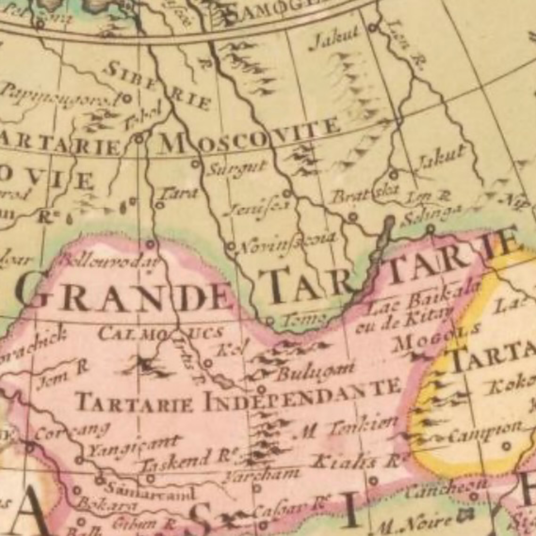
Lecture 2 – Where is Tartary?
Week 2: January 21 & 23 Lecture 2. Where is Tartary? Introduction to the geography of Central Eurasia and its historical import Lecture 3. Nomadic pastoralism and the nomadic peoples of Eurasia Khazanov, Anatoly. Nomads and the Outside World, 15-84 Simakov, Georgii N. "Hunting with Raptors in Central Asia and Kazakhstan." Khalid, Central Asia, chapter 1 Watch: "The Eagle Huntress" (Extended Preview) (Or watch the whole movie if you like. The film doesn't make this clear, but the people are Kazakhs living in western Mongolia. The film's dialog is in Kazakh.) Read "Tips for improving writing" and report in class that you have done so Start Map Exercise Further reading: Sinor, ed. The Cambridge History of Early Inner Asia (Introduction and Chapter 2). Lhamasuren Munkh-Eredene, The Nomadic Leviathan (ebook in Lauinger)—chapters divided up Consider: what defines Central Asia / Inner Asia / Inner Eurasia geographically and historically? What are the broad patterns of Central Eurasian history? How are they important to the study of world history? What is a "nomadic pastoralist"? How is / was this economic system different from hunter-gathering? In what ways does pastoral nomadism involve sophisticated decision-making and manipulation of the environment? What is the relationship of pastoral nomads to agrarian society? What are some different varieties of pastoral nomadism? How stark is the distinction between farmer and herder?
Lecture 3 – Nomadic pastoralism and the nomadic peoples of Eurasia
Week 2: January 21 & 23 Lecture 2. Where is Tartary? Introduction to the geography of Central Eurasia and its historical import Lecture 3. Nomadic pastoralism and the nomadic peoples of Eurasia Khazanov, Anatoly. Nomads and the Outside World, 15-84 Simakov, Georgii N. "Hunting with Raptors in Central Asia and Kazakhstan." Khalid, Central Asia, chapter 1 Watch: "The Eagle Huntress" (Extended Preview) (Or watch the whole movie if you like. The film doesn't make this clear, but the people are Kazakhs living in western Mongolia. The film's dialog is in Kazakh.) Read "Tips for improving writing" and report in class that you have done so Start Map Exercise Further reading: Sinor, ed. The Cambridge History of Early Inner Asia (Introduction and Chapter 2). Lhamasuren Munkh-Eredene, The Nomadic Leviathan (ebook in Lauinger)—chapters divided up Consider: what defines Central Asia / Inner Asia / Inner Eurasia geographically and historically? What are the broad patterns of Central Eurasian history? How are they important to the study of world history?  What is a "nomadic pastoralist"? How is / was this economic system different from hunter-gathering? In what ways does pastoral nomadism involve sophisticated decision-making and manipulation of the environment? What is the relationship of pastoral nomads to agrarian society? What are some different varieties of pastoral nomadism? How stark is the distinction between farmer and herder?
Lecture 4 – The languages of Central Eurasia and what linguistics can tell us
Week 3: January 28 & 30 Lecture 4: The languages of Central Eurasia and what linguistics can tell us Lecture 4.5: Pronunciation. See the Language Handout (on Canvas). Lecture 5: From origins to the first steppe nomadic power (the Scythians / Sakas) On language: · Allworth, Central Asia, pp. 61-71, 82-91 · Anthony, The Horse, the Wheel and Language, Chapter 5 (83-101) · Watkins, "Indo-European and the Indo-Europeans" (American Heritage Dictionary, supplement on Indo-European linguistics) (Don't get bogged down in this) · "Altaic Languages." https://en.wikipedia.org/wiki/Altaic_languages (to the extent this interests you: students of Turkish, Japanese, Korean, Mongolian, Uzbek, Uyghur, Kazakh take note. Don't bog down; do note the controversies) On early Central Eurasia: · *Di Cosmo, "The Steppe Highway" (from Ancient China and its Enemies) (ca. 30 pages) · For horse lovers, just three pages: Anthony, The Horse, the Wheel and Language, Chapter 10, pp. 221-24 (skim 193-221 to get an idea how this research is done; read 221-24) Further reading: Pulleyblank, "Early contacts between Indo-European peoples and China" (this is a fine example of old-school philological study, in which words shed light on history. It may make your head spin.) What were the main language families of Central Eurasia? Why were those languages spoken there? Why are some language families better represented in the textual record others? How do scholars study ancient language families? How can the study of history benefit from comparative or historical linguistics? How are historical linguistics and genetics related? What's the difference between a language and a script? What do we know about the earliest inhabitants of Inner Eurasia? When and how did pastoral nomadism arise? What were the historical implications of this form of economy? How did these peoples interact with neighboring peoples?
Lecture 5 – From origins to the first steppe nomadic power
Week 3: January 28 & 30 Lecture 4: The languages of Central Eurasia and what linguistics can tell us Lecture 4.5: Pronunciation. See the Language Handout (on Canvas). Lecture 5: From origins to the first steppe nomadic power (the Scythians / Sakas) On language: · Allworth, Central Asia, pp. 61-71, 82-91 · Anthony, The Horse, the Wheel and Language, Chapter 5 (83-101) · Watkins, "Indo-European and the Indo-Europeans" (American Heritage Dictionary, supplement on Indo-European linguistics) (Don't get bogged down in this) · "Altaic Languages." https://en.wikipedia.org/wiki/Altaic_languages (to the extent this interests you: students of Turkish, Japanese, Korean, Mongolian, Uzbek, Uyghur, Kazakh take note. Don't bog down; do note the controversies) On early Central Eurasia: · *Di Cosmo, "The Steppe Highway" (from Ancient China and its Enemies) (ca. 30 pages) · For horse lovers, just three pages: Anthony, The Horse, the Wheel and Language, Chapter 10, pp. 221-24 (skim 193-221 to get an idea how this research is done; read 221-24) Further reading: Pulleyblank, "Early contacts between Indo-European peoples and China" (this is a fine example of old-school philological study, in which words shed light on history. It may make your head spin.) What were the main language families of Central Eurasia? Why were those languages spoken there? Why are some language families better represented in the textual record others? How do scholars study ancient language families? How can the study of history benefit from comparative or historical linguistics? How are historical linguistics and genetics related? What's the difference between a language and a script? What do we know about the earliest inhabitants of Inner Eurasia? When and how did pastoral nomadism arise? What were the historical implications of this form of economy? How did these peoples interact with neighboring peoples?
Lecture 6 – The Bactrian Pivot of Asia
Week 4: February 4 & 6 Lecture 6: The Bactrian Pivot of Asia (Achaemenids, Macedonians, Yuezhi, Kushans) Golden, Chapter 2: "The Early Nomads," 21-34. Herodotus, The Histories, Book 4 (Canvas pdf) Another translation with the parallel Greek here. "Scythians: Warriors of Ancient Siberia" (museum exhibition. View the images of artifacts, and read the text—noting its tone and Russian perspective.) "Scythian art," Internet Encyclopedia of Ukraine Artifacts from the frozen tomb in Pazyryk, the Altai Further reading: Xinru Liu, The Silk Road in World History, ch. 3 (42-61) or "Migration and Settlement of the Yuezhi-Kushan" Richard Frye, The Heritage of Central Asia, 77-150 What was the relationship of Central Asia (and the Sakas and Scythians) to the Persian empire? To the Greeks? What is the historical significance of the Greco-Bactrian and Kushan epochs of Central Asia? Why was this region, now considered a backwater, so important to Alexander and others?
Lecture 7 – Huns and Han: Emergence of a Pattern
Week 5: February 11 & 13 (HIST 1108 will meet in Friday sections this week) Lecture 7: Huns and Han: the Xiongnu (Hsiung-nu) and Han China: Emergence of a Pattern Lecture 8: Religious traditions and Central Eurasian History Sima Qian, Shiji (Records of the Historian), ch. 110: "Historical Biography of the Xiongnu." English on Canvas; Chinese text here. Note the general structure of the narrative: when it is broad, when focused? Don't get bogged down in the first section's list of peoples, but what is Sima Qian doing with this ancient history? Is there an ideological thrust? In the later, more detailed stories, what is Sima Qian's message? How does he deliver it? Further reading: Di Cosmo, Nicola. "Those who draw the bow" (from Di Cosmo, Ancient China and its enemies) Di Cosmo, Nicola. "State Formation and Periodization in Inner Asian History" What was the nature of Han (Chinese) - Xiongnu relations? What dynamics were involved? How do they compare to those of the Achaemenids (Persian Empire) with the Sakas (Scythians)? What role does the Central Eurasian region play in the spread of world religions? What role do these religions play in Central Eurasia? How is religion related to trade? What is the significance of Dunhuang and other cave temples from India to Korea?
Lecture 8 – Religious traditions and Central Eurasian History
Week 5: February 11 & 13 (HIST 1108 will meet in Friday sections this week) Lecture 7: Huns and Han: the Xiongnu (Hsiung-nu) and Han China: Emergence of a Pattern Lecture 8: Religious traditions and Central Eurasian History Sima Qian, Shiji (Records of the Historian), ch. 110: "Historical Biography of the Xiongnu." English on Canvas; Chinese text here. Note the general structure of the narrative: when it is broad, when focused? Don't get bogged down in the first section's list of peoples, but what is Sima Qian doing with this ancient history? Is there an ideological thrust? In the later, more detailed stories, what is Sima Qian's message? How does he deliver it? Further reading: Di Cosmo, Nicola. "Those who draw the bow" (from Di Cosmo, Ancient China and its enemies) Di Cosmo, Nicola. "State Formation and Periodization in Inner Asian History" What was the nature of Han (Chinese) - Xiongnu relations? What dynamics were involved? How do they compare to those of the Achaemenids (Persian Empire) with the Sakas (Scythians)? What role does the Central Eurasian region play in the spread of world religions? What role do these religions play in Central Eurasia? How is religion related to trade? What is the significance of Dunhuang and other cave temples from India to Korea?
Lecture 9 – Buddhism and the Silk Road (ft. Michelle Wang)
Week 6:February 18 Lecture 9: Conversation with Prof. Michelle Wang about Buddhism and the Silk Road Lecture 10: Tarim Basin Oases and the Silk Road Golden, Chapter 4 (50-62) Hansen, Valerie. Chapter 6: "The Time Capsule of Silk Road History: The Dunhuang Caves." In The Silk Road: A New History, 167-198. “Mogao Caves: UNESCO video (2 mins. 45 seconds) Visit the Dunhuang caves (if you need to log in, you can use millwarj@gmail.com and password: hist1082021 ) Further reading: Xinru Liu, The Silk Road in World History, ch. 1 (1-19) Hansen, Valerie. Chapter 1: "At the crossroads of Central Asia: the Kingdom of Kroraina," in The Silk Road: A New History, 25-55. Christian, David. "Silk roads or Steppe Roads? The Silk Roads in World History." Millward, James. The Silk Road: A Very Short Introduction (Oxford, 2011). How did Buddhism move from India to Central and East Asia? How did it develop along the way? How does Buddhist iconography reflect the myriad connections of the Bactrian pivot of Asia (Hellenic, Persian, Indian) and convey those elements to East Asia? Can we still see the evidence of these ancient connections today? What does the term “Silk Road” refer to? What are its implications? What is its historical significance? Is it a real thing, or a metaphor for thinking about cultural connections across Eurasia? Were these connections driven by private merchants, or empires?
Lecture 10 – Tarim Basin Oases and the Silk Road
Week 6:February 18 Lecture 9: Conversation with Prof. Michelle Wang about Buddhism and the Silk Road Lecture 10: Tarim Basin Oases and the Silk Road Golden, Chapter 4 (50-62) Hansen, Valerie. Chapter 6: "The Time Capsule of Silk Road History: The Dunhuang Caves." In The Silk Road: A New History, 167-198. “Mogao Caves: UNESCO video (2 mins. 45 seconds) Visit the Dunhuang caves (if you need to log in, you can use millwarj@gmail.com and password: hist1082021 ) Further reading: Xinru Liu, The Silk Road in World History, ch. 1 (1-19) Hansen, Valerie. Chapter 1: "At the crossroads of Central Asia: the Kingdom of Kroraina," in The Silk Road: A New History, 25-55. Christian, David. "Silk roads or Steppe Roads? The Silk Roads in World History." Millward, James. The Silk Road: A Very Short Introduction (Oxford, 2011). How did Buddhism move from India to Central and East Asia? How did it develop along the way? How does Buddhist iconography reflect the myriad connections of the Bactrian pivot of Asia (Hellenic, Persian, Indian) and convey those elements to East Asia? Can we still see the evidence of these ancient connections today? What does the term “Silk Road” refer to? What are its implications? What is its historical significance? Is it a real thing, or a metaphor for thinking about cultural connections across Eurasia? Were these connections driven by private merchants, or empires?
1 de 2