INOV8RS CLUB

INOV8RS CLUB

por Nanthakumar Victor Emmanuel P.Eng.
Temporada 1
#Brazil’s #RareEarth Boom: Can the #UnitedStates Break #China’s #CriticalMinerals Dominance?
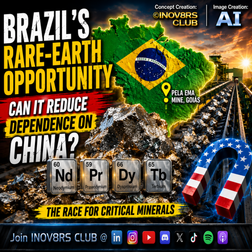
⛏️ #Brazil’s #RareEarth Opportunity: Can It Reduce Dependence on #China? Brazil is emerging as a potential powerhouse in the global race for rare-earth minerals. The Pela Ema mine in Goiás, operated by Serra Verde, highlights both Brazil’s enormous mineral potential and the challenges of building a critical-minerals supply chain outside China. 🇧🇷 Brazil’s Rare-Earth Advantage Brazil holds some of the world’s largest rare-earth reserves, but currently produces only a small share of global supply. The Pela Ema mine could help change that by producing strategically important minerals including neodymium, praseodymium, dysprosium and terbium. 🔋 Why Rare Earths Matter Rare-earth elements are essential for powerful permanent magnets used across electric vehicles, wind turbines, electronics, industrial machinery and defense technologies. As global demand grows, countries are looking for reliable sources outside China. 🇨🇳 China Dominates the Supply Chain Mining rare earths is only the beginning. China has spent decades developing large-scale capabilities in separation, refining, metals, alloys and permanent-magnet manufacturing. That means even countries with major mineral reserves face a difficult challenge: creating the complete industrial infrastructure needed to transform mined material into high-value products. 🇺🇸 The U.S. Push for Alternative Supplies Billions of dollars in U.S.-backed investment and financing are supporting Brazil’s emerging rare-earth industry and related supply-chain development. The strategic objective is clear: diversify global critical-mineral supplies and reduce dependence on China. ⚡ The Mine-to-Magnet Race Rare-Earth Mining → Separation & Refining → Metals & Alloys → Permanent Magnets → EVs, Wind Turbines & Advanced Technology Building this entire mine-to-magnet supply chain could create new investment, manufacturing and technology opportunities across Brazil and the Americas. 📈 Why This Matters Can Brazil transform its massive rare-earth resources into a globally competitive industry? And can projects such as Pela Ema meaningfully reduce the world’s dependence on China? Watch to discover why Brazil could become a major player in the global critical-minerals race—and why breaking China’s rare-earth dominance will be far more complicated than simply opening new mines.
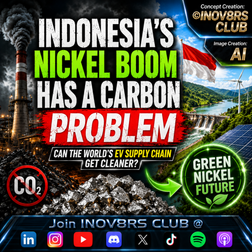
#Indonesia #Nickel Industry: The Carbon Problem Behind the Boom
🌏 #Indonesia’s #Nickel Boom Has a Carbon Problem: Can the #EV Supply Chain Get Cleaner? Indonesia has become the world’s dominant nickel producer and a critical player in the global electric-vehicle battery supply chain. But behind the country’s extraordinary nickel boom is a growing challenge: much of the metal is processed using energy from coal. 🏭 The Carbon Problem Behind Indonesia’s Nickel Boom Nickel processing requires enormous amounts of electricity. Many Indonesian smelters operate in remote industrial areas and rely on captive coal-fired power plants. This means nickel destined for stainless steel, batteries and clean-energy technologies can carry a substantial carbon footprint before reaching manufacturers. 🔋 Why Nickel Matters for Electric Vehicles Nickel is an important ingredient in several lithium-ion battery chemistries. As global EV production expands, Indonesia’s enormous nickel resources have become strategically important to automakers, battery manufacturers and governments seeking secure supplies of critical minerals. ⚡ Coal Power vs. Green Nickel Indonesia now faces an important question: can the world’s largest nickel producer reduce its dependence on coal? Renewable electricity from hydropower, solar and wind, combined with improved energy efficiency and electricity infrastructure, could significantly reduce emissions from nickel processing. 🌱 Could Green Nickel Become the Future? Indonesia already has examples of nickel operations using hydropower, demonstrating that lower-carbon production is possible. The future supply chain could increasingly look like: Nickel Mining → Low-Carbon Processing → Battery Materials → EV Batteries → Electric Vehicles If automakers begin prioritizing lower-carbon materials, cleaner nickel could become a valuable competitive advantage. 🌎 Why Indonesia’s Nickel Industry Matters Globally Indonesia’s dominance means changes to its nickel industry could influence global commodity markets, battery manufacturing and the environmental footprint of electric vehicles. Can Indonesia transform its nickel industry from a coal-dependent powerhouse into a global leader in green nickel?
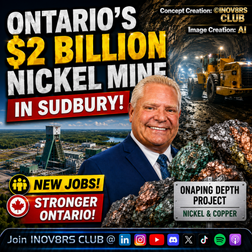
#Ontario’s $2 Billion #Nickel Mining Project in #Sudbury | New #Glencore Mine
⛏️ #Ontario’s $2 Billion #NickelMine: How #Sudbury Could Strengthen #Canada’s Mining Future Ontario is celebrating a major milestone at Glencore Canada’s Onaping Depth Project in Greater Sudbury. Located approximately 2.6 kilometres underground, the development could provide a significant new source of nickel and copper while extending regional mining activity beyond 2040. 🏗️ A Major Investment in Northern Ontario The nearly $2-billion project represents a major investment in Sudbury’s mining industry. Construction has supported thousands of jobs, while full production—expected in 2027—could create hundreds of permanent positions and new opportunities for local suppliers, contractors and skilled workers. 🔋 Why Nickel Matters Nickel is essential for stainless steel, specialty alloys and certain electric-vehicle batteries. As countries compete to secure reliable supplies of critical minerals, Ontario’s nickel resources could support Canadian manufacturing, clean technology and domestic battery supply chains. ⚡ The Future of Underground Mining Mining at extreme depths creates challenges involving heat, ventilation, transportation and worker safety. The Onaping Depth Project plans to use automation, remote operations and battery-electric mining equipment to help create a cleaner, safer and more efficient underground operation. 🚗 From Sudbury Mines to Canadian Manufacturing Nickel Mining → Mineral Processing → Battery Materials → Electric Vehicles Connecting Northern Ontario’s mineral resources with the province’s automotive manufacturing sector could attract investment, generate high-skilled employment and strengthen Canada’s position in the North American EV economy. 📈 Why This Project Matters Can Sudbury’s new nickel project help Ontario become a global leader in critical minerals and advanced mining technology? Watch to discover how the Onaping Depth Project could influence jobs, electric vehicles and Canada’s economic future. 👍 Like, comment and subscribe for more coverage of Canadian mining, critical minerals, clean energy and investment opportunities
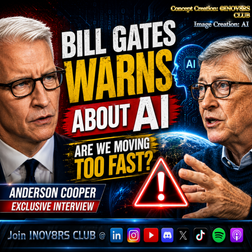
🚨#BillGates Warns About #AI: The Future of Artificial Intelligence | #CNN's #AndersonCooper Interview
IA
🚨 Bill Gates Warns About AI Bill Gates discusses the rapid rise of artificial intelligence in his interview with Anderson Cooper. ⚠️ Is AI Moving Too Fast? Artificial intelligence is developing at an extraordinary pace, raising questions about whether society is prepared for what comes next. 🤖 The Promise of AI AI could transform healthcare, education, scientific research, productivity, and the way we work. The Risks of Powerful AI Bill Gates discusses concerns surrounding AI safety, cybersecurity, and other risks associated with increasingly powerful technology. 🌎 AI and Our Future Artificial intelligence could help solve some of humanity’s biggest challenges, but how we develop and manage it today could shape generations to come. The Big Question Will AI make the world better, or are we developing powerful technology faster than we can safely manage it? 💬 Join the Conversation What do you think about Bill Gates’ views on artificial intelligence? Share your opinion in the comments. Like and subscribe for more content about AI, technology, innovation, and the future. 🔔 Join INOV8RS CLUB Explore emerging technologies, groundbreaking ideas, and conversations shaping tomorrow.
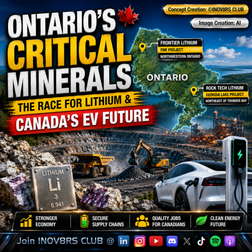
#Ontario’s #CriticalMinerals Race: Why #Lithium Could Transform #Canada’s Economy
🔋 Ontario’s Critical Minerals Boom Ontario is emerging as a major player in North America’s critical minerals race. With valuable deposits of lithium, nickel, copper, cobalt and graphite, the province could help build a secure Canadian supply chain for electric vehicle batteries, clean energy and advanced manufacturing. ⛏️ The Race for Ontario Lithium Frontier Lithium’s PAK Project and Rock Tech Lithium’s Georgia Lake Project highlight Northern Ontario’s growing lithium potential. These developments could help Canada produce and process battery-grade lithium domestically instead of relying heavily on overseas supply chains. 🚗 From Mines to Electric Vehicles Ontario has a powerful advantage: critical mineral resources in the north and an established automotive manufacturing industry in the south. Mining → Processing → Battery Materials → Batteries → Electric Vehicles By connecting these industries, Ontario could attract investment, create high-skilled jobs and become a leading North American battery and EV manufacturing hub. 🤝 Indigenous Partnerships and Responsible Mining Meaningful partnerships with First Nations, environmental stewardship and shared economic benefits will be essential to developing Ontario’s critical minerals responsibly. 📈 Why This Matters Can Ontario transform its mineral wealth into a complete domestic battery supply chain? Watch to discover how lithium mining, local processing and EV manufacturing could shape Ontario’s economy and Canada’s clean-energy future. 👍 Like, comment and subscribe for more insights into Canadian mining, critical minerals, clean energy and investment opportunities.
#Africa’s #CriticalMinerals Future: Building Regional Processing Hubs
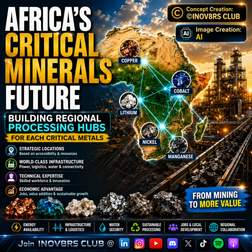
🚨 Africa’s Critical Minerals Future: Building Regional Processing Hubs Africa holds some of the world’s most important critical minerals—but can the continent move beyond mining and raw-material exports to capture more value through mineral processing, refining, beneficiation and downstream manufacturing? In this podcast, we explore the concept of developing specialized regional critical mineral processing hubs across Africa, with locations strategically selected based on mineral-resource accessibility, infrastructure, energy and water availability, logistics, technical expertise, market access and overall economic viability. Inspired by the United Nations Economic Commission for Africa (UNECA) discussion on critical minerals and Africa’s structural transformation, we examine how greater regional cooperation could help African countries transform their mineral resources into higher-value products. Africa holds approximately 30% of global reserves of critical energy-transition minerals and is already a major producer of cobalt, manganese, platinum group metals, graphite and other strategically important resources. But mining the minerals is only the beginning. ⚙️ In this podcast, discover: 🔹 Why Africa’s critical minerals are becoming increasingly important to global supply chains 🔹 How regional mineral-processing hubs could support greater value addition 🔹 Why every country may not need its own refinery or battery-material plant 🔹 How lithium, cobalt, nickel, copper and manganese could support regional value chains 🔹 Why reliable electricity is critical for mineral processing and refining 🔹 How infrastructure, logistics, water and reagent availability affect processing economics 🔹 Why technical expertise and metallurgical capability are essential for beneficiation 🔹 How battery materials could create opportunities beyond traditional mining 🔹 Why low-carbon energy could become an advantage for African mineral processing 🔹 How regional cooperation could help create larger and more competitive processing industries The opportunity extends far beyond simply increasing mineral production. 🌍 Could regional processing transform Africa’s critical mineral industry? As global demand increases for minerals required for electric vehicles, batteries, renewable energy, energy storage and advanced technologies, Africa has an opportunity to capture significantly more value from its natural resources. The challenge is moving from: Mining → Exporting toward: Mining → Processing → Refining → Manufacturing → Recycling The future of Africa’s critical minerals may therefore depend not only on what lies underground, but on the metallurgical capability, infrastructure, technology, skills and regional cooperation built above ground.
#Canada’s #Hydrogen Export Opportunity: What to Watch at Hydrogen Technology World Expo 2026
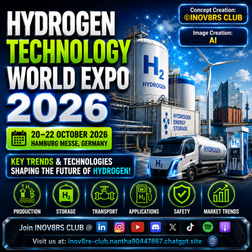
Hydrogen Technology World Expo 2026: Key Trends & Technologies Shaping the Future of Hydrogen Hydrogen technology is entering a critical new phase. The conversation is moving beyond ambitious targets toward a much bigger question: Can hydrogen become a practical, scalable, and economically viable part of the global energy and industrial system? This podcast explores the Hydrogen Technology World Expo 2026, taking place 20–22 October 2026 at Hamburg Messe, Germany, and examines some of the key technologies and industry trends shaping the future of hydrogen. From green hydrogen production and electrolysis to hydrogen storage, transportation, infrastructure, fuel cells, refueling systems, safety, and industrial applications, the hydrogen economy requires much more than simply producing H₂. 🟢 HYDROGEN PRODUCTION: How can electrolysers, renewable energy, and emerging technologies reduce the cost of producing low-carbon and green hydrogen? 🔵 STORAGE & TRANSPORT: Can pipelines, tanks, carriers, ammonia, and other solutions move and store hydrogen safely and economically at scale? 🟡 HYDROGEN APPLICATIONS: Where could hydrogen have the greatest impact—heavy industry, steel, chemicals, transportation, shipping, aviation, energy storage, or power generation? 🔴 SAFETY & INFRASTRUCTURE: What engineering technologies will be required to build reliable hydrogen networks, refueling stations, storage facilities, and industrial systems? The future of hydrogen may not be determined by the biggest announcements. It may be determined by better engineering, lower costs, reliable infrastructure, and real industrial demand. Compressors, valves, pipelines, sensors, storage systems, electrolysers, fuel cells, automation, safety technologies, and digital monitoring could all become essential pieces of the emerging hydrogen economy. The key question is no longer simply: “Can we produce green hydrogen?” We should also be asking: “Can we build the infrastructure needed to make hydrogen competitive, reliable, and scalable?” Hydrogen Technology World Expo 2026 could provide an important window into how the industry is addressing these challenges. Watch the full discussion and share your perspective: IS HYDROGEN READY FOR ITS NEXT BIG PHASE? Which hydrogen technology do you believe has the greatest potential—production, storage, transportation, fuel cells, mobility, or industrial applications? Share your thoughts in the comments. INOV8RS CLUB — Exploring Innovation, Engineering, Manufacturing, Energy, Technology & the Future.
#AI Tool or Replacer: The Future of AI in Manufacturing, Innovation and #Engineering
AI: Threat or Tool? Will Artificial Intelligence Replace Manufacturing Workers and Engineers—or Make Them More Powerful? Artificial intelligence is rapidly transforming manufacturing, engineering, automation, robotics, and the future of work. But one major question remains: Will AI replace humans, or will AI become one of the most powerful tools workers have ever used? This podcast explores the growing impact of AI in manufacturing, including industrial automation, robotics, engineering productivity, smart factories, workforce transformation, and the changing relationship between humans and intelligent machines. Inspired by the wider debate about innovation, economic progress, AI productivity, and the future of jobs, we examine both sides of the AI revolution. 🔴 AI AS A THREAT: Could artificial intelligence, robotics, and automation eliminate manufacturing and engineering jobs? 🔵 AI AS A TOOL: Could AI instead help engineers, technicians, operators, and manufacturers solve problems faster, improve productivity, reduce downtime, enhance quality, and accelerate innovation? The future may not simply be humans vs. AI. It may be humans using AI vs. humans who don't. From industrial robots and predictive maintenance to smart manufacturing, AI-assisted engineering, quality control, and data-driven factories, artificial intelligence is changing how products are designed and manufactured. The critical question is not only “What jobs can AI replace?” We should also be asking: “What can humans accomplish with AI that was impossible before?” Listen the full discussion and decide: AI — THREAT OR TOOL? Share your opinion in the comments. Will AI ultimately replace manufacturing workers—or make skilled people even more valuable? INOV8RS CLUB — Exploring Innovation, Engineering, Manufacturing, Technology & the Future.

🤖 #AI in Manufacturing: What AI Can—and Cannot—Do for Industrial #Innovation - #Harvard Business.
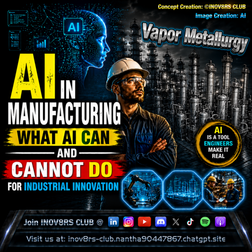
🏭 Artificial Intelligence is transforming manufacturing, engineering, metallurgy, process technology, and industrial innovation. But how far can AI really go—and where do experienced engineers, scientists, and operators remain essential? In this video, INOV8RS CLUB explores the rapidly evolving role of AI in manufacturing and how artificial intelligence could change the way industrial plants are designed, operated, optimized, and improved. ⚙️ AI + ENGINEERING + MANUFACTURING Modern industrial facilities generate enormous quantities of data from: 📊 Process instrumentation 🌡️ Temperature and pressure measurements 🧪 Laboratory analysis ⚙️ Equipment monitoring 🏭 Production systems 💻 Process simulations 🔧 Maintenance records 📈 Historical operating data AI and machine learning can potentially analyze this information at extraordinary speed. That creates opportunities for engineers to use AI for: 🔹 Process Optimization AI can identify relationships among operating variables and help engineers investigate opportunities to improve efficiency, productivity, and consistency. 🔹 Predictive Maintenance Machine-learning systems can analyze equipment behavior and potentially identify developing problems before equipment fails. 🔹 Industrial Data Analysis AI can rapidly examine large datasets and identify patterns that may be difficult to recognize manually. 🔹 Digital Twins & Simulation AI can complement digital twins and engineering models to explore different operating scenarios. 🔹 Engineering Research Generative AI can accelerate literature searches, summarize technical information, assist calculations, and generate ideas for engineers to investigate. 🔹 Industrial Automation AI can become another layer within increasingly intelligent manufacturing and process-control environments. 🧠 BUT WHAT CAN AI NOT DO? Industrial innovation happens in the physical world. A process that appears successful in a computer model must ultimately work inside an actual: 🏭 Plant ⚗️ Reactor 🔥 Furnace 🔩 Machine 🧪 Laboratory ⚙️ Production system AI may identify correlations—but correlation does not automatically prove causation. An AI model can also produce a confident prediction even when the historical data does not adequately represent a new operating condition. That is why: ⚠️ AI predictions still require engineering validation. 👷 WHY ENGINEERS STILL MATTER Experienced engineers, scientists, technicians, and plant operators possess something extremely difficult to reproduce digitally: Real-world industrial experience. An experienced engineer may recognize that: 🔧 A vibration indicates a developing mechanical problem. 📉 A pressure fluctuation suggests process instability. 🧪 A laboratory result looks technically possible but does not make chemical sense. 🌡️ A proposed operating temperature could create unexpected materials or equipment problems. ⚙️ A theoretically attractive modification may become impractical when maintenance and operability are considered. This knowledge comes from years of experimentation, troubleshooting, commissioning, operation, failure analysis, and continuous improvement.
🚨 #Vale & #ABB Expand #AI and Automation Across #Brazil’s #Iron Ore Operations
🚨 #Vale & #ABB Expand #AI and Automation Across #Brazil’s Iron Ore Operations Artificial intelligence is transforming the mining industry—and Vale and ABB are pushing that transformation deeper into Brazil’s massive iron ore sector. In this video, we explore how Vale and ABB are using AI, industrial automation, digital monitoring, predictive analytics, and integrated mining technologies to modernize iron ore processing operations. ⚙️ In this podcast, discover: 🔹 How Vale and ABB are applying AI to iron ore processing 🔹 Why Conceição II is becoming a model for digital mining 🔹 How automation can help prevent unplanned equipment shutdowns 🔹 How thousands of connected sensors are changing mine operations 🔹 Why predictive maintenance could dramatically improve mining efficiency 🔹 How remote operations can improve worker safety 🔹 How AI can optimize hundreds of processing variables in real time 🔹 Why Brazil could become a major showcase for the future of automated mining The transformation goes beyond simply replacing manual processes with machines. AI and advanced analytics can continuously analyze production information, detect abnormal equipment behavior, support faster decision-making and help operators optimize complex mineral-processing systems. 🌎 Is this what the mine of the future looks like? As mining companies face pressure to increase productivity, improve safety, reduce downtime and operate more efficiently, technologies such as artificial intelligence, autonomous systems, predictive maintenance and industrial automation could become increasingly important competitive advantages.
1 de 7