BlockLayer Podcast

BlockLayer Podcast

por Kenzi Takahashi, Sachi Shiokava, Diksha Desai
Temporada 3
Anna Kazlauskas | CEO & Co-Founder of Vana — Solving AI’s Data Dilemma
In this episode of Blocklayer Podcast, Kenzi Takahashi, Sachi Shiokava, and Diksha Desai sit down with Anna Kazlauskas, CEO and Co-Founder of Vana, to unpack one of the biggest bottlenecks in AI: data ownership and incentives. Anna shares her path from traditional finance into decentralized AI, and what it’s like building Vana — a platform designed to let people own their data and contribute it to AI models on their terms. We dig into why tokenomics matters in this model (and where it can go wrong), plus the hard parts of starting a Web3 company: hiring mission-aligned teams, staying focused through noise, and designing systems that can survive contact with real users. The conversation goes deep on the AI data shortage and how Vana approaches it through decentralized data ownership and data DAOs. Anna breaks down the difference between data DAOs, trusts, and unions, why private data is uniquely valuable, and what the ecosystem has learned from experiments like the Reddit Data DAO concept. If you’re interested in the future of AI, data rights, and crypto-native coordination, this one is packed. This episode was supported by Diksha Desai and Sachi Shiokava.
Jay Jog | Co-Founder of Sei Labs — The EVM’s Dominance and Its Limitations
In this episode of Blocklayer Podcast, Kenzi Takahashi, Sachi Shiokava, and Diksha Desai sit down with Jay Jog, Co-Founder of Sei Labs, to unpack why the Ethereum Virtual Machine keeps winning — and where its limits start to show. Jay draws a sharp analogy between legacy cities and virtual machines: once a system becomes the default, it’s incredibly hard to displace because distribution, tooling, and culture compound over time. He shares his journey from traditional finance and his time at Robinhood Markets to building Sei Network, and why user feedback loops matter more than narratives when you’re trying to ship something people actually use. We dig into the core technical thesis: why higher throughput is becoming non-negotiable, what parallelization changes (and what it doesn’t), and how Sei thinks about performance without breaking developer ergonomics. Jay also reflects on memecoins — not as a joke, but as a mechanism for coordination and community movement that can bootstrap attention and identity in an ecosystem. Expect a thoughtful conversation on execution environments, scaling constraints, and Jay’s Web3 founder journey. This episode was supported by Diksha Desai and Sachi Shiokava.
Avery Ching | CTO & Co-Founder of Aptos Labs — Decoding the Aptos Ecosystem
In this episode of Blocklayer Podcast, Kenzi Takahashi, Sachi Shiokava, and Diksha Desai sit down with Avery Ching, CTO and Co-Founder of Aptos Labs, for a deep dive into the Aptos ecosystem — and what it really takes to build an L1 with mainstream-scale ambitions. Avery shares his outlook on the intersection of crypto and AI, walks through Aptos’ fundraising journey, and breaks down the design differences between Aptos and other Layer 1s like Solana and Ethereum. We dig into where Aptos believes it can win: performance, developer experience, and the kinds of consumer-facing applications that demand speed without sacrificing safety. We also talk about use cases emerging on Aptos today, the realities of adopting the Move programming language (what’s powerful, what’s painful), and the roadmap Avery is most focused on as the ecosystem matures. Before Aptos, Avery spent over a decade building distributed systems at massive scale — and led the crypto platform team at Meta, spanning wallet infrastructure and L1 development, including work on Diem. Expect a technical, founder-focused conversation on L1 tradeoffs, ecosystem building, and where crypto meets AI next. This episode was supported by Diksha Desai and Sachi Shiokava.
Michael Heinrich | Founder of 0G Labs — Building the First Modular AI Chain
In this episode of Blocklayer Podcast, Kenzi Takahashi, Sachi Shiokava, and Diksha Desai sit down with Michael Heinrich, Founder of 0G Labs, to explore a bold thesis: the future of AI infrastructure may need its own modular, crypto-native stack. Michael shares his unconventional journey — from high school boredom to building 0G Labs — and how practices like spiritual reading and meditation reshaped his leadership style as a founder. We talk about the less-discussed side of company-building: clarity, emotional regulation, and staying consistent when the market (and your own head) is volatile. On the product side, we dive into what “the first modular AI chain” means in practice, why decentralized AI infrastructure is emerging as a category, and why Michael believes a community-owned approach is essential for the future of AI and data. 0G Labs is building a modular Web3 platform aimed at unlocking data infrastructure and storage for advanced AI workloads — connecting decentralized networks with tooling designed for machine-learning-native applications. Expect a wide-ranging conversation on decentralized AI, community ownership, founder psychology, and what it takes to build at the frontier where crypto meets compute. This episode was supported by Diksha Desai and Sachi Shiokava.
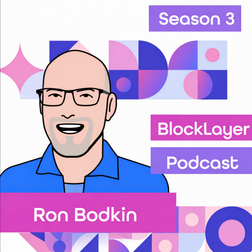
Ron Bodkin | CEO & Co-Founder of Theoriq — Understanding Agent Collectives in AI
In this episode of Blocklayer Podcast, Kenzi Takahashi sits down with Ron Bodkin, CEO and Co-Founder of Theoriq, to unpack what “agent collectives” really are — and why the next wave of AI may be coordinated by crypto-native incentives. Ron explores the intersection of AI and Web3 through the lenses of responsibility, governance, and long-term alignment. He shares his journey from Google to founding Theoriq and ChainML, and reflects on what changes when you move from corporate AI leadership to startup execution. The conversation dives into agent collectives, why standardization in AI is still a mess, and what metrics might actually matter for decentralized AI success. Ron introduces “Proof of Contribution” and “Proof of Collaboration” as trust-building mechanisms for agents and teams — and explains Theoriq’s core pillars: interoperability, composability, and decentralized innovation. We also get into token economics, governance design, and how company culture shapes what a protocol becomes over time. Ron closes with lessons on leadership — and a forward-looking view of where decentralized AI could go next. This episode was supported by Diksha Desai and Sachi Shiokava.
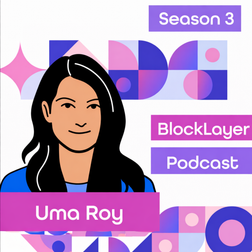
Uma Roy | Co-Founder of Succinct Labs — Why Zero-Knowledge Is Key to Scaling Crypto
In this episode of Blocklayer Podcast, Kenzi Takahashi and Diksha Desai sit down with Uma Roy, Co-Founder of Succinct Labs, to unpack why zero-knowledge proofs are becoming one of the most important primitives in crypto — for both scalability and privacy. Uma shares her path into Web3 and the motivations behind building Succinct Labs, including how the team formed and grew in San Francisco with a strong preference for in-person collaboration. We talk about what ZK actually enables beyond “faster chains,” the practical tradeoffs teams face when they adopt proof systems, and why developer tooling is the real unlock for mainstream ZK adoption. Uma also goes deep on SP1 — a ZK virtual machine — covering the hardest engineering challenges they hit while building it and the solutions they developed to make ZK systems more usable, reliable, and production-ready. Expect a technical-but-accessible conversation on building ZK infrastructure, founder lessons, and where the ecosystem is headed next. This episode was supported by Sachi Shiokava.
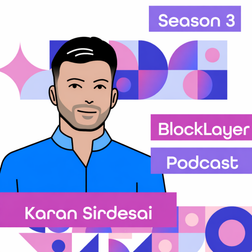
Karan Sirdesai | Co-Founder & CEO of Mira Network — Building Reliable AI on the Blockchain
In this episode of Blocklayer Podcast, Kenzi Takahashi speaks with Karan Sirdesai, Co-Founder and CEO of Mira Network — a decentralized AI infrastructure platform taking aim at one of the biggest blockers to real adoption: hallucinations and reliability. Karan explains how Mira approaches “trustworthy AI” for high-stakes use cases like finance and healthcare — where being mostly right isn’t good enough. We dig into the core idea behind Mira’s architecture: using multiple models and consensus-based verification to catch errors, reduce hallucinations, and make outputs more auditable and dependable. He also shares his non-linear founder journey — from hustling in university and working with Balaji Srinivasan, to building Mira alongside deep AI and crypto operators. You’ll hear the team’s “aha” moment: hands-on experimentation with GPU rentals and AI pipelines that revealed where reliability breaks — and how those learnings led to a breakthrough approach that could make AI systems safer by default. This episode was supported by Diksha Desai and Sachi Shiokava.
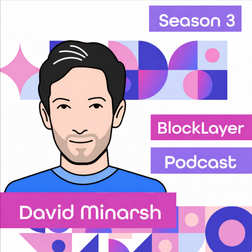
David Minarsch | Co-Founder & CEO of Valory — The Rise of Autonomous Agents and the Future of Web3
In this episode of Blocklayer Podcast, Kenzi Takahashi sits down with David Minarsch, Co-Founder and CEO of Valory, to explore what “autonomy” really means — and why autonomous agents might become the next major interface layer between humans, software, and markets. David shares his path into crypto and AI, including his work with Fetch.ai, and the founding story behind Valory and OLAS. We dig into the rise of autonomous agents: what they can do today (beyond demos), where they’re already useful, and what breaks when you try to deploy them in the real world — especially inside permissionless, adversarial environments like Web3. The conversation also covers the challenges in the Web3 × AI landscape: coordination problems, incentive design, security, and reliability. David makes a strong case for mission-driven teams that can keep building through cycles, and for an open-source ethos — with OLAS positioned as infrastructure to coordinate decentralized autonomous agents in a way that’s composable, verifiable, and scalable. Expect a thoughtful deep dive on autonomy, agent coordination, and the future shape of Web3 as agents become first-class participants. This episode was supported by Diksha Desai and Sachi Shiokava.
Nick Emmons | Co-Founder & CEO of Allora Labs — The Synergies Between Web3 and AI
In this episode of Blocklayer Podcast, Kenzi Takahashi, Sachi Shiokava, and Diksha Desai sit down with Nick Emmons, Co-Founder and CEO of Allora Labs, to explore what crypto actually adds to AI — and where the hype ends. Nick breaks down the synergies between Web3 and AI through a practical lens: how decentralized systems could coordinate models, incentives, and data into something closer to a “collective intelligence” network. He shares Allora’s mission and why they’re focused on AI-powered DeFi — building new financial primitives that use predictive models and markets to make on-chain systems smarter and more adaptive. We also get into the open vs. closed AI debate, why that tension matters for builders, and what kinds of opportunities exist right now for blockchain developers stepping into the AI space. Nick highlights the milestones at Allora Labs that excite him most — and returns to a core idea: markets aren’t just for price discovery; they’re one of the best tools we have for coordinating solutions to hard problems. Expect a wide-ranging conversation on decentralized AI, crypto-native incentives, and Nick’s founder journey at the Web3 × AI frontier. This episode was supported by Diksha Desai and Sachi Shiokava.
Gabby Dizon | Co-Founder of Yield Guild Games — Tokenomics and In-Game Economies
In this episode of Blocklayer Podcast, Kenzi Takahashi, Sachi Shiokava, and Diksha Desai sit down with Gabby Dizon, Co-Founder of Yield Guild Games (YGG), to unpack what makes Web3 gaming economies work — and why most of them don’t. Gabby shares his journey from PC gamer to Web3 pioneer, and what he’s learned after years of watching in-game economies succeed, fail, and evolve. We talk about tokenomics that actually sustain player behavior (not just incentives that pump and dump), how guilds change the onboarding equation, and why mainstream adoption won’t happen until the product experience competes with the best of Web2 — not just on ownership, but on fun. We also dive into the future of Web3 gaming: where AI might reshape both game design and player markets, what qualities founders need to survive long cycles, and how YGG has evolved from a play-to-earn guild into experiments like on-chain guilds and more decentralized coordination models. Gabby is a game industry veteran with 18+ years of experience. Beyond YGG, he’s a founding board member of the Blockchain Game Alliance, and his mission is simple but massive: onboarding millions of gamers into new digital opportunity — with a belief that the future of work will be built inside an open metaverse. This episode was supported by Diksha Desai and Sachi Shiokava.
1 de 4