

AnthroArt

AnthroArt

por Antropedia / Namla / Ambigrama
Temporada 2
From Block to Garden: How Are Food Practices Changing?​ - Alexandra Leca
This article explores how migration from urban to rural areas influences dietary habits and promotes the adoption of more sustainable food practices. The research is set against the backdrop of increasing counterurbanization, where individuals are leaving cities in pursuit of healthier, more balanced lifestyles in rural settings. The connection between food and nature is examined in this context, highlighting shifts towards local, seasonal produce, self-sufficiency, and sustainability. The aim of the study is to understand how the dietary habits of people who have relocated from urban to rural areas have evolved in terms of sustainability. Based on semi-structured interviews with seven families who moved from cities like Bucharest, Cluj, and Craiova to nearby villages, the research investigates topics such as changes in food preferences, challenges in adapting to rural life, food sourcing strategies, and levels of awareness and commitment to sustainable practices. The findings show that the transition to rural living led participants to rethink their relationship with food, with many adopting sustainable practices such as composting and growing fresh vegetables in their own gardens. This shift reflects a deeper connection with nature and an enhanced commitment to sustainability, something that participants had not necessarily prioritized before moving. Article by Alexandra Leca, illustrated by Amandine Bănescu https://theanthro.art/from-block-to-garden-how-are-food-practices-changing-alexandra-leca/
Do no harm to investors? Rosia Montana arbitration and structural injustices - Irina Velicu and Ionuț Codreanu
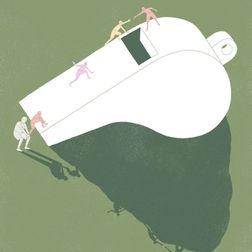
Corporations have always had the power to demand their rights: their freedom often clashes with the freedom of others to protect their needs and their lives. The article analyzes the arbitration over Roșia Montană brought by Gabriel Resources against Romania in 2015. Beyond Romania’s unexpected victory, we want to highlight that this controversial legal mechanism is a form of perpetuation of structural injustices. Between January and July 2024, our research aimed to analyze how this topic is being discussed by key actors in Romania: we examined public statements by government officials and mainstream media, as well as carried out interviews with residents of Roșia Montana. Article by Irina Velicu and Ionuț Codreanu, illustrated by Mina Mimosa https://theanthro.art/do-no-harm-to-investors-rosia-montana-arbitration-and-structural-injustice/
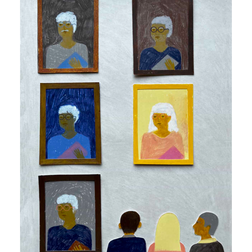
Room 242 and the Portraits That (Do Not) Speak. Unveiling Gender and Leadership in Higher Education Contexts - Rosalina Pisco Costa

It is necessary to reflect on the role of the anthropologist in denouncing realities that are often subalternised, with the role of changing them through initiatives and solutions proposed by the anthropologist, allowing us to reflect on the porosity between the spheres of activism and anthropology. To realize the implications and interconnections between different contexts, it is necessary to take a multi-scalar and multi-sited approach. One of the fields most concerned with the interconnections between local, national, and international scales is environmental studies, and it is on this theme that the article focus, mobilising former research to reach this goal. Article by Rosalina Pisco Costa, illustrated by Juliana Penkova https://theanthro.art/room-242-and-the-portraits-that-do-not-speak-unveiling-gender-and-leadership-in-higher-education-contexts/
Challenges and strategies for including sustainability in the social control of the municipal School Feeding Councils in Minas Gerais in the National School Feeding Program - Lucas Daniel Sanches
This study investigates the challenges and strategies for incorporating sustainability into the social control of municipal School Feeding Councils (CAEs) in Minas Gerais within the National School Feeding Program (PNAE). The research aims to understand the performance of CAEs in promoting sustainability and evaluates the impact of an educational intervention on counselors’ intentions to act. The methodology involves action research with qualitative and quantitative analyses, including workshops and discussion groups. Key findings highlight the importance of family farming, school gardens, and reducing food waste as strategies for sustainability. The study also identifies obstacles such as lack of support and negative interference from teachers. The educational intervention appears to have raised awareness and fostered partnerships among CAEs, suggesting the need for intensified training initiatives to enhance counselors’ skills and competencies in sustainability. Article by Lucas Daniel Sanches, Ana Carolina Ratti Nogueira, Monique de Oliveira Sant'Anna, Jaciara Reis Nogueira Garcia, Bruno Martins Dala Paula​, illustrated by Guilia Cavallo https://theanthro.art/challenges-and-strategies-for-including-sustainability-in-the-social-control-of-the-municipal-school-feeding-councils-in-minas-gerais-in-the-national-school-feeding-program/
Creating Life Champions: Youth Coaching values, ethics, careers and a sustainable development of trainers and athletes - Daniel Alves
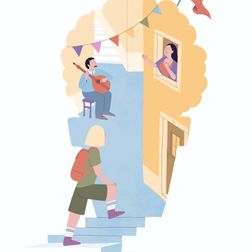
The Creating Life Champions project is a collaboration between the ERASMUS+ program and the UEFA Foundation for Children, to strengthen positive social values and principles by using sports fields as a vehicle. This project gathered 16 partners from 8 European countries. The following text presents the results of the ethnographic research done in Portugal regarding this project, aimed to conduct an in-depth analysis of how trainers perceive the educational and pedagogical role of sport and what may be the path for a sustainable strengthening of this role. From April to May 2023, a total of 20 in-depth interviews with youth coaches from 3 cities and 14 football clubs various football clubs in Portugal, to understand, the main factors, values and necessities of working with children in sports, creating a blueprint of the profile of a youth coach in Portugal for the Creating Life Champions Project to create a module and Moodle course for trainers. Article by Daniel Alves, illustrated by Patricia Palma https://theanthro.art/creating-life-champions-youth-coaching-values-ethics-careers-and-a-sustainable-development-of-trainers-and-athletes/
Around The Neighborhood: A storytelling of Mouraria’s memories, traditions and history - Augusto Ferreira
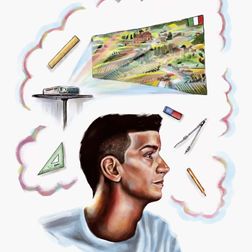
This article explores the pivotal role of videos and thematic routes in promoting sustainable tourism through the lens of intangible cultural heritage (ICH). Anchored in anthropological and ethnographic methodologies, it highlights how these tools preserve and celebrate traditions, crafts, music, and oral histories. Using the Mouraria neighborhood in Lisbon as a case study, the project documents local narratives and practices to create immersive and authentic tourist experiences. This model demonstrates how tourism can safeguard cultural identity, enhance socio-economic development, and promote sustainability without compromising authenticity. Article by Augusto Ferreira, illustrated by Patricia Palma https://theanthro.art/aroundtheneighborhood-a-storytelling-of-mourarias-memories-traditions-and-history/
What if... Anthropology + Speculative Design = Social innovation? - Andrea Gaspar

Speculative Design is a methodological approach that can be a huge tool for anthropologists. By working in collaboration with designers and using speculative design techniques, anthropologists and designers together could engage with communities and specific social groups for understanding social problems and imagining alternative futures. With this text is on the one side to present Speculative Design, while at the same time speculating how it could work for anthropologists as a tool for social innovation. Article by Andrea Gaspar, illustrated by Michaela Jones https://theanthro.art/what-if-anthropology-speculative-design-social-innovation-2/
On shared automobility practices: From horse carriages to digitally prearranged rides - Iulian Gabor
Ridesharing practices such as hitchhiking and carpooling form specific ways of mobility, rich in composition and narratives. Both social practices are present at the margins of all urban areas in Romania having their own specific modus operandi. Although they are not associated with the concept of sustainability by their public, they are embedded in a sustainable kind of mobility, as alternatives to personal road vehicles. The sustainable dimension of ridesharing is also supported by the debate around the occupancy of the car seats. Comparative and historical material demonstrates that states may encourage, discourage, criminalise, or neglect hitchhiking through different policies or even propaganda in order to fill as many car seats as possible. Through such policies, ridesharing is promoted as an act of individual responsibility towards the environment and society as a whole. In other cases it is perceived as a limitation for mobility, and the social results are easy to detect. As Graham and Marvin (2001) noted when they were discussing electronically tolled highways or superhighways, these practices are clearly exclusionary, accentuating the splintering of urbanism. My article proposes a timeline in the history of ridesharing and explores the way unorganised travelling like hitchhiking and organised commuting like digital carpooling (especially through the Blablacar platform) might be part of a more sustainable behaviour. In contrast, other so-called ridesharing platforms such as Uber or Bolt are falsely considered part of the broad concept of sharing economy. Borrowing the concept from Belk (2014), I consider them “pseudo-sharing”. Article by Iulian Gabor and Ben Eyre, illustrated by Daniela Olaru https://theanthro.art/on-shared-automobility-practices-from-horse-carriages-to-digitally-prearranged-rides/
Can you make an impact? Anthropologists and sustainable finance - Stefan Voicu and Ben Eyre

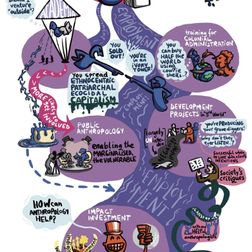
For several years now the financial industry has been enrolled, more or less voluntarily, in the global quest for sustainability. Sustainable finance is currently a complex, variegated field of practices and discourses which claims to invest in projects that have, in the best case scenario, a positive impact on society and the planet, or, worst case scenario at least avoid having a negative one, while also making returns. This article focuses on investors practicing a sustainable investment strategy called impact investing, reflecting on a question we were asked at one of the field’s main annual conferences in late 2023: “how can you leverage anthropology to make an impact?” We reflect on what this question actually means, draw parallels between impact investing and development programs, and explore different answers given by both academic and applied anthropologists to show how anthropologists think about finance and sustainability, and how are their ideas informed by and transformed into actions. Article by Stefan Voicu and Ben Eyre, illustrated by Cristina Labo https://theanthro.art/can-you-make-an-impact-anthropologists-and-sustainable-finance/
On Digital Clutter: Understanding Our Relationship with the New Cloud of Unknowing - Liana Gheorghiu
In today’s digital age, cloud storage has become increasingly prevalent, fundamentally altering how we manage and interact with data ownership. While corporate entities have traditionally relied on cloud storage for large-scale data management, personal data storage has recently migrated to the cloud, emerging as a primary means of storing various virtual assets. This shift towards personal cloud storage reflects a broader cultural trend towards digitalization and convenience. However, it also underscores the challenges of digital clutter and data accumulation on a personal level. Through interviews and observation, this research delves into the reasons behind our tendencies to continuously accumulate digital assets and explores their ecological consequences. Emotional attachments and subscription plans emerge as significant drivers of digital clutter. Furthermore, amidst the unsettling trend of corporate dominance over data, the article advocates for a more conscientious and sustainable approach to managing digital possessions. Drawing on diverse theories and environmental discourse, it emphasizes the importance of striking a balance between personal convenience and ecological responsibility. Article by Liana Gheorghiu, illustrated by Andreea Moise https://theanthro.art/on-digital-clutter-understanding-our-relationship-with-the-new-cloud-of-unknowing-liana-gheorghiu-illustration-by-andreea-moise/
1 de 10