All the Best — UNL ORCA Awardees Tell Their Stories

All the Best — UNL ORCA Awardees Tell Their Stories

por Mark Griep
Temporada 1
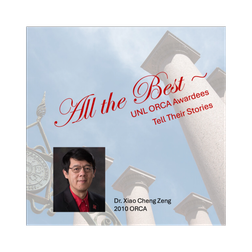
Xiao Cheng Zeng, Theoretical/Computational; Nebraska ice & Gold nanocages
Dr. Xiao Cheng Zeng became a chemistry professor at the University of Nebraska-Lincoln in 1993, quickly rose through the ranks, and was in the department for 29 years. In 2022, he left to become head of the Department of Materials Science and Engineering at the City University of Hong Kong. Xiao was born in Beijing and earned a bachelor’s in physics at the University of Beijing in 1984. Next, he traveled 6800 miles east to Ohio State University in Columbus where he earned his doctorate in condensed matter physics. He followed that up with two postdoctoral experiences, first at the University of Chicago and the second at the University of California Los Angeles. At UNL, Xiao’s lab carried out theoretical/ computational studies on a wide range of interesting solids, liquids, and gases.
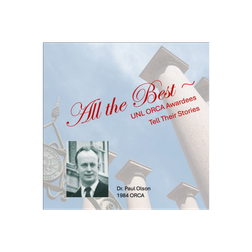
Paul Olson, English Literature & Curricular Reform; Great Plains Studies
Prof. Paul Olson was born in 1932 in Washburn, Wisconsin. During his youth, his family also farmed in Nebraska and South Dakota. He earned a bachelor’s degree from Bethany College in Lindsborg, Kansas. Next, he earned a master’s in English from the University of Nebraska, a Fulbright fellowship to spend a year at London University in England, and his doctorate in medieval and Renaissance studies from Princeton University in New Jersey. In 1957, he joined UNL as an assistant professor of English and was soon promoted to full professor. One of his earliest projects was to help English teachers across the state to reform their curricula. As a literary historian, he eventually published twelve books and many book chapters and articles on topics such as medieval literature, Plains and Indian literature, and English education reform. In 1976, Paul became founding director of the Center for Great Plains Studies, which is now celebrating its 50th anniversary this year. Paul retired in 2006 and still lives in Lincoln, Nebraska.
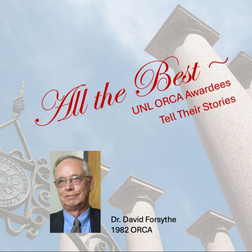
David Forsythe, International Human Rights
Prof. David Forsythe was awarded the ORCA in 1982. He was born in North Carolina and earned a bachelor’s in political science from Wake Forest University in Winston-Salem. Next, he earned a master’s and doctorate in Politics from Princeton University in New Jersey. In 1973, he joined UNL as an associate professor of political science and was soon promoted to full professor. In 1993, he became chair of his department and received the Charles J. Mach Distinguished Professorship of Political Science. He has authored, co-authored, or edited about 30 books on was International Human Rights, Law, and Politics, and has authored or co-authored dozens of journal articles in those same areas. He has been a visiting professor or lecturer at universities and organizations around the world. Dave was very active in the International Studies Association, in which he held several elected positions. Dave retired in 2010 and still lives in Lincoln, Nebraska.
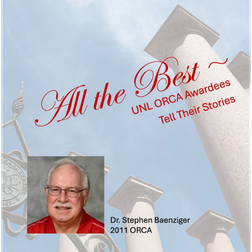
David Hage, Drug-Protein Interactions
Prof. David Hage.was awarded the ORCA in 2018. He was born in La Crosse, Wisconsin, and earned a bachelor’s in chemistry at the University of Wisconsin in La Crosse. Next, he earned a doctorate from Iowa State University and did postdoctoral work at the Mayo Clinic in Rochester, Minnesota. In 1989, he joined UNL as an assistant professor of chemistry and quickly rose through the ranks. He has won many awards and, for the past 13 years, has been the James Hewet University Professor of Chemistry. Allow me to share some remarkable facts about Dave before we get into the interview. One is that his lab found a way to make very small chromatography columns that could withstand very high pressures, which allows rapid analysis of a wide range of molecules. Another fact is that he has published over 365 peer-reviewed publications and that 10% of those papers have been cited more than 100 times. My third fact is that he has mentored over 77 graduate students who have received M.S. or PhD degrees, which places him among the most productive advisors in the department’s history. Since more than half his graduate students have been women, it also means he has mentored more women than any other.
Margaret Jacobs, History of Indigenous Child Removal
Dr. Margaret Jacobs was awarded the ORCA in 2021. She was born in San Pedro, California, but grew up in Colorado. Something in her youth must have sparked an interest in history because she earned a bachelor’s, master’s, and doctorate in that subject with a focus on the interactions between Indigenous peoples and settlers. Her bachelor’s was from Stanford University in California, while her master’s and doctorate were from the University of California, Davis. After teaching history at New Mexico State University, she joined the University of Nebraska-Lincoln in 2004 as professor of history and director of the Women’s and Gender Studies Program. She has been very successful. In 2019, she was elected as a fellow of the American Academy of Arts and Sciences. Also in 2019, she received a three-year grant from the National Endowment for the Humanities to gather materials related to the Genoa Indian Industrial School and then partner with two others make the materials available in a culturally sensitive way. In 2020, she became the Director of the UNL Center for Great Plains Studies where she has found ways to explore Great Plains culture, and to develop meaningful relationships with Nebraska’s current and former American Indian populations.
Michael James, Quilted Fabric Construction Artist
Prof. Michael James was born in New Bedford, Massachusetts. Something in his youth must have sparked an interest in the arts because he earned a bachelor and master of fine arts, both with an emphasis on painting and printmaking. His bachelor’s was from the University of Massachusetts at Dartmouth and his master’s was from the Rochester Institute of Technology. After graduation, he embarked on a 26-year career as an independent studio quilt designer and maker. His career took a new direction in Spring 2000 when he was a Visiting Lecturer in Textiles at his Dartmouth Alma Mater. In Fall 2000, he arrived at the UNL campus as a senior lecturer in the Department of Textiles, Merchandising and Fashion Design. He quickly jumped to the tenure-track as a full professor and, soon thereafter, chair of his department. He’s had a remarkable career with dozens of solo exhibitions, with work in over 20 public collections including the Smithsonian’s Renwick Gallery. He retired in 2020 and has begun writing books.
Pill-Soon Song, Photobiologist and Photochemist
Pill-Soon Song was born in Osaka, Japan. When he was 13 his family moved back to Korea. Something in his youth must have sparked an interest in science because he enrolled at Seoul National University where he earned a bachelor’s and master’s in agricultural chemistry with an emphasis on biochemistry. Next, he earned a doctorate from the University of California at Davis and did postdoctoral work at Iowa State University in Ames with David Metzler. In 1987, after about 21 years as a faculty member in the chemistry department at Texas Tech University, he joined UNL chemistry as chair and full professor. He is remembered fondly because he led us through a decade of faculty hiring, including myself in 1990. There are two interesting facts I’d like to mention before we get started. One is that he was a leader on many levels in the international photochemistry and photobiology community. The other is that he published over 200 journal articles and co-authored over twenty patents. He left in 2003 to develop his turfgrass project at Jeju National University in Korea.
Reuben Rieke, Discoverer of Rieke Metals
Emeritus Prof. Reuben Rieke was awarded the ORCA in 1995. Reuben was born in Fairfax, Minnesota. Something in his youth must have sparked an interest in science because he traveled 100 miles east to The University of Minnesota where he earned a bachelor’s in chemistry. Next, he earned a doctorate from the University of Wisconsin, and did postdoctoral work at the University of California Los Angeles. In 1977, after about 11 years as a faculty member in the chemistry department at the University of North Carolina, he joined UNL as a full professor of chemistry. I’ll share two remarkable facts about Reuben before we get into the interview. One is that his lab found a way to make highly reactive metal halides, now called Rieke Metals, that are useful in many synthetic reactions. The other fact is that Reuben started his own company in 1991 to produce the Rieke Metals. He retired in 2004 to devote his full time to running his company. Lightly edited transcript in pdf form: https://digitalcommons.unl.edu/unlorca/5/
John Janovy, Jr., Parasitologist and Author
Professor John Janovy, Jr., was awarded the ORCA in 1998. John was born in Louisiana, but his family moved to Oklahoma, where he grew up in Tulsa and then Oklahoma City. Something in his youth must have sparked an interest in science because he earned three degrees from the University of Oklahoma in Norman: a bachelor of science in math in 1959, a master of science in zoology in 1962, and doctoral degree in zoology in 1965. Next, he ventured 1400 miles east to Rutgers University in New Brunswick, New Jersey, where he did post-doctoral work for about a year. Throughout his young adulthood, from 1959 to 1966, he was in the US Army Reserves. In 1966, he joined the University of Nebraska–Lincoln as an assistant professor of zoology. He had a remarkable career as he rose through the ranks. One interesting fact is that he has written over 25 books about zoology and other topics. His first book was Keith County Journal that was published in 1978. He retired in 2011 and is now writing novels among other things. You'll find a list of John's books on his website: https://www.johnjanovy.com/ Lightly edited transcript: https://digitalcommons.unl.edu/unlorca/4/
Karen Kunc, Abstract Print Artist
Emeritus Professor Karen Kunc was born in Omaha, Nebraska. Something in her youth must have sparked an interest in art because she earned her bachelor of fine arts degree from the University of Nebraska-Lincoln in 1975. Next, she ventured 800 miles east to Ohio State University in Columbus, where she earned a master of fine arts. For the next six years, she enhanced her teaching credentials as a printmaking instructor at the Columbus College of Art & Design. From there, she joined the University of Nebraska–Lincoln in 1983 as a visiting, but soon an assistant, professor of art. She’s had a remarkable career as she rose through the ranks. For instance, her work has shown in at least 1000 exhibitions and in over 120 one-person shows, and her work is in dozens of corporate and private collections and in over 180 public collections. Karen retired in 2020 and is now running her Constellation Studios on O Street in Lincoln. Kunc's artwork website: www.karen-kunc.com Lightly edited transcript in pdf form: https://digitalcommons.unl.edu/unlorca/3/
1 de 2