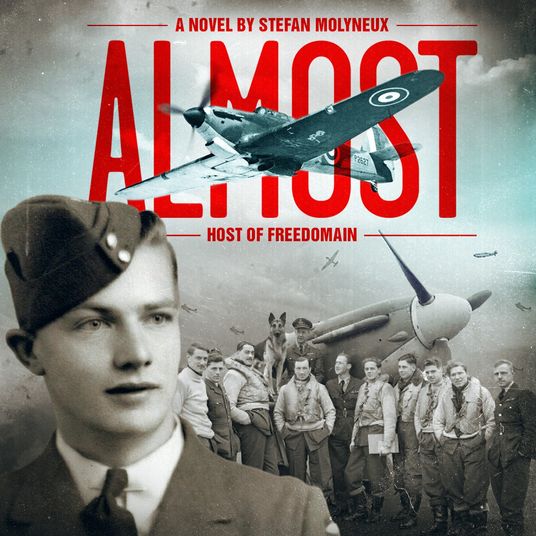
"Almost" - A Novel by Stefan Molyneux

"Almost" - A Novel by Stefan Molyneux

by Stefan Molyneux, MA
Season 1
"Almost" Part 1: Chapters 1-3
Chapter One During the first months of the Great War, Reginald loved to run to the edge of the white cliffs of Dover and lie panting on the grass, staring out over the English Channel. He loved listening to the rumble of guns and the flashes of light from France, where there were always ashen clouds, even on sunny days. His father Quentin lived in those clouds, and Reginald truly believed he was a species of thunder-god, who strode miles at a step and bit down on white lightning with tobacco teeth. Reginald did not really remember his father being home, home in the way his mother was, sitting and knitting and sighing and, from time to time, wandering with the other mothers, from house to house, with tears in their eyes and handkerchiefs to their faces. Home was a large, rambling house, a very English house, which was cold in the endless rain and spacious and creaky and covered with doilies crocheted by dead grandmothers and walled by pictures of chilly men who never smiled, not from any angle. The cabinets were glassy, glossy, containing plates and cups that were never used. It was a very quiet house. There were servants, but they were all very old, or women. It was a world without men. Reginald hated spending time alone, and so spent a lot of time with his friends. Mostly they fought elaborate wars with sticks and old tennis balls. They aimed and boomed from the corners of their mouths, fell in heaps, dragged each other to safety, healed with a touch and argued over wounds and accuracy. They strove mightily to send their small braveries over the Channel to shore up the resolves of their fathers. When his father left, Reginald was the ‘man of the house,’ and he did press-ups and tried to run without panting, half-expecting to receive a tiny gun and a little helmet and to be sent to France to run with the feet of the giant soldiers...
"Almost" Part 2: Chapters 4-6
Chapter 4 In the confusion and horror of her war years, Ruth found herself unable to educate her children about right and wrong. Every word she imagined speaking seemed hollow in her own ears. The evil of the Great War, the ghastly effect it had had on her own family, own marriage, own soul – lent scant weight to the little ethics, from which grow the great ones. Ruth did not greatly care if Tom lied, or stole, or ate too much, and so his education was left to Reginald. But children can never really teach other children about right and wrong. The only lesson children can inflict on each other is conformity, and this was about as far as Reginald got before Tom abruptly wrenched the rudder from his hand. At first, Tom was so naturally compliant that sometimes, when he stood in front of wallpaper, Ruth half-expected him to assume its colour and texture. He was very different from Reginald, who was rarely compliant, rarely rebellious, and fundamentally quite cold. Through the haze of her loss, Ruth still strove to understand her eldest son. Reginald’s coldness was hard to penetrate. He was often attentive, high-spirited, and could be very funny, but he had all the spontaneity of a statue. He gave dry kisses and distant hugs; his eyes never shone, and his cheeks rarely flared red or white. He has an old soul, thought his mother – and if he did, it had a lot to do with her, who was from the old world, and was full of old corpses too long unburied. Ruth’s general exhaustion (or, as Quentin put it, her ‘lack of resources’) was not helped by the fact that she had given birth to one morning child and one night child. Reginald got up early, and would sometimes drag Tom out of bed in the half-dark of dawn to play with soldiers or read comics or build a Sopwith Camel biplane out of balsa wood and black thread. Tom enjoyed all these things (especially building aeroplanes), but did not like to get up until the third call for breakfast. Almost like a photograph, Tom developed in the dark. Unless he was extraordinarily tired, he could never fall asleep before one or two o’clock in the morning (and if he did get to sleep early, his rest would be broken by endless bouts of waking, so that it seemed that night had been little more than a passage of dark, jumpy dizziness). Being a prisoner of the general cult of morning people, he was not allowed light at night and so he developed excellent night vision, and good games of semi-darkness. One of these was ‘arctic explorers.’ In the blue moonlight of his window, his sheets looked like vast fields of ice; his pillow, properly plumped, was a glacier or ice mountain. His blanket, a dark frigid sea. His toy soldiers? Intrepid Arctic explorers, or secret Swedish commandos. Their goal? An ancient weapon locked in the depths of ice, which would end the war and bring ’em all home. Tom’s imagination was detailed to the point of near-gruesomeness. A fair number of his toy soldiers lacked hands, arms or legs, which was because the intrepid Arctic explorers had a habit of getting snowed in (a white gym sock, laid across their sleeping forms) and ended up eyeing each others’ frozen extremities with narrowed and hungry eyes. One had even eaten himself, and was just a head.
"Almost" Part 3: Chapters 7-9
Chapter Seven Reginald had all the attributes of a successful school boy, highly respected prefect, and future scion of the intellectual empire of the West. He had almost no inner life, and so no hesitations, no conflicts, no doubts. Everything was unconscious, everything assumed; he had all the fate of defenses disguised as instincts. Tom, on the other hand, was quite often wracked with doubt. His relationship to rules, for instance – unlike Reginald’s – was complex. One day, at boarding school, Tom vaulted the iron fence over to the sanatorium to retrieve an errant soccer ball, and on return had been met by a grim-faced group of prefects. His brother lurked in the background. “Attaboy, Tom,” said Edward the Head Prefect, a fresh-faced boy of glassy, soulless perfection. “Not many new boys have the guts for that kind of move.” “Um – thanks,” said Tom, rolling the ball in his grimy hands. “Against the rules, of course, so you’ll have to take your licks, but we can all admire a renegade. Cheers.” Tom took a step backwards. “Well, I shan’t do it again.” “I am quite convinced of that,” smiled Edward. “That is what we prefects are all about. It’s why we patrol. To ensure that no-one does anything wrong twice.” “The Empire is built on daring and obedience, Tom,” added Reginald. “You have the first. Now, you must learn the second.” “Come on then,” said Edward, leaning forward and pinching Tom’s earlobe painfully. They surrounded Tom and marched him up to the Headmaster’s office, and he had to wait outside while they made their report. After a few minutes, Tom was called in. The Headmaster was a deity of the Old Empire, with a pale face, jug ears, a high, broad forehead and delicately thinning, colourless hair. “Sit down, Tom,” said the Headmaster. The prefects left the office; as he passed, Reginald pinched the flesh on Tom’s hip savagely, almost making him cry out. Tom said nothing, though. He knew the rules; it was only honourable to squeal down the chain of command. “So, Tom, you took it upon yourself to retrieve this football – which I would, actually, appreciate you leaving in the hallway.” Tom got up, put the football outside, came back, and sat down again. The Headmaster stared at him blankly for a moment, then said: “This is your first transgression, so we shall have to have a little chat about it. Is it my understanding that you in fact know that it was against school rules to go over the sanatorium fence?” Tom tried to speak, then swallowed and tried again. “Yes, sir, I did.” The Headmaster leaned forward. He seemed very tired, which in Tom’s short experience always was the first sign of impending violence from authority.
"Almost" Part 4: Chapters 10-13
Chapter Ten Quentin enjoyed taking Reginald to his study for an after-dinner drink. Tom was sometimes invited, but knew from experience that he would not be drawn into the conversation. The last one he had attended was in 1925, when Reginald was 17, and Tom 15. “So, my boy,” said Quentin, pouring a large cognac for himself, a small one for Reginald, and a glass of water for Tom. “Do you know that today, a great treaty was signed between England, France, Italy and Germany, at Locarno.” “Someone said something,” said Reginald, reaching for the glass. He quickly sunk into ‘his’ armchair, the possession of which had been the subject of pitched battles between himself and Tom in their early years, until Tom had realized that he was fighting against Reginald, rather than for the chair, and gave it up, enduring Reginald’s constant smirks of triumph whenever he got the chair without complaint – even now, six years after the end of the conflict. “This is very good news,” said Quentin, “and I wonder if you can tell me why.” “Well,” said Reginald, swirling his glass under his nose. “It means that Germany isn’t being just treated as a conquered nation any more.” “Yes, very good. It will pave the way for her entrance into the League of Nations, mark my words. And it means that England, France and Italy, rather than just seeing themselves as the winners of the Great War, are now prepared to guarantee the borders of France and Belgium with Germany. And the Allies are removing the military Control Commission and the last of the occupation troops from German soil. That will go a long way towards restoring Germany’s faith in herself.” “Why Belgium?” asked Reginald. “Sorry?” “Why does the Treaty of Locarno guarantee the borders of Belgium, when she’s not even a signatory?” “Well, glance at the globe, and tell me.” Reginald leaned forward, twirling the globe at his feet, tracing his fingers over the borders of France. “Because – because the French share a border with Belgium?” “Yes, but why else?” Reginald sniffed. “Don’t know.” Quentin grinned, leaning forward. “Think defense.” “Hm.” “Think Maginot…” “Oh!” “Yes?” “Well,” said Reginald excitedly, jabbing his finger. “The French are building the Maginot line on their eastern borders, as a defense against the Germans, but not on their northern borders, which they share with Belgium.” “The great fear of the French,” said Quentin, sitting back with a grunt of satisfaction, “is that Germany comes through Belgium in through the north. As in the Great War.” “Oh, so if Belgium is invaded…” “Compromised,” corrected Quentin. “Sorry?” “Say ‘compromised.’ It’s more sophisticated. ‘Invaded’ sounds like you’re still playing with lead soldiers.” Reginald shrugged. “All right, then if Belgium is compromised, then England has to come to the aid of France.” “Which means that Germany will have to think twice about coming at France through the north. So France can focus on its defenses in the East, against Germany itself.”
"Almost" Part 5: Chapters 14-16
Chapter Fourteen Tom and Reginald went to school within two years of each other, and this produced an unexpected Renaissance within the Spencer household. It was not immediate, but it was unmistakable. Two weeks after Tom went away to All Souls, Ruth came down for breakfast. Quentin glanced up from his newspaper, stunned. At first he thought that she might be sleepwalking; it had not happened for – what, eight years? Catherine – at Tom’s request – had been kept on as a cook, and she handled it magnificently. “Good morning, Ruth,” she said with great imperturbability. “Are you hungry?” “I am,” Ruth murmured, touching her throat. “I really am.” “Two eggs,” smiled Quentin. “Eggs sunny side up. One piece of brown toast, unbuttered.” Ruth smiled faintly and sat down. Quentin sat still, afraid to speak, of startling her back upstairs, to her dark nest. They ate in silence. Quentin lowered the newspaper from time to time, just a shade, to watch his wife eat. Her cheeks coloured slightly, and he realized she was aware of his stare, and raised his paper – again, very slowly. She went back to bed after breakfast, but gradually, intermittently, she began to appear more often, like a ghost straining for corporeality. Something was stirring in her heart. Some sort of light was breaking over her exhausted inner armies. Not a healing, not quite, but a sort of armistice. Quentin had not put aside his political aspirations, but they had been delayed. The by-election he hoped to run in had come and gone while he was still paralyzed by his wife’s hostility. She had agreed to refrain from proclaiming her beliefs, but he had had the following conversation with the Conservative party head. “Well,” said Mr. Watkins, who was tall and thin and had a close-cropped sheen of silver hair. “You possess unremarkable credentials, having had no parliamentary experience, no close affiliation with the Conservative party, and scant financial resources. However, these are not utterly insurmountable, insofar as a man with ability, drive and oratorical power can position himself as the outsider who can ride into town and clean things up. But, to pursue the American metaphor, perhaps, beyond good taste, you cannot do this without a credible posse. And my inquiries have led me to the understanding that you are in possession of a rather singular wife.” “I have talked with Ruth,” said Quentin, stressing her name in the hopes of transforming her from crippling hibiscus to fallible human being, “and she fully supports my desire to serve my country.” “No doubt,” said Mr. Watkins dryly. “Yet we have before us several possible candidates, and their wives have performed every kind of social service, from running the Red Cross to sitting on Means Test committees to running political seminars explaining why the League of Nations failed to check Japanese aggression in Manchuria to our understandably-confused constituents. Whether we like it or not, a man is judged by the company he keeps. When offered a candidate with a shut-in wife, voters might legitimately question the man’s ability to keep a steady focus on the job. It is the contention of the Conservative party that the current decade will contain within it grave dangers, and will require a tenaciously steady hand at the tiller. By all appearances – and with all due respect – you are not that man.” It was a kindness to even receive that depth of explanation, Quentin knew, and did not press the issue...
"Almost" Part 6: Chapters 17-20
Chapter Seventeen Reginald had a broken nose, two cracked ribs, a split chin, a bruised spine, a cracked forearm, two chipped molars and a nasty bite on his tongue. There was little to do but set his nose, bind him from head to toe and dull him with morphine. But, Tom felt, there was always something comforting about hospitals; the white, crisp starchiness seemed to envelop and heal somehow. They got a private room at the Home for Incurables, which was a blessing, because a large number of the demonstrators were brought in for various ailments, and there was a great deal of shouting, drinking, cursing, fighting and coarse flirting. Reginald’s face was a mess. Angled metal hung on his nose. A black eye, bruises all around, a stitched chin – he was almost impossible to recognize. “Poor Reggie,” murmured Klaus, patting Reginald’s forehead with a wet cloth. “I still can’t believe you were entirely unhurt.” “Well, he fought them, and I did not.” “What d’you mean?” “He was trying to turn the tide before its time.” Klaus dipped the cloth into a cup of water. “It was a collective phenomena, open to control by no man. It has to spend itself, like a fever.” “Hm,” said Tom. “Could have been chance.” “Equally so. Yes. I don’t feel that, though.” “When did you lose sight of him?” “Immediately,” sighed Klaus, his voice softening into lax dreaminess. “The crowd hit us like surf. There was no point trying to swim. The passion of every heart, pumping wildly all around me – we were more than men. We were cells in a python, a python striking for the future. Individually, no man knew what he was about. Together – ah, Tom – together we were one. No ‘I,’ no ‘thou,’ only a ‘we.’ I mean, look at the results! Their voices have been heard, and not a single death. Flailing arms, flying bullets – and no deaths! It is beyond belief, unless one remembers that even – or perhaps especially – a mob has a Higher Purpose. God moved in that street today.” Tom sighed. “Well, he left quite a mark on my brother.” “Things so much larger than the individual cannot be fought. The only destruction is in resistance. Water flows around and over rocks; we follow it, or smash. Tom, I cannot tell you what I felt in that – I cannot even say ‘madness,’ because it only looked like madness, from the outside, from above. We all thought as one. If I stumbled, a hand came out and propped me up. I flailed without thinking, a man ducked. But – but it was more than events, more than just men. I don’t know… I have never felt such ecstasy, such escape… I felt my whole being, my entire span of skin, every pore I possess, opening up into the white light of purest Godhead. Every difference fell away, and I seemed to merge into the universe itself… It was as if, through surrendering to Man, I opened myself up to God. Such passion, such courage – and terror. Such terror! That kind of emotional power is a current which lights the eyes of the divine! We all saw God today.” Tom was a little irritated at Klaus’s speech. There was something off-putting, almost narcissistic about wallowing in divine ecstasy while limbs were being broken all around him. But he was too tired to protest. He sighed. Klaus turned to him and smiled...
"Almost" Part 7: Chapters 21-23
Chapter Twenty One Martin was a priest of the old school, which meant that for him – as for millions of men, women and children across Germany – that God was alive. God was alive, and God was everywhere. Hell was as real as a car crash; heaven as possible as a good night’s sleep. And not just God in the abstract, but God as a vital Christian. God was not a crutch for times of crisis. God was not vaguely present at marriages and funerals. God was not something you dressed up and gossiped on the church steps for. God was not ‘what all religions basically worshipped.’ The Muslims and Jews might share the Old Testament, but anyone who denied the divinity of Christ was wrong – sinfully wrong. Against God. A heathen. Going to hell. Now, this kind of faith had its last holdout in certain countries in Central and Eastern Europe. Germany was one. France was not. England, Spain and Italy were not. In Germany, God was the final arbiter. There was no room for doubt. Doubt was evil; it was the cloak of Satan before the sun of God. Germany was the home of the Reformation, the spark in the mind of Martin Luther which set Europe ablaze for a hundred years. Hundreds of thousands died in religious wars. And what of it? Saving souls was grim work. To save the soul at the expense of the body was a virtue. No moral man, no Christian, could stand by and watch his fellow men marching over the cliff of error into the fires of hell. Compassion demanded that error be corrected, before it spread, before it ate like a cancer into the souls of the undecided. Martin had been called to the priesthood early, when the fires of childish imagination were at their strongest. There was hatred, tension and terror in his heart. He hated the world, hated sin, hated the devil. He walked the tightrope of having a pure soul trapped in a fleshy case of sin, in a body which could be played by the devil like an infernal organ. He was terrified of hell. There was love in his heart as well. He loved God. He prayed and wept; his soul soared high as his tears fell. He loved his fellow man, and feared for the errors of their ways. Martin was not a humanist. He did not believe that there were many roads to salvation. God did not allow each man to pick his own path. There were endless paths to hell. There was but one path to heaven. The Protestant path. People were weak. That much was clear. People were weak, and the devil was patient and cunning. To set oneself against the devil was the highest calling of all. Martin had laid low all his doubts. Any which remained had long since left the light of day. He knew that he was capable of error, of misplaced sympathy and false compassion. His particular weakness was a desire to forgive where he knew that God would never forgive. This was true for women in particular. Women who came to him broken in mind and heart, weeping over tainted desires, infidelities, jealousies and thwarted hopes – his heart ached to wave their terrors and losses away. He always hesitated to cast their souls into the pit of despair – though he knew from his own experience that this pit was required for salvation. His own heart contracted agonizingly in the face of their pitiful requests for absolution, for the word from him which would save the remainder of their days. The words always came to him: ‘sister, be forgiven, and go in peace.’ They rose in his throat like sugar, but turned to bile on his tongue. For he knew that they were not his to give. Forgiveness was only God’s to give. And the rules were clear. The rules were clear.
"Almost" Part 8: Chapters 24-25
Chapter Twenty Four Reginald had caused a great academic sensation at All Souls. His language skills were so extraordinary that arguing with him was almost impossible. His abilities were centered in two main areas: the first was scorn, and the second was agility. His scorn was a force of nature, something which had to be seen to be believed. Reginald was of the opinion that every moral stand was a mere posture, and he mocked earnest young men without mercy. He dismissed theoretical constructs as a waste of time, constantly insisting that focusing on practical matters was the only useful approach. He did not believe in bad men, but conceded that some people were in fact ‘misguided’ about their own interests. He was a great fan of Gandhi. He was not optimistic about human nature, but was optimistic about the future. People were squalid, grasping and only concerned with their own welfare – but that very selfishness was what would save mankind, he felt. Now that the bomber had brought warfare to the homes of the leaders, no-one would dare start a war. He had no love of democracy, but respected its historical roots in England. “It is our way,” he would say, with an ironic smile. “And we are stuck with it.” He liked Mussolini (“There is a man who knows what he is about!”) but knew that fascism would never take root on British soil. “Our local, gin-sodden worthies – who can no more write books than they can fly – are, for some unfathomable reason, most attached to their freedom of expression.” Reginald had a prodigious memory, (in great contrast to Tom, who had great difficulty keeping all but the broadest abstractions in his mind), and was a past master of the ‘oppositional quote.’ In debates, he would dig up some obscure reference by a great thinker, toss it at his opponents, and watch them writhing under the challenge of opposing genius. (Of course, there was a faint pattern to the kind of knowledge which Reginald retained, but that did not become evident for some time.) Certainty was quite hard to come by in the early Thirties. The only way to approach it was to be dogmatic, and Reginald was far too vain for that. He disliked communism as Messianistic German idealism, but conceded that it would probably never work because man was too selfish. “The theory is very nice, but the problem is that mankind is not very nice, so it would never work.” (In this he was in the same camp as the Vatican, which said that, although communism would in fact be heaven on earth, it was impossible, because the framers of communism forgot to take into account Original Sin, so that mankind, due to his innate sinfulness, could never achieve heaven on earth.)
"Almost" Part 9: Chapter 26
Quentin was elected on Tuesday 27 October 1931, with a fairly narrow margin. His opponent, from the Labour party, kept hammering at him on the issue of unilateral disarmament. Quentin opposed this, because it would cause even more unemployment. Ever since his son had been attacked in London, Quentin was very focused on unemployment. To his credit, he had never used the attack in a speech, but it became general knowledge anyway. Rather than undermining his credibility, it helped his cause. People said: “Quentin is one of the few rich people who has suffered more than financially.” They assumed that he would fight hard to restore employment. By the end of 1932, the situation was becoming truly desperate. Solutions abounded. Free trade! Protectionism! Unions! Breaking the unions! Government spending! Raising taxes! Lowering taxes! Deficit financing! But everything seemed intractable. Nothing worked. Society reformed itself again and again, like a mouse in a lab contorting itself to avoid random blows. Still the ranks of the unemployed grew. And everything changed with it. Youths lived with their parents longer. Marriage declined. Children were postponed. Creativity in the workplace declined. University students stayed in school. The regular rhythms of life were undermined. The allegiance of the youth fell away. Mired in habits and slogans, elders were revealed as impotent. Society had nothing to offer the young, and so could command no obedience. The social contract weakened. And yet, there was a salvation in society. All was not lost. In desperation, thinkers of every stripe turned towards the Government to solve the problems. Freedom had proven too unstable. The concept of the ‘benevolent state’ was born, and it was a very new beast. For most of human history, of course, the State was a rapacious predator, providing meager protection at a most terrible price. Ordinary men quailed in its presence. War, repression, random punishments and the denial of basic rights – the State was military in nature, endless in authority, murderous in practice. Governments were not born from the desires of the ruled, but from outlaws too lazy to move on. And the free countries – the countries which had tamed the State, and made it serve the individual – they had been attacked by a militaristic, statist Germany, and now, shuddering and bleeding under the wound, even fourteen years later, they turned to the State to protect them again. Thus can the body weaken further, even after throwing off the infection. At the turn of the twentieth century, Churchill and others had been involved in the great debate of protectionism, and it was a debate lost to the memories of the younger generation. The protectionists they opposed had a simple argument: we can help English workers by taxing goods coming into the country...
"Almost" Part 10: Chapters 27-28
Ruth liked having a headache when she was going over her correspondence; it made her feel like she had a real job. As the wife of an MP, she received the kinds of letters which, it was imagined, men would never be able to understand. Over the past year, she had grown used to a number of catchphrases. First, were the openers. There was the standard ‘Mrs. Spencer.’ There was the feminist ‘Ms. Spencer.’ There was the over-familiar ‘Dear Ruth’ – or just ‘Ruth’ or, horror of horrors, ‘Ruthie’ – as if the letter were a note scribbled in haste from her oldest friend. There were also the amusing: ‘To The Power Behind The Throne,’ or ‘To The Person Whose Husband I Voted For So I Could Send You This Letter.’ The opening sentences were also repetitive – and would never be addressed to a man. There was the desperate: ‘I am truly at my wits’ end,’ which Ruth did not like particularly, because of its assumed chummy female solidarity: Men don’t notice such things, or care if a woman is at her wits’ end, but you, as a woman, will care! There was also the falseness of: ‘I really don’t know who else to turn to.’ If you are turning to strangers, you have surely widened your options to more than just one stranger! There was also the instant-intimacy of: ‘As a woman, I know you will understand when I say…’ Or the back-story of: ‘When I was young, I never expected that this would happen to me.’ There was also the uselessness of: ‘I have not written to ask anything of you, but thought you might find the following history informative…’. There were also the paper-cutters. A surprising number of people followed her career, and sent her photographs of herself in the newspaper, often with fashion or makeup tips. An elderly woman in Yorkshire disapproved of almost everything Ruth wore, circling with a heavy-inked pen all the flesh left exposed by her outfits. It seemed that Ruth would only find her approval by appearing in public in a burka, or a small pup-tent. Instructively, a divorcee in Cheltenham thought that Ruth’s costumes did not show enough skin, and warned her that ‘men do not like to stick around a woman who is not appealing, and if he leaves you, you lose the power to strike blows for women.’ Obviously, thought Ruth, her parting with her husband was neither mutual nor amicable. Another woman was always giving her advice on how to manipulate Quentin: ‘just wriggle up to him, sit on his lap, cup his cheeks, kiss his forehead, and ask for a little favour in a breathy voice. Don’t be afraid to pout!’ she added helpfully, though that made Ruth sigh deeply, toying with her hair. I think that Quentin has had quite enough pouting from me! There were, occasionally, simple, direct appeals. ‘My husband was lost at the Somme, but he enlisted too young, and they keep cutting off my benefits.’ ‘My neighbour’s dog keeps barking.’ ‘They start construction on my street at 6am, and I am a shift-worker.’ ‘What do I do if am owed money by brothers of mine?’ ‘My son is missing, and the police are doing nothing about it!’
1 of 4