Let's Talk Development

Let's Talk Development

por Consortium for Development Policy Research
Temporada 3

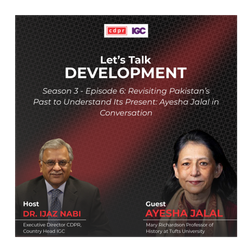
Revisiting Pakistan’s Past to Understand Its Present: Ayesha Jalal in Conversation
What can history teach us about Pakistan’s current economic dilemmas and its future? In this episode, Ayesha Jalal joins Ijaz Nabi to reflect on the country’s enduring political and economic challenges.The conversation touches on Jinnah's constitutional vision, the fractured nature of Pakistan’s federal politics, the recurring cycles of aid inflows during military regimes and the missed opportunities for building sustainable growth through trade and taxation. Jalal also emphasizes the importance of reclaiming history as a discipline rather than an ideological tool to better understand identity, regional connections and the possibilities for Pakistan’s future within South Asia.

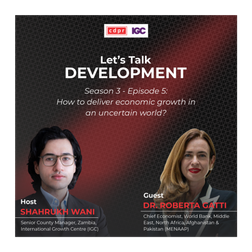
How to deliver economic growth in an uncertain world?
Global growth is slowing, debt burdens are rising and climate pressures are intensifying, what does this mean for the future of economies? In this episode, Dr. Roberta Gatti from World Bank and Shahrukh Wani from IGC explore some of the most pressing questions shaping growth today: the changing role of industrial policy, how governments can promote stronger business environments and why data and evidence are crucial for effective policymaking. They discuss the MENAAP region’s debt challenges, the risks and opportunities from trade realignment, and the importance of measuring what works - and admitting what does not. With insights from one of the World Bank’s leading economists, this conversation offers valuable perspectives for policymakers, researchers and anyone interested in the future of growth.

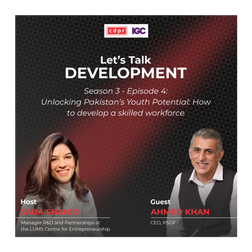
Unlocking Pakistan’s Youth Potential: How to develop a skilled workforce

64% of Pakistan’s population is under the age of 30. This “youth bulge” holds immense promise if equipped with the right skills. In this episode, Ahmed Khan and Saba Shahid discuss how Pakistan can turn its growing youth population into a productive economic force. They discuss how PSDF is addressing this challenge through industry aligned, digitally delivered and outcome focused training programs across urban and rural locations in the country. They shed light on initiatives taken by PSDF for women, the transgnder community and other marginalized groups aiming to improve job opportunities at the grassroot level.

Cities on the Brink: Climate Risks and Urban Realities in Pakistan

Pakistan is facing a dual burden of rapid urbanisation and increasing climate vulnerability, with low-income and marginalised communities bearing the greatest impact. In this episode, Hina Shaikh and Nausheen Anwar discuss the lived realities and politics of urban transformation in Pakistan’s cities. They unpack the complex relationship between urban development and climate challenges, examining how issues such as air pollution, urban flooding and heatwaves manifest differently across cities, shaped by each city’s unique geography, infrastructure, and inequalities.

Mapping Karachi: Spatial Vulnerability and Climate Change

The impact of climate change in cities is highly dependent on spatial factors. Within a sprawling and metropolitan city like Karachi, examining its topographic and geographic spatiality in terms of its unique location by sea, desert and forest is key in determining the negative effects of climate change on its twenty million residents. In this episode, Maha Qasim and Yasir Hussain dive into the historiography of Karachi’s spatial vulnerabilities to discuss problems of climate change linked to heat, water and agriculture, and examine solutions ranging from planting urban forests to strengthening disaster management systems and institutions.

Gateway to Growth: Export Policy as a Catalyst for Pakistan’s Economy

Pakistan’s economy is known for its volatile ‘boom-and-bust’ framework. When it experiences bouts of growth and stability, trade and industrialisation imbalances force it two steps backwards, trapping it in a cycle that relies on imports to sustain Pakistan in an increasingly polarising and unpredictable global context. In this episode, Usman Khan and Hamed Yaqoob Sheikh talk about trade solutions ranging from tariff reforms, non-tariffs and locally-based solutions, export-oriented growth, and diversification of the textile industry. They discuss how Pakistan's industrialisation should be supported by Governmental bodies and relevant stakeholders to ensure its long-term economic security and success.
Temporada 2

Sri Lanka's Economic Recovery: Lessons for Pakistan

Sri Lanka suffered a great economic crisis 2019 onwards, however in the late 2024, it's economy demonstrated significant signs of recovery. In this episode, Dr. Shantayanan Devarajan and Dr. Ijaz Nabi talk about Sri Lanka's economic crisis, comparing it to Pakistan's situation, and exploring potential solutions. They discussed the stabilization measures, structural reforms, debt restructuring, and the role of the IMF in supporting developing economies.

The Unbalanced Scale: Gender, Work and Productivity

Pakistan has one of the lowest female labour force participation rates in the South Asian region (22%), compared to 35% in Bangladesh and 37% in India. This means half of Pakistan’s population remains largely untapped in formal employment, as women are predominantly involved in informal or home-based work. In this episode, Dr. Farah Said and Dr. Uzma Afzal talk about the gender dynamics affecting productivity and the impact on overall productivity levels on marginal communities because of the male/female gender ratios.

From Crisis to Resilience: Rethinking Water Management in Pakistan

In Pakistan, poor water management coupled with climate change has severely intensified the frequency and intensity of floods. The unpredictable rainfall patterns and inadequate infrastructure has further worsened Pakistan’s water calamity. In this episode, Dr. Azeem Ali Shah and Amen Jalal discuss water management issues prevailing in the country, recurring floods as a result of the climate crisis as well as climate smart agricultural interventions to improve water productivity.

The Climate-Energy Nexus: A critical review

For a country like Pakistan, it has become increasingly critical to focus on the climate-energy nexus as it grapples with climate vulnerability and escalating energy insecurity. Navigating this intersection presents formidable challenges as well as foreseeable opportunities. In this episode, Dr. Fatima Khushnud and Numair Liaqat explore the climate-energy nexus and examine its implications for the general public. They discuss Pakistan’s energy policies, pricing strategies and the ongoing energy crisis.
2 de 5